WorldCom: The Largest Telecom Accounting Scandal in US History
WorldCom booked $3.8 billion of routine costs as assets; the SEC later put the fraud at about $9 billion. How it worked, who was caught, and SOX.
WorldCom was the second-largest long-distance phone company in the United States. It collapsed in 2002 after admitting that it had recorded billions of dollars of ordinary operating expenses as capital investments, which let the company, in the SEC's words, falsely portray "itself as a profitable business during 2001 and the first quarter of 2002." The company first disclosed $3.8 billion of improperly capitalized costs on June 25, 2002. The totals grew from there. By November 2002 the SEC said WorldCom had overstated income by about $9 billion from 1999 through early 2002. The board's own investigation found more than $7 billion of improper line-cost cuts plus $958 million of improper revenue. News reports, such as the Associated Press, have usually called it an $11 billion fraud. WorldCom filed for bankruptcy on July 21, 2002, listing more than $107 billion in assets, then the largest bankruptcy filing in US history.
The WorldCom scandal ended with CEO Bernard Ebbers sentenced to 25 years in prison, a $750 million SEC penalty, and nearly $6.2 billion in investor settlements. It also helped push the Sarbanes-Oxley Act through Congress within weeks. This page covers what the company was, how the accounting fraud worked, how internal auditors uncovered it, what happened to the people involved, and what investors can still learn from it.
What WorldCom Was: The Company Behind the Scandal
WorldCom began in 1983 as Long Distance Discount Services (LDDS), a small reseller of long-distance calls started by Murray Waldron and William Rector in Hattiesburg, Mississippi. Bernard Ebbers, a Canadian-born Mississippi businessman, became chief executive in 1985, according to the Mississippi Encyclopedia. The business model was simple: buy long-distance capacity wholesale from the big carriers and resell it to customers at a discount.
Ebbers grew the company almost entirely through acquisitions, many of them paid for with WorldCom stock. LDDS took the WorldCom name after its 1995 purchase of Williams Telecommunications Group. In 1998 it merged with MCI Communications in a stock deal the Mississippi Encyclopedia values at about $40 billion, creating MCI WorldCom, the second-largest US long-distance carrier behind AT&T. The company also owned UUNET, a major internet backbone provider. It was headquartered in Clinton, Mississippi.
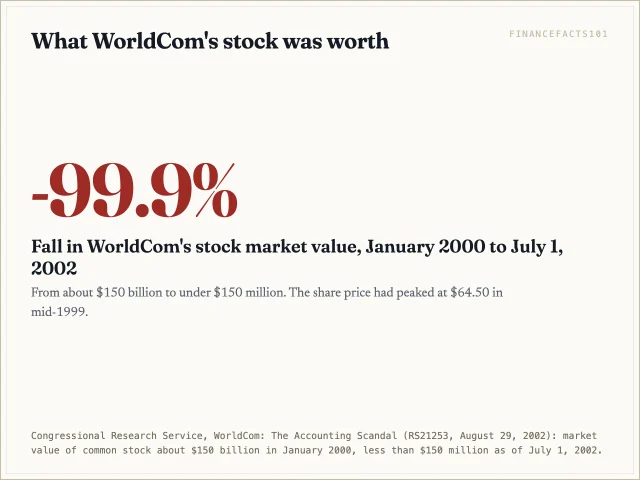
The high point came in 1999. The share price peaked at $64.50 in mid-1999, and the market value of the common stock was about $150 billion in January 2000, according to a Congressional Research Service report. Then the growth engine stalled. In June 2000 the Justice Department sued to block WorldCom's planned acquisition of Sprint, and the companies dropped the deal the next month. Without new acquisitions to fold in, and with long-distance prices falling and the telecom bubble deflating, WorldCom had to show growth from its existing business. That pressure deepened a fraud that had already begun: the board's investigation traced improper reserve releases back to the second quarter of 1999, and in 2001 the company moved on to capitalizing line costs.
How the WorldCom Accounting Fraud Worked
WorldCom's biggest expense was line costs: the fees it paid other phone companies to start and finish calls and data transmissions on their networks. Line costs were routine operating expenses, and they ran to roughly half of revenue. Wall Street watched the ratio of line costs to revenue closely, and management wanted it to stay flat.
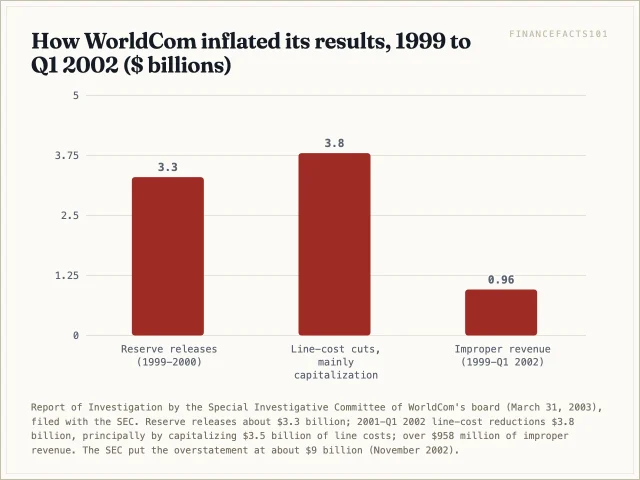
The Special Investigative Committee of WorldCom's own board, whose report of investigation was filed with the SEC in June 2003, found that "from the second quarter of 1999 through the first quarter of 2002, WorldCom improperly reduced its reported line costs (and increased pre-tax income) by over $7 billion." It did so in two phases, and it inflated revenue as well:
- Releasing reserves, 1999 to 2000. Accountants reversed accruals (amounts set aside for bills still to be paid) without a legitimate basis, cutting reported line costs by about $3.3 billion.
- Capitalizing line costs, 2001 to early 2002. When the reserves ran thin, senior finance staff moved line costs out of the expense accounts and into asset accounts as if they were capital spending on the network. That removed about $3.8 billion of expenses, mostly through $3.5 billion of capitalized line costs.
- Padding revenue. The committee found over $958 million of improperly recorded revenue between 1999 and early 2002. The appeals court opinion in Ebbers' case describes a revenue program inside the company called "Close the Gap."
The reason capitalizing an expense inflates profit is mechanical. An expense hits the income statement in full in the period it is incurred. A capital asset sits on the balance sheet and is charged to income a little at a time, through depreciation, over its useful life. Move $1 billion of this quarter's line costs into a network asset account, and this quarter's pre-tax profit rises by $1 billion, less a small depreciation charge. The cash has still gone out the door. Long before today's audit checklists, WorldCom showed how far that one move could carry a set of books.
The result, per the committee: "WorldCom consistently emphasized throughout 2001 that its line cost E/R ratio stayed the same—about 42%—quarter after quarter. That representation was false." Without the capitalized amounts, the ratio would have been "much higher, typically exceeding 50%." The SEC's original complaint said that WorldCom overstated income before taxes and minority interests by about $3.055 billion in 2001 and $797 million in the first quarter of 2002.
Ebbers had a personal reason to keep the stock price up. According to the Second Circuit's opinion affirming his conviction, he had borrowed over $400 million from banks using his WorldCom shares as collateral, and as the stock fell in 2000 he received margin calls. WorldCom's board then authorized the company to lend him hundreds of millions of dollars so he could meet those calls without selling his stock, the committee's report found.
How the Fraud Was Discovered: Cynthia Cooper and Internal Audit
The WorldCom fraud was not caught by the outside auditor, the SEC or Wall Street analysts. It was caught by the company's own internal audit department, led by vice president Cynthia Cooper.
In the spring of 2002, within two months of Ebbers' resignation as CEO in April, Internal Audit began reviewing capital expenditures. The committee's report says the team "persisted in the face of discouragement by Sullivan and Myers," the chief financial officer and the controller. Gene Morse, one of Cooper's auditors, searched the company's computerized general ledger and found the entries that had moved line costs into asset accounts. Andersen, the outside auditor, had repeatedly been refused access to that same ledger.
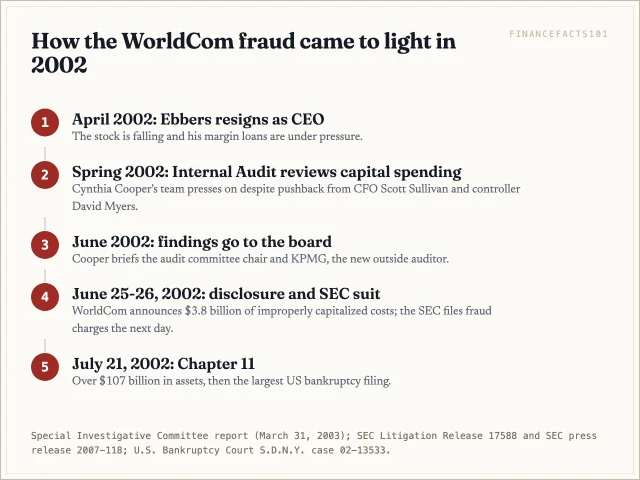
In June 2002, Cooper took the findings to the chair of the board's audit committee and to KPMG, the firm that had replaced Arthur Andersen as outside auditor. Sullivan was fired, Myers left the company, and on June 25 the company announced the $3.8 billion restatement. The SEC filed suit the next day. TIME later named Cooper one of its three Persons of the Year for 2002, alongside Enron's Sherron Watkins and the FBI's Coleen Rowley.
The discovery shows why internal audit needs a route to the board that does not run through the finance chief. Cooper's findings reached the directors because she went over the CFO's head to the audit committee.
Who Was Involved in the WorldCom Scandal, and What Happened to Them
Prosecutors in the Southern District of New York built the case from the bottom up. Mid-level accountants who made the entries pleaded guilty and cooperated. Sullivan pleaded guilty in 2004 and testified against Ebbers for more than 30 hours at trial.
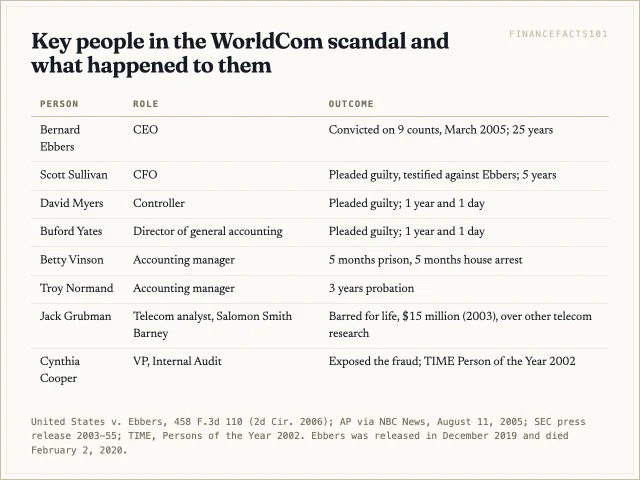
Ebbers went to trial. He was convicted on March 15, 2005, on nine counts of conspiracy, securities fraud and false filings with regulators, and sentenced to 25 years in prison. The Second Circuit affirmed the conviction and sentence on July 28, 2006. He was granted compassionate release in December 2019 and died on February 2, 2020, at 78.
At Sullivan's sentencing, US District Judge Barbara Jones said, "Mr. Sullivan, I believe, was the architect of the fraud at WorldCom," NBC News reported. His cooperation earned him five years, against Ebbers' twenty-five. Controller David Myers and accounting director Buford Yates each received a year and a day. Accounting manager Betty Vinson got five months in prison and five months of house arrest, and Troy Normand, another accounting manager, three years' probation. Staff who follow orders to book false entries are not shielded by the orders.
Arthur Andersen's Role as WorldCom's Auditor
Arthur Andersen had audited WorldCom since 1989. In testimony to the House Financial Services Committee at a July 8, 2002 hearing, Andersen partner Melvin Dick said that before June 21, 2002, when Andersen was first contacted about the matter, neither he nor his team had any inkling the transfers had been made. Ebbers and Sullivan, called to the same hearing, declined to testify, citing their Fifth Amendment rights.
The board committee's report split the blame. It found that WorldCom personnel "repeatedly rejected Andersen's requests for access to the computerized General Ledger" and that some managers "altered significant documents before providing them to Andersen." But it also criticized Andersen's method. The firm relied heavily on assessing whether the company had adequate controls in place instead of substantive testing of the numbers themselves.
Andersen's criminal case came from Enron, not WorldCom. A jury convicted the firm in June 2002 of obstructing the SEC's Enron investigation by persuading employees to destroy documents. The firm stopped auditing public companies and effectively ceased to exist, even though the Supreme Court unanimously overturned the conviction on May 31, 2005. Andersen later settled with WorldCom investors in the class action. The case helps explain why US auditors now answer to a regulator; the entry on the Public Company Accounting Oversight Board covers how that oversight works, and the page on unqualified audit opinions explains what a clean opinion does and does not promise.
Jack Grubman and the Wall Street Analysts
Jack Grubman, the star telecom analyst at Salomon Smith Barney, had backed WorldCom for years. At the July 2002 hearing he said he had believed in the company "wholeheartedly for a long time," that his firm downgraded the stock from buy to hold on April 21, 2002 and to underperform on June 21, and that he had "no advance knowledge whatsoever of this fraud."
The regulators' case against Grubman, settled in April 2003 as part of the global research analyst settlement, did not turn on WorldCom. The SEC's announcement cited fraudulent or misleading research on other telecom stocks. Grubman was permanently barred from the securities industry and paid $15 million. The WorldCom link came through the investor lawsuit instead, in which Salomon and its parent Citigroup were sued as underwriters of WorldCom securities. Citigroup agreed in May 2004 to pay $2.575 billion to settle claims by people who bought WorldCom stock and bonds; its own filing put the pre-tax cost at $2.65 billion. Analyst conflicts of this kind are the subject of the entry on conflicts of interest in finance.
Bankruptcy, the MCI Name and the Sale to Verizon
WorldCom filed for Chapter 11 on July 21, 2002, in the US Bankruptcy Court for the Southern District of New York, case no. 02-13533, before Judge Arthur J. Gonzalez. It listed more than $107 billion in assets, surpassing Enron's filing seven months earlier, PBS NewsHour reported. That record stood until Lehman Brothers failed in 2008.
The court confirmed a reorganization plan on October 31, 2003. On April 20, 2004, the company emerged as MCI Inc., dropping the WorldCom name. It had cut its debt from $41 billion to about $6 billion and moved headquarters from Clinton, Mississippi, to Ashburn, Virginia. Under the confirmed plan of reorganization (section 4.11), holders of WorldCom stock received nothing, and all WorldCom equity interests were extinguished when the company emerged.
A month before emerging, in March 2004, the company restated 2000 and 2001, cutting combined pretax profits by $74.4 billion. Most of that, $59.8 billion, was write-downs of goodwill and other assets bought at bubble prices, per the Reuters account of the filing. Those write-downs were not the fraud itself, but they showed how little the acquisitions were really worth. Verizon completed its roughly $8.5 billion purchase of MCI on January 6, 2006.
What WorldCom Cost Investors, and What They Got Back
Between January 2000 and July 1, 2002, the market value of WorldCom's common stock fell from about $150 billion to under $150 million, per the CRS report. The company said it would cut 17,000 of its 85,000 jobs right after the June 2002 announcement.
Two channels returned some money:
- The SEC penalty. WorldCom settled the SEC's civil penalty claim for $750 million: $500 million in cash plus $250 million of stock in the reorganized company, approved by the court on July 7, 2003. Under Section 308 of Sarbanes-Oxley, the SEC could send that money to defrauded investors through a Fair Fund. Before 2002, civil penalties went to the US Treasury. By June 2007 more than $500 million had been distributed to victims.
- The class action. Led by the New York State Common Retirement Fund, investors who bought between April 29, 1999 and June 25, 2002 recovered nearly $6.2 billion, according to lead counsel's case summary. Citigroup's $2.575 billion was then the largest payment by a third party in a securities class action.
Recoveries on that scale were still a fraction of the losses. The durable lesson for an individual investor is concentration. Anyone holding a broad index fund owned a sliver of WorldCom; anyone holding mainly WorldCom lost nearly everything. The comparison of index funds and ETFs covers the low-cost ways to get that diversification.
What Changed After WorldCom: The Sarbanes-Oxley Act
Congress had been debating accounting reform since Enron's collapse. WorldCom's June 25 announcement ended the debate. The Sarbanes-Oxley Act of 2002, Public Law 107-204, was signed on July 30, 2002, five weeks later.
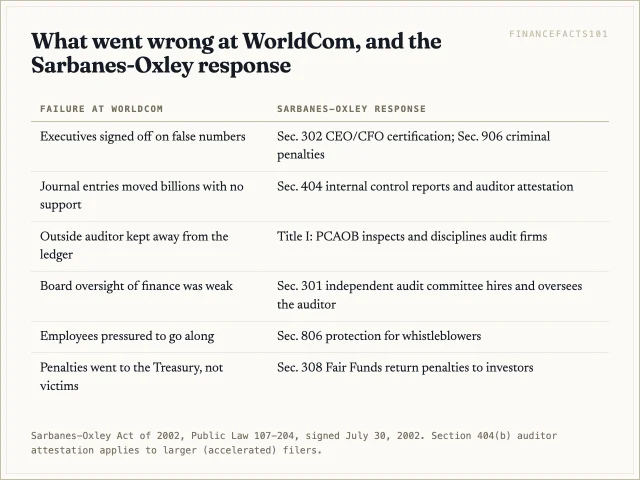
Several provisions map directly onto what went wrong at WorldCom. CEOs and CFOs must personally certify each periodic report (Section 302), with criminal penalties for knowingly false certifications (Section 906). Management must report on internal control over financial reporting, and at larger companies the auditor must attest to it (Section 404). Audit committees must be independent and must directly oversee the outside auditor (Section 301). Auditors now answer to the PCAOB, may not provide a list of non-audit services such as bookkeeping and internal audit outsourcing to audit clients, and must rotate the lead audit partner every five years. Employees who report fraud gained protection against retaliation (Section 806). The site's entry on the Sarbanes-Oxley Act walks through the act section by section.
Warning Signs From the WorldCom Case
Most of what exposed WorldCom is visible to an outside reader with the right questions:
- Suspiciously steady ratios. A key cost ratio that holds at about 42% for quarter after quarter, while prices and demand are falling across the industry, deserves a closer look.
- Capital spending rising while the business slows. Growing capital expenditures and flat operating costs together can mean expenses are being reclassified. Compare capital spending to cash flow from operations over several years.
- Growth by acquisition. Serial acquisitions make results hard to compare from year to year and leave room for reserve manipulation.
- A CEO with a personal financial stake in the share price, especially one borrowing against his shares.
- An auditor kept at arm's length from the underlying ledgers, or an internal audit team that reports only to the CFO.
The techniques were not new. The entry on voodoo accounting covers the wider family of tricks used to inflate revenue and hide expenses.
FAQ
What was the WorldCom scandal in simple terms?
WorldCom, a large US telecom company, recorded billions of dollars of routine network costs as long-term assets instead of expenses, and released reserves and booked improper revenue as well. That inflated reported profits from 1999 to early 2002. The SEC said WorldCom "falsely portrayed itself as a profitable business during 2001 and the first quarter of 2002." When internal auditors exposed it in June 2002, the company collapsed into what was then the largest bankruptcy in US history.
How much money was involved in the WorldCom fraud?
The first disclosure, on June 25, 2002, was $3.8 billion of improperly capitalized costs. The SEC's figure, by November 2002, was about $9 billion from 1999 through early 2002. The board's special committee later found over $7 billion of improper line-cost reductions plus $958 million of improper revenue. News reports usually cite about $11 billion. The separate $74.4 billion restatement mostly reflected write-downs of overvalued assets.
Who exposed the WorldCom fraud?
Cynthia Cooper, WorldCom's vice president of internal audit, and her team, including Gene Morse. They reviewed capital spending in the spring of 2002 despite pushback from the CFO and controller, then took their findings to the audit committee and the new outside auditor, KPMG.
What happened to Bernie Ebbers and Scott Sullivan?
Ebbers, the CEO, was convicted on nine counts in March 2005 and sentenced to 25 years. He was released on compassionate grounds in December 2019 and died in February 2020. Sullivan, the CFO, pleaded guilty, testified against Ebbers and was sentenced to five years.
Does WorldCom still exist?
No. It emerged from bankruptcy in April 2004 as MCI Inc., and Verizon bought MCI in January 2006. MCI's network and business customers became part of Verizon's business unit.
Sources
- Securities and Exchange Commission, Litigation Release No. 17588, SEC v. WorldCom, Inc. (June 27, 2002) — the original $3.8 billion fraud charge; income overstated by about $3.055 billion in 2001 and $797 million in Q1 2002
- Securities and Exchange Commission, Litigation Release No. 17866 (November 26, 2002) — income overstated by approximately $9 billion from 1999 through Q1 2002; partial judgment and corporate monitor Richard Breeden
- Securities and Exchange Commission, SEC Distributions to WorldCom Fraud Victims Top Half-Billion Dollar Mark (June 14, 2007) — $750 million penalty, Fair Fund under SOX Section 308
- Dennis R. Beresford, Nicholas deB. Katzenbach and C.B. Rogers Jr., Report of Investigation by the Special Investigative Committee of the Board of Directors of WorldCom, Inc. (March 31, 2003), filed with the SEC — $7 billion of line-cost manipulation, $958 million of revenue, the 42% E/R ratio, Andersen's access to the ledger
- U.S. House Committee on Financial Services, Wrong Numbers: The Accounting Problems at WorldCom, hearing of July 8, 2002 — testimony of Melvin Dick (Arthur Andersen) and Jack Grubman; Ebbers and Sullivan invoke the Fifth Amendment
- U.S. Bankruptcy Court, Southern District of New York, WorldCom Inc. bankruptcy information — case 02-13533, filed July 21, 2002; plan confirmed October 31, 2003
- U.S. Government Publishing Office, Public Law 107-204, Sarbanes-Oxley Act of 2002 — approved July 30, 2002
- Securities and Exchange Commission, Jack Grubman permanently barred, $15 million payment (April 28, 2003)
- Citigroup Inc., Form 8-K exhibit 99.1 (May 2004) — $2.65 billion pre-tax WorldCom class action settlement
- U.S. Court of Appeals for the Second Circuit, United States v. Ebbers, 458 F.3d 110 (2006) — nine counts, 25-year sentence affirmed; Ebbers' $400 million in margin loans; "Close the Gap"
- Supreme Court of the United States, Arthur Andersen LLP v. United States, 544 U.S. 696 (2005) (via Cornell LII) — Andersen's Enron conviction reversed
- U.S. Department of Justice, Justice Department Sues to Block WorldCom's Acquisition of Sprint (June 2000)
- Bob Lyke and Mark Jickling, Congressional Research Service, WorldCom: The Accounting Scandal, RS21253 (August 29, 2002) — $64.50 share peak, market value from about $150 billion to under $150 million, 17,000 job cuts, Andersen auditor since 1989
- Bernstein Litowitz Berger & Grossmann (lead counsel), In re WorldCom, Inc. Securities Litigation — nearly $6.2 billion total recovery; Citigroup's $2.575 billion; class period
- TIME, Persons of the Year 2002: The Whistleblowers
- Mississippi Encyclopedia, WorldCom — founding in 1983, Ebbers as CEO from 1985, acquisitions, headquarters in Clinton
- Reuters via NBC News, MCI restates results lower (March 12, 2004) — $74.4 billion restatement, $59.8 billion of impairment charges
- Associated Press via NBC News: MCI emerges from bankruptcy (April 20, 2004) — debt cut from $41 billion to about $6 billion; "$11 billion accounting fraud"; Sullivan gets five years for WorldCom fraud (August 11, 2005)
- PBS NewsHour, WorldCom Files for Largest Bankruptcy in U.S. History (July 22, 2002)
- Deseret News (AP), Verizon completes purchase of MCI in $8.5 billion deal (January 7, 2006)
- U.S. Bankruptcy Court, Southern District of New York, Debtors' Modified Second Amended Joint Plan of Reorganization (October 21, 2003) — section 4.11: WorldCom equity holders receive no distributions; all WorldCom equity interests extinguished on the effective date
- WorldCom, Inc., Form 8-K (October 15, 2003) — SEC penalty satisfied by $500 million in cash plus $250 million of stock in the reorganized company; approved by the District Court on July 7, 2003
 Next entry · No. 5,803Understanding the World Gold Council: Its Role in Gold Mining, Investment, and Consumption
See also
-
 No. 3,769
25 Apr 2025
20 min
Understanding Options Backdating: An Unethical and Illegal Practice in Finance and Investment
Business Finance
No. 3,769
25 Apr 2025
20 min
Understanding Options Backdating: An Unethical and Illegal Practice in Finance and Investment
Business Finance -
 No. 5,544
17 Sep 2025
18 min
Voodoo Accounting: Unethical Techniques to Inflate Revenues and Conceal Expenses
Business Finance
No. 5,544
17 Sep 2025
18 min
Voodoo Accounting: Unethical Techniques to Inflate Revenues and Conceal Expenses
Business Finance -
 No. 5,297
27 Aug 2025
16 min
Understanding Unqualified Opinions in Auditing and Financial Reporting
Business Finance
No. 5,297
27 Aug 2025
16 min
Understanding Unqualified Opinions in Auditing and Financial Reporting
Business Finance -
 No. 4,561
28 Jun 2025
20 min
Understanding the Sarbanes-Oxley (SOX) Act of 2002: Key Provisions and Impact
Business Finance
No. 4,561
28 Jun 2025
20 min
Understanding the Sarbanes-Oxley (SOX) Act of 2002: Key Provisions and Impact
Business Finance -
 No. 3,380
23 Mar 2025
22 min
Understanding Negative Assurance in Auditing: Meaning, Importance, and Procedures
Business Finance
No. 3,380
23 Mar 2025
22 min
Understanding Negative Assurance in Auditing: Meaning, Importance, and Procedures
Business Finance -
 No. 3,333
19 Mar 2025
16 min
Navigating the Role of NASBA in Accountancy Profession: More Than Just the CPA Exam
Business Finance
No. 3,333
19 Mar 2025
16 min
Navigating the Role of NASBA in Accountancy Profession: More Than Just the CPA Exam
Business Finance