Friedrich Hayek: A Defender of Free-Market Capitalism and Nobel Laureate

Explore Friedrich Hayek's life as a Nobel Laureate economist, defender of free-market capitalism, and influential figure in the Austrian School.
Early Life and Education
Friedrich Hayek, born May 8, 1899, in Vienna, Austria, was a renowned economist who significantly contributed to academia through his groundbreaking work on free market capitalism. His educational journey began at the University of Vienna where he pursued doctorates in law and political science in 1921 and 1923, respectively. Following postgraduate studies at New York University in 1924, Hayek laid the foundation for his professional career by establishing the Austrian Institute for Business Cycle Research, acting as its director from 1927 to 1931. In 1931, he embarked on an international academic tenure that included joining the London School of Economics (LSE) as the Tooke Professor of Economic Science and Statistics until 1950. Throughout his career, Hayek held positions at prestigious institutions such as the University of Chicago and the University of Freiburg.
A soldier in World War I, Hayek’s experiences during this time deeply influenced him, leading him to study economics and dedicate himself to preventing another devastating war. He later became a British subject in 1938. Throughout his life, Hayek lived and worked in Austria, Great Britain, the United States, and Germany.
Friedrich Hayek: A Defender of Free-Market Capitalism and Nobel Laureate (Continued)
Section Title: The Austrian School of Economics
Description: Explanation of the Austrian School of Economics and its significance to Friedrich Hayek’s work.
Section Title: Founding the Austrian Institute for Business Cycle Research
Description: Description of the institute and Hayek’s role as its director.
Section Title: Joining the London School of Economics
Description: Details about his tenure at LSE and contributions to academia.
Section Title: Notable Accomplishments: The Road to Serfdom
Description: Detailed analysis of Hayek’s most popular work, its impact on academia, and society.
Section Title: Honors and Awards
Description: Information about the Nobel Prize and other notable awards received by Friedrich Hayek.
Section Title: Beliefs: Free Market Capitalism and Creativity
Description: Explanation of Hayek’s beliefs in free market capitalism and its role in fostering creativity.
Section Title: Defender of Free-Market Capitalism
Description: Discussion on Friedrich Hayek’s stance against socialist norms and advocacy for capitalism.
Section Title: Significance: The Importance of Changing Prices
Description: Analysis of the importance of price changes in economic decision-making, a major contribution to economics.
Section Title: FAQ
Description: Commonly asked questions about Friedrich Hayek and his contributions to the field of economics.

The Austrian School of Economics
Friedrich Hayek was a renowned economist and political philosopher who significantly contributed to the field of economics, especially from the perspective of the Austrian school. Established in the late 19th century, the Austrian School emphasizes the use of logic to discover economic laws. In this context, Hayek became a critical figure in the development and popularization of the Austrian school’s ideas.
The core beliefs of the Austrian School include subjectivism, methodological individualism, and praxeology. Subjectivism holds that individuals have unique perceptions, and their understanding shapes their economic choices. Methodological individualism emphasizes analyzing phenomena from an individual perspective. Praxeology is a deductive science focusing on human action as its primary concern.
Friedrich Hayek’s association with the Austrian School began in his youth when he attended the University of Vienna. His education laid the groundwork for his lifelong exploration of economic and political theory. The influence of the Austrian School became increasingly evident in Hayek’s work as he grew older.
One of Hayek’s most significant contributions was his development of the concept of spontaneous order, which is central to the Austrian School. Spontaneous order refers to a system that emerges organically from individual actions rather than through conscious planning or design. This idea challenges the notion of centralized planning, which had gained popularity during Hayek’s time.
Hayek’s belief in spontaneous order contributed significantly to his defense of free-market capitalism. He argued that the free market is an excellent example of a spontaneously ordered system where individual actions lead to collective benefits. This perspective contrasted with socialist ideas, which emphasized central planning as a means to achieve economic stability and equality.
The Austrian School’s insights also influenced Hayek’s theory on price fluctuations, which brought him recognition in the academic world. His work on how changing prices serve as crucial signals for market participants, guiding their decisions, became a significant contribution to economics, earning him the Nobel Prize with fellow economist Gunnar Myrdal.
In summary, Friedrich Hayek’s association with and contributions to the Austrian School of Economics played an essential role in shaping his beliefs and theories. His defense of free-market capitalism based on spontaneous order and price fluctuations continues to influence economic thought today.
Founding the Austrian Institute for Business Cycle Research
Following his completion of doctorates in law and political science, Hayek joined forces with another prominent economist, Hans F. Sennholz, and established the Austrian Institute for Business Cycle Research in Vienna in 1927. Serving as its director until 1931, this institute was dedicated to studying and addressing business cycles through a free-market perspective. In doing so, Hayek began to build a reputation within academic circles for his dedication to understanding economic fluctuations from a unique viewpoint.
The institute’s foundation came at an opportune moment in history as the global economy started experiencing significant upheaval. The Great Depression had taken hold of Europe and North America, leading economists to search for explanations and potential solutions. Hayek’s approach was decidedly different from the mainstream Keynesian theories gaining prominence. This difference would set him apart and pave the way for his lasting impact on economic thought.
At this point in history, many economists believed that government intervention could stabilize economic fluctuations through monetary and fiscal policies. However, Hayek championed the power of free markets to self-correct imbalances. The institute’s research focused on the importance of prices as essential signaling mechanisms within an economy. By studying these price signals during business cycles, Hayek hoped to shed light on how market forces could be harnessed to restore balance and promote sustained economic growth.
This period in Hayek’s career was also marked by the publication of his groundbreaking paper “Prices and Production,” which detailed the significance of prices as coordinating mechanisms within an economy. The paper would later serve as a crucial foundation for his 1941 book, “The Pure Theory of Capital.”
In 1931, Hayek left Austria to join the London School of Economics (LSE), where he spent nearly two decades refining and expanding upon the ideas that emerged during his time at the Austrian Institute for Business Cycle Research.
Joining the London School of Economics
After leaving the Austrian Institute for Business Cycle Research, Friedrich Hayek joined the London School of Economics (LSE) as the Tooke Professor of Economic Science and Statistics in 1931. During his tenure at LSE, he made significant contributions to academia.
At the time, the United Kingdom was grappling with economic instability, leading many economists to advocate for interventionist policies inspired by John Maynard Keynes’ theories. However, Hayek held firm in his belief in free-market capitalism and argued against these ideas in his academic work. His position on the importance of prices as a means of coordinating economic activity was a striking contrast to the prevailing consensus that prices were merely reflections of underlying power relations between classes.
In 1936, Hayek published a critical article in the Economic Journal called “Economics and Knowledge,” which laid out his argument for the importance of dispersed knowledge and its role in economic decision-making. This work would later become foundational to the development of the modern theory of knowledge and its application to economics.
Hayek’s association with LSE proved to be influential, as it exposed him to a diverse range of thinkers and ideas that broadened his intellectual horizons. During this period, he began collaborating with other scholars, such as Lionel Robbins and Hermann Minkowski-Ehrenberg, on projects related to the business cycle and economic theory.
In 1938, Hayek became a British subject, marking a significant milestone in his personal and professional journey. Despite this change, he continued to advocate for classical liberal principles, which eventually earned him international recognition as an influential thinker on political economy and social philosophy.
By the late 1950s, Hayek’s ideas had gained considerable popularity among scholars and policymakers, particularly in the United States. This led him to leave LSE to take up a position at the University of Chicago, where he would continue to shape economic thinking for years to come.
In summary, Friedrich Hayek’s tenure at LSE was pivotal in shaping his intellectual development and solidifying his reputation as an influential economist and political philosopher. His unwavering commitment to free-market capitalism and individual liberty set him apart from the prevailing consensus, and his work on the importance of dispersed knowledge would continue to influence economic theory for generations.

Notable Accomplishments: The Road to Serfdom
Friedrich Hayek’s most influential work, “The Road to Serfdom,” published in 1944, became a powerful argument against socialist ideologies that dominated the academic and political landscape of his time. Written during World War II, Hayek penned this book out of deep concern for the prevalent belief in Britain that fascism was a reaction to capitalism. He believed that socialist policies were, in fact, leading people down the path to serfdom.
The title “The Road to Serfdom” was inspired by the French classical liberal thinker Alexis de Tocqueville’s writings on the perilous consequences of centralized authority. The book, a manifesto for individualism and classical liberalism, quickly gained popularity in both America and Britain due to its compelling argument against collectivist ideologies.
The Road to Serfdom was published by the University of Chicago Press in 1944, reaching an even broader audience beyond academia. The American magazine Reader’s Digest further amplified its reach by publishing an abridged version in April 1945. This widespread dissemination marked a significant turning point for Hayek’s intellectual influence and established him as a leading critic of the socialist consensus.
The Austrian School of Economics, which Hayek was a part of, emphasizes the importance of individualism and the use of logic to discover economic laws. The Road to Serfdom became an enduring testament to this approach, demonstrating how market-oriented policies could lead to greater creativity, innovation, and entrepreneurship.
As a result of this groundbreaking work, Hayek was awarded the Nobel Memorial Prize in Economic Sciences in 1974 alongside Gunnar Myrdal for their “pioneering work in the theory of money and economic fluctuations” as well as their “penetrating analysis of the interdependence of economic, social, and institutional phenomena.”
The significance of Hayek’s work extends far beyond economics. His ideas have influenced numerous aspects of modern society, including politics, sociology, and philosophy. By challenging collectivist ideologies and advocating for individual freedom and limited government intervention, Hayek’s theories continue to resonate with people striving for economic prosperity and personal growth.
Honors and Awards
Friedrich Hayek’s groundbreaking contributions to economics were recognized with numerous prestigious awards, most notably the Nobel Memorial Prize in Economic Sciences in 1974, which he shared with Swedish economist Gunnar Myrdal. This award was bestowed upon them for their pioneering work on the theory of money and economic fluctuations, as well as their profound analysis of the interconnectedness of economic, social, and institutional phenomena.
Prior to receiving the Nobel Prize, Hayek had already made significant strides in his field, starting with the founding of the Austrian Institute for Business Cycle Research in Vienna in 1927, where he served as its director until 1931. His tenure at the London School of Economics from 1931 to 1950 saw him make valuable contributions to academia, including his seminal work “The Road to Serfdom.”
As a result of the growing popularity of The Road to Serfdom in the United States and its impact on American politics, Hayek became an influential figure in the world of economics. He joined the University of Chicago as a professor of Social and Moral Science from 1950 until 1962, where he continued his research and teaching. His innovative ideas were embraced by many intellectuals and politicians who believed in individual freedom and classical liberalism.
In addition to the Nobel Prize, Hayek was appointed as a member of the Order of the Companions of Honour by Queen Elizabeth II in 1984 for his services to economics, and he received the Hanns Martin Schleyer Prize in 1984. In 1991, Hayek was honored with the U.S. Presidential Medal of Freedom by President George H.W. Bush.
Hayek’s legacy extended beyond academia as his economic theories influenced politicians and policymakers. His unwavering commitment to individual freedom, free markets, and limited government resonated with many during a time when socialist ideas were gaining popularity. Hayek’s brilliance in economics, coupled with his foresight and courage to challenge the status quo, solidified his place as a pioneering figure in the field.
Beliefs: Free Market Capitalism and Creativity
Friedrich Hayek’s beliefs were deeply intertwined with the principles of free-market capitalism and its role in fostering creativity, innovation, and entrepreneurship. As a key figure in the Austrian School of Economics, Hayek was committed to emphasizing the importance of individual freedom, competition, and market prices as crucial drivers for societal progress.
Hayek’s advocacy for free-market capitalism can be traced back to his upbringing, which took place amidst the fading Habsburg Empire. Although he grew up in a middle-class family that was sympathetic towards socialist ideologies, Hayek developed a keen interest in economics during his education at the University of Vienna. This interest intensified when he experienced World War I firsthand and became determined to understand how economic forces could contribute to conflict and war.
Throughout his career as an economist, Hayek made several noteworthy contributions to the field, one of which was his defense of free markets against the prevailing socialist consensus during the interwar years. In particular, he feared that fascism could emerge from a failure to appreciate the importance of individual freedom and the price system in guiding economic decisions.
The Road to Serfdom, published in 1944, is perhaps Hayek’s most well-known work, which encapsulates his belief in free-market capitalism as a bulwark against totalitarianism. In this book, he argues that state intervention and central planning can only lead to economic mismanagement, unintended consequences, and ultimately, the erosion of individual freedom. Instead, Hayek emphasizes the role of decentralized markets in enabling individuals to make informed decisions based on market prices, which in turn fosters innovation and progress.
Hayek’s ideas about free-market capitalism extended beyond economics, as he saw it as a vital component in nurturing creativity and personal growth. He believed that the competitive pressures inherent within markets provide powerful incentives for individuals to innovate and create value, thus ensuring that societies remain dynamic and vibrant.
These beliefs were further reinforced by Hayek’s observations of the socialist experiments in the Soviet Union and Eastern Europe during his time at the London School of Economics (LSE). He became disillusioned with the notion that a centrally planned economy could effectively respond to consumers’ needs and wants, as well as the ever-changing conditions within their respective economies.
Hayek’s unwavering stance on free-market capitalism made him a polarizing figure in academic circles during his career, but his ideas have persisted and continued to shape economic discourse long after his passing in 1992. His influence is evident in the neoliberal movement that emerged in the late 1970s, which sought to roll back state intervention and promote market liberalization.
In conclusion, Friedrich Hayek’s beliefs centered on free-market capitalism as a key driver for individual creativity, economic progress, and societal development. Through his extensive research and writings, he highlighted the importance of decentralized markets in enabling individuals to respond to ever-changing conditions, making him an influential figure not only within academia but also amongst policymakers and intellectuals alike.

Defender of Free-Market Capitalism
Friedrich Hayek’s unwavering commitment to free-market capitalism made him a formidable figure in academia and beyond, especially during an era dominated by socialist ideologies. As a staunch opponent of central planning and the welfare state, Hayek was not only critical of these concepts but also believed they would lead society down a disastrous path towards serfdom. In his famous book, “The Road to Serfdom,” Hayek argued that individual freedom and economic liberty were interconnected, and socialism, with its inherent collectivist tendencies, posed a significant threat to both.
“The Road to Serfdom,” published between 1940 and 1943, was not only an intellectual triumph but also a polemical work. It was written in response to the prevailing view among British academics that fascism represented a capitalist reaction to socialism. In fact, Hayek’s title itself was inspired by Alexis de Tocqueville’s writings on “the road to servitude.” The book gained widespread popularity after its publication and played a significant role in shaping the classical liberal movement of the 20th century.
Hayek’s stance against socialist norms and his advocacy for free-market capitalism were not solely based on ideological grounds, but also rooted in his understanding of human nature and economic realities. He believed that individuals possess limited knowledge and that decentralized markets are the most efficient means to disseminate information and coordinate economic activity. For Hayek, this was crucial for ensuring that societies could flourish and citizens could prosper.
Moreover, Hayek’s views on economics extended beyond theory. They also informed his approach to policy. He believed that individuals should be free to make their own choices as long as they did not infringe upon the rights of others. This perspective was at odds with the prevailing economic consensus, which emphasized the need for active government intervention to address market failures and promote social welfare.
Hayek’s belief in free markets extended beyond economics. He believed that creative destruction – the process of innovation that often results in the obsolescence of established products, processes, or business models – was essential for societal progress. Without this process, he argued, stagnation and decline would follow.
In summary, Friedrich Hayek’s defense of free-market capitalism was not merely an intellectual stance but a deeply held belief informed by his understanding of human nature, the limitations of knowledge, and the importance of individual freedom and creativity. His ideas continue to inspire scholars and policymakers today and remain relevant in debates surrounding the role of government, the limitations of central planning, and the importance of markets in advancing societal progress.
Significance: The Importance of Changing Prices
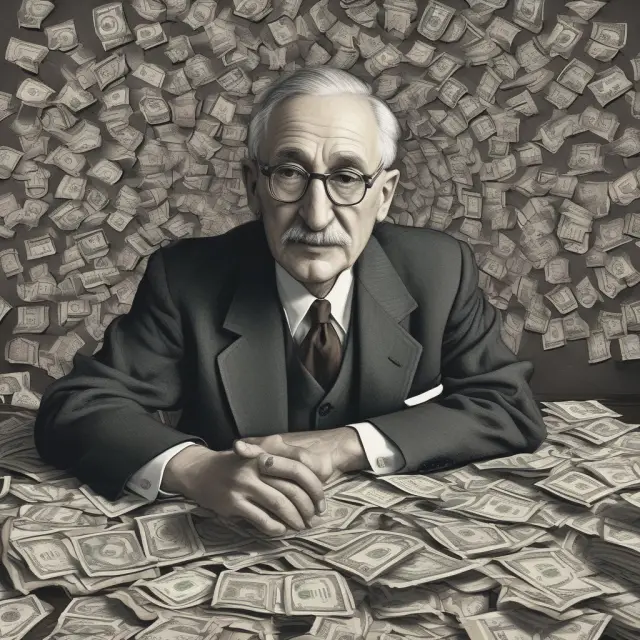
A pivotal contribution from Friedrich Hayek, a renowned economist and political philosopher, lies within his groundbreaking understanding of the importance of changing prices in economic decision-making. In a free market economy, prices are dynamic and serve as essential signals for individuals to make informed decisions regarding production and consumption. This phenomenon is crucial since it fosters an efficient allocation of resources and encourages a more significant overall economic outcome.
Hayek’s work on the role of changing prices in economics can be traced back to his association with the Austrian School of Economics, which he joined early in his career. The Austrian school is known for its emphasis on individual decision-making and market processes, as opposed to focusing on macroeconomic models. Hayek’s beliefs in free markets, competition, and the importance of individuals’ knowledge in making economic decisions were fundamental aspects that influenced his perspective on the significance of changing prices in economic theory.
The Austrian business cycle theory, developed by Hayek and other scholars associated with the Austrian school, suggests that misaligned monetary policy can create an artificial boom, followed by a subsequent bust. During the boom phase, artificially low-interest rates lead to increased borrowing and investment. However, the prices of goods and services do not reflect the underlying production costs due to the distorted interest rate levels. Ultimately, this discrepancy between real and monetary valuations results in an unsustainable growth of economic activity.
When the central bank eventually increases interest rates to counteract inflationary pressures, the bubble bursts, resulting in a recession. During the bust phase, prices begin to reflect the actual market conditions, allowing individuals to reassess their investments and allocate resources more efficiently. This adjustment process can be painful as it involves the liquidation of malinvestments, but it is essential for economic stability and long-term growth.
Hayek’s understanding of the importance of price changes in economics was not only significant within academic circles but also influenced public policy debates during his time. His book “The Road to Serfdom,” published in 1944, warned against the dangers of excessive government intervention and collectivism, advocating for free markets as a more effective means to achieve prosperity and individual freedom.
In summary, Friedrich Hayek’s insights on the importance of changing prices in economic decision-making have shaped our understanding of how markets function most effectively. His contributions to economics have been widely acknowledged by academia, earning him the Nobel Memorial Prize in Economic Sciences in 1974, alongside Gunnar Myrdal, for their joint work on the theory of money and economic fluctuations.
FAQ:
What are some notable accomplishments of Friedrich Hayek?
Hayek is most famous for his book “The Road to Serfdom,” which argued against excessive government intervention and collectivism, advocating for free markets as a more effective means to achieve prosperity and individual freedom. He also made significant contributions to the Austrian School of Economics, particularly in relation to business cycles and the role of changing prices in economic decision-making. Hayek won the Nobel Memorial Prize in Economic Sciences in 1974 for his work on monetary theory and economic fluctuations.
What is the importance of changing prices in economics?
Changing prices serve as essential signals for individuals to make informed decisions regarding production and consumption in a free market economy. They help facilitate an efficient allocation of resources and encourage overall economic growth. Hayek’s ideas on price changes were fundamental aspects that influenced his perspective on the significance of markets, contributing to his association with the Austrian School of Economics and his Nobel Prize in Economic Sciences.
FAQ
What was Friedrich Hayek’s early life and education?
Friedrich Hayek, born on May 8, 1899, in Vienna, Austria, pursued doctorates in both law and political science at the University of Vienna in 1921 and 1923. He completed postgraduate work at New York University in 1924 before founding the Austrian Institute for Business Cycle Research and serving as its director from 1927 to 1931. In 1931, he joined the London School of Economics (LSE) where he stayed until 1950. Afterwards, he accepted positions at the University of Chicago and the University of Freiburg.
What is the Austrian school of economics, and how does it relate to Friedrich Hayek’s work?
The Austrian School of Economics, developed in the late 19th century, emphasizes logic to discover economic laws. Friedrich Hayek was a prominent figure within this school and focused on the importance of free markets as a means for creativity, innovation, and entrepreneurship. He believed that these aspects were essential for societies to thrive and individuals to prosper.
What notable accomplishments did Friedrich Hayek achieve throughout his career?
One of Hayek’s most significant achievements was the publication of “The Road to Serfdom.” This book, written from 1940 to 1943, warned against the general view in British academia that fascism was a capitalist reaction to socialism. It reached an even wider audience when it was published in the United States and became popular among individualists and classical liberals. Hayek also received numerous awards for his work, including the Nobel Prize in Economic Sciences in 1974, which he shared with Gunnar Myrdal, for their pioneering work on money and economic fluctuations.
What are some of Friedrich Hayek’s most notable beliefs?
Friedrich Hayek was a defender of free-market capitalism and spoke out against many of the economic norms of the 20th century, such as Keynesian economics and socialism. He believed that free markets allowed for creativity, innovation, and entrepreneurship, which were crucial for societies to flourish and individuals to prosper.
What honors and awards did Friedrich Hayek receive during his career?
Friedrich Hayek received several notable honors throughout his career, including being appointed a member of the Order of the Companions of Honour by Queen Elizabeth II in 1984 on the advice of Prime Minister Margaret Thatcher for his services to the study of economics. He was also the first recipient of the Hanns Martin Schleyer Prize in 1984 and received the U.S. Presidential Medal of Freedom from President George H. W. Bush in 1991.
For what did Friedrich Hayek win the Nobel Prize?
Friedrich Hayek won the Nobel Prize in Economic Sciences for his work on the theory of money and economic fluctuations, which he shared with Gunnar Myrdal in 1974.
 Next entry · No. 1,687A Comprehensive Guide to Understanding Fringe Benefits: Taxation, Common Types, and Special Considerations
See also
-
 No. 2,687
27 Jan 2025
21 min
Kenneth Arrow: Nobel Laureate Economist and His Impossibility Theorem
Economics
No. 2,687
27 Jan 2025
21 min
Kenneth Arrow: Nobel Laureate Economist and His Impossibility Theorem
Economics -
 No. 5,572
20 Sep 2025
18 min
Understanding the Wage-Price Spiral and Its Impact on Inflation
Finance Policy
No. 5,572
20 Sep 2025
18 min
Understanding the Wage-Price Spiral and Its Impact on Inflation
Finance Policy -
 No. 4,992
03 Aug 2025
21 min
A Comprehensive Guide to Understanding the Tobin Tax: Its History, Mechanics, and Controversies
Finance Policy
No. 4,992
03 Aug 2025
21 min
A Comprehensive Guide to Understanding the Tobin Tax: Its History, Mechanics, and Controversies
Finance Policy -
 No. 4,232
02 Jun 2025
22 min
The Quantity Theory of Money: Understanding Monetary Policy and Its Competing Theories
Finance Policy
No. 4,232
02 Jun 2025
22 min
The Quantity Theory of Money: Understanding Monetary Policy and Its Competing Theories
Finance Policy -
 No. 4,054
18 May 2025
22 min
Understanding Price Ceilings: Advantages and Disadvantages for Institutional Investors
Finance Policy
No. 4,054
18 May 2025
22 min
Understanding Price Ceilings: Advantages and Disadvantages for Institutional Investors
Finance Policy -
 No. 3,643
15 Apr 2025
18 min
Official Settlement Accounts: An Overview of Central Bank’s Role in International Reserves Management
Finance Policy
No. 3,643
15 Apr 2025
18 min
Official Settlement Accounts: An Overview of Central Bank’s Role in International Reserves Management
Finance Policy