Marx’s Enduring Impact on Modern Capitalism: From Theory to Practice

Explore Marx's life, theories, critiques, and impact on modern capitalism. Understand historical materialism, key publications, and sociological influences.
Early Life and Education of Karl Marx
Karl Marx (1818-1883) was a groundbreaking philosopher, economist, and social theorist whose ideas on capitalism, socialism, and communism have left an enduring impact on modern thought. Born in Trier, Prussia (now Germany), in May 1818, Marx grew up as the son of a successful Jewish lawyer who later converted to Lutheranism before his birth.
Marx’s education began with studies in law at the universities of Bonn and Berlin, where he was introduced to the philosophy of Georg Wilhelm Friedrich Hegel. His intellectual development took a radical turn when he became involved with the Young Hegelians, a group of students who criticized the political and religious establishments of their time. Marx received his doctorate from the University of Jena in 1841 but was unable to secure a teaching position due to his radical beliefs. Instead, he took up journalism and became an editor for Rheinische Zeitung, a liberal newspaper in Cologne.
Marx’s life took him to Paris, where he met Friedrich Engels, his lifelong friend and collaborator. Together, they wrote The Communist Manifesto (1848), which outlined their vision of a future communist society. After being expelled from France, Marx lived briefly in Belgium before settling in London for the remainder of his life. He died in London on March 14, 1883, and was buried at Highgate Cemetery.
Despite being born into a privileged family, Marx’s upbringing instilled in him a strong sense of social justice. His education introduced him to the philosophical ideas that would shape his critique of capitalism, particularly those of G.W.F. Hegel and Adam Smith. The political and religious turmoil of Europe in the mid-19th century further fueled Marx’s revolutionary spirit.
Marx’s early years were marked by a combination of intellectual pursuits and political activism. His radical views led to his exclusion from academic circles, pushing him towards journalism and editing as a means of expressing his ideas. Despite the challenges he faced, Marx’s work would go on to reshape economic thought and inspire social and political movements for generations to come.

Marx’s Theories on Capitalism: A Critique
Marx’s theories on capitalism went beyond a mere critique of its shortcomings; they laid the foundation for the development of Marxism, which has influenced socialist and communist movements worldwide. In this section, we will explore Marx’s major critiques of capitalism, including his concepts of exploitation, surplus value, labor theory of value, and historical materialism.
Exploitation
Marx believed that capitalism’s inherent flaws led to the exploitation of workers by employers. He argued that this was due to two main issues: the chaotic nature of free market competition and the extraction of surplus labor. Capitalists, who owned the means of production, could pay laborers less than the full value of their work in order to generate profits. This surplus value was extracted from workers, creating a power imbalance that Marx argued was nefarious.
Surplus Value and Labor Theory of Value
Marx’s theories on capitalism are deeply rooted in his labor theory of value. He believed that the value of goods could be measured objectively by the amount of labor required to produce them. If an item took more labor hours to create than another, it was worth more. However, this theory faced a significant challenge when applied to capitalist economies: if goods were sold at their true objective labor values, how could any capitalists generate profits? Marx concluded that capitalists underpaid or overworked laborers to drive down production costs and extract surplus value.
Historical Materialism
Marx’s historical materialism is another critical component of his theories on capitalism. This theory posits that society is ordered by the technology used in production. Under industrial capitalism, society is organized with capitalists controlling the process of production and laborers working for wages. Prior to capitalism, Marx suggested that feudalism existed as a specific set of social relations related to the hand-powered or animal-powered means of production prevalent at the time.
Marx’s theories on capitalism have remained relevant long after his death in 1883. Although mainstream economic thought has largely moved away from Marxian economics, many of his critiques of capitalism continue to resonate with contemporary issues, such as increasing economic inequality, the rise of monopolistic corporations, and the changing nature of work. As we delve deeper into Marx’s ideas in subsequent sections, it becomes clear that his impact on our understanding of capitalism is far-reaching and enduring.
Key Publications: The Communist Manifesto and Das Kapital
Marx’s most notable works have significantly influenced economic thought and political movements. Two of his most famous publications, The Communist Manifesto (1848) and Das Kapital (first published in 1867), continue to captivate scholars, economists, and thinkers around the world.
The Communist Manifesto, written with Friedrich Engels, serves as a succinct yet powerful critique of capitalism and outlines the Marxist vision for a communist society. This influential pamphlet advocates for the revolutionary overthrow of the bourgeoisie (capitalist) class to establish a classless, communist society. The manifesto’s key tenets, such as the historical inevitability of class struggle and the role of technology in transforming societal structures, continue to shape political and economic discourse today.
Das Kapital, also known as Capital: A Critique of Political Economy, represents Marx’s magnum opus. This three-volume work explores the inner workings of the capitalist mode of production from a critical perspective. Marx presents his theories on labor value, surplus value, and the exploitation of workers in this monumental treatise. His analysis of capitalism as a self-destructive system has influenced economic thought and continues to be studied extensively.
Together, these groundbreaking publications have left an indelible mark on history, inspiring movements towards social justice and economic equality. While Marx’s ideas have been challenged and refined over the years, his critiques of capitalism and vision for a more equitable society continue to resonate with people around the world.
To understand Marx’s critiques of capitalism in detail, let us explore his theories on exploitation, surplus value, labor theory of value, and historical materialism. These concepts provide insight into Marx’s perspective on capitalism and its inherent issues, making it easier to appreciate the significance of The Communist Manifesto and Das Kapital.
In the next section, we will delve deeper into Marx’s theories on exploitation and surplus value. These concepts serve as the foundation for understanding his critique of capitalism and the role of workers in the production process.
Marx’s Influence on Socialist and Communist Movements
As Karl Marx’s theories on capitalism gained prominence, his ideas began to inspire socialist and communist movements around the world. The philosophical, social, and political tenets of Marxism have influenced numerous ideologies, revolutions, and even everyday life in many parts of the globe. This section will explore the key ideas that have shaped Marx’s influence on socialist and communist movements throughout history.
Marx’s writings on capitalism offered a powerful critique of the existing economic and political order. He argued that capitalism perpetuated class struggle, exploitation, and inequality. Marx’s vision for a better society was one where the proletariat (working class) would overthrow the bourgeoisie (capitalist class), leading to the establishment of a classless, communist society.
One of Marx’s most influential works in this regard is The Communist Manifesto, which he co-authored with Friedrich Engels in 1848. This pamphlet outlined the historical development and ultimate demise of various modes of production, culminating in a call for the proletariat to overthrow the bourgeoisie. This message resonated deeply with many workers and intellectuals across Europe and beyond, leading to the spread of Marxist ideas in the late 19th and early 20th centuries.
Marx’s influence on socialist movements extended far beyond the theoretical realm. His ideas played a significant role in shaping political parties, labor unions, and revolutionary movements throughout Europe and beyond. One of the most notable examples is the Russian Revolution of 1917, where Marxist ideology provided the foundation for the Bolshevik Party under the leadership of Vladimir Lenin. The new Soviet Union established under Lenin’s rule became a model for communist states across the world, including China and Cuba, which adopted Marxist-Leninist ideologies in their respective revolutions.
Marx’s ideas on historical materialism also influenced sociology and other social sciences. Historical materialism posits that societal structures and transformations are the result of technological change in economic production. This concept has been used to understand various aspects of social, political, and economic life, including class relations, power dynamics, and the role of technology in shaping societies.
In the present day, Marxist ideas continue to influence political discourse and social movements around the world. Marx’s critiques of capitalism have gained renewed relevance as income inequality, technological change, and globalization have become increasingly prominent issues. Marxist theories on labor exploitation, class struggle, and the role of the state in regulating economic activity remain influential for scholars, activists, and politicians alike.
Despite criticisms and debates surrounding Marx’s theories, his ideas on capitalism, class struggle, and historical materialism continue to shape the way we understand society and its transformation. From labor movements to political parties and revolutions, Marxist ideas have left an indelible mark on modern history.
Understanding Historical Materialism: Society’s Order and Transformation
Historical materialism is a concept introduced by Karl Marx as an approach to understanding societal changes. This theory posits that society at any given point in time is ordered by the type of technology used in the process of production. In simple terms, the means of production determine the social relations within a society. According to Marx, society evolves through stages characterized by distinct technological and economic systems. Understanding historical materialism requires examining its origins, key principles, and relevance today.
Origins of Historical Materialism
Marx’s ideas on historical materialism can be traced back to his early influences, especially the philosophy of G.W.F. Hegel. Marx expanded upon Hegelian dialectics by arguing that societal changes are driven primarily by economic developments and technological advancements. He believed that technology shapes the mode of production, which in turn shapes society’s political and social structures.
Key Principles of Historical Materialism
Marx outlined several principles in his theoretical framework of historical materialism:
- Base and Superstructure: The base refers to the economic infrastructure, while the superstructure includes the political and ideological aspects of a society. Marx argued that changes to the base, such as technological advancements, ultimately lead to transformations within the superstructure.
- Determinism vs. Dialectical Interplay: Some interpret historical materialism as deterministic, meaning economic factors alone dictate societal developments. However, Marx’s original intention was to describe a dialectical interplay between economic and non-economic elements. He believed that while the economy sets the broad contours of social change, other factors like ideology and politics can influence the specific forms this change takes.
- Class Conflict: Historical materialism emphasizes class conflict as a driving force behind societal transformations. As different classes vie for power, conflicts arise, leading to changes in social structures. This idea is central to Marx’s analysis of historical development.
- Dialectical Materialism: This term refers to Marx’s approach to understanding reality through contradictions and the resolution of these contradictions. For example, he believed that every society contains inherent contradictions, which eventually lead to crises and transformations.
Marx’s Relevance Today
While historical materialism has faced criticisms and challenges, it remains a valuable theoretical framework for understanding societal change. Marx’s ideas continue to inspire ongoing debates in disciplines like sociology, political science, anthropology, and economics. For instance:
- Sociological Implications: Historical materialism offers a powerful lens for analyzing social structures and their historical development. It can help us understand the role of technology, ideology, class conflict, and power dynamics in shaping societies.
- Technological Change and Societal Transformations: The rapid advancement of technologies like AI and automation has renewed interest in Marx’s ideas. Historical materialism provides a useful framework for analyzing how these changes might impact social structures, political systems, and labor markets.
- Class Conflict in the Modern World: The persistence of economic inequality and class struggle continues to be a significant issue worldwide. Historical materialism offers valuable insights into the root causes of class conflict and its potential consequences.
- Marxist Approaches in Contemporary Economics: While mainstream economics has largely rejected Marxian economics, some scholars continue to draw on historical materialism to analyze economic systems and societal transformations. For example, post-Keynesian economists have incorporated elements of historical materialism into their analyses of capitalist economies.
In conclusion, Karl Marx’s theory of historical materialism offers a powerful framework for understanding societal changes throughout history. By examining the role of technology, ideology, class conflict, and power dynamics in shaping societies, we gain valuable insights into the complex processes driving social transformations. Despite criticisms and challenges, Marx’s ideas remain relevant today as we navigate the challenges and opportunities presented by ongoing technological advancements and societal changes.

Marx’s Critique of Capitalism: Relevance in Today’s World
Marx’s theories on capitalism, originally put forth over 170 years ago, continue to hold significance and relevance in today’s world. In the face of increasing economic inequality, technological change, and transformations in the nature of work, Marx’s critiques of capitalist exploitation and class relations remain a powerful framework for understanding societal dynamics and political movements.
In essence, Marx predicted that capitalism would eventually lead to its own destruction due to inherent flaws, including the chaotic nature of free market competition and the extraction of surplus labor from workers. This critique has only gained traction with time as issues such as economic inequality, technological change, and the changing nature of work have come to the forefront of public discourse.
Marx’s idea that capitalism would inevitably lead to a revolution where production is turned over to the working class as a whole continues to be debated in contemporary economic thought. While his vision of a communist society may not be achievable, many of Marx’s critiques and ideas have influenced various socialist and communist movements throughout history.
Understanding Marx’s Relevance in Today’s World: Economic Inequality
One of the most pressing issues that resonates with Marx’s theories today is economic inequality. According to the International Monetary Fund, global income inequality has reached historic highs, with the top 1% owning more wealth than the bottom 50%. This trend has been particularly pronounced in developed countries like the United States and the United Kingdom, where wealth disparities have grown significantly since the late 20th century.
Marx’s critiques of capitalism emphasized the exploitation of workers by capitalists through the extraction of surplus labor value. Today, this phenomenon is evident in various forms, including wage stagnation and the widening gap between executive salaries and worker wages.
Understanding Marx’s Relevance in Today’s World: Technological Change
Marx’s theories on technology and its impact on employment and class relations have also gained renewed relevance in today’s world, where automation and artificial intelligence are transforming industries and labor markets. Marx believed that technological change would ultimately lead to a reduction of human labor and the alienation of workers from their work, as machines and technology took over tasks previously done by humans.
While some argue that automation and AI will lead to mass unemployment and further economic inequality, others believe that these technologies will create new opportunities for employment and growth. Regardless of the outcome, Marx’s theories on technological change serve as a useful lens through which to examine the potential consequences and implications for labor markets and class structures in the 21st century.
Understanding Marx’s Relevance in Today’s World: Changing Nature of Work
Marx’s critiques of capitalism are also relevant today as the nature of work continues to evolve, with many workers finding themselves in precarious employment situations characterized by low wages, irregular hours, and limited job security. In this context, Marx’s ideas on class relations and exploitation continue to offer insight into the experiences and challenges faced by contemporary workers.
Moreover, the increasing popularity of non-standard forms of work, such as gig work and the sharing economy, raises questions about labor rights, worker protections, and the role of unions in advocating for workers’ interests. Marx’s theories provide a theoretical framework to explore these issues and their potential implications for class structures and societal transformations.
In conclusion, Marx’s critiques of capitalism remain relevant today as economic inequality, technological change, and the changing nature of work continue to shape our world. While his vision of a communist society may not be achievable in the near future, his ideas on exploitation, class relations, and societal transformations offer valuable insights into the dynamics of capitalist societies and their potential for change.
As we move forward into an increasingly globalized and technologically advanced world, understanding Marx’s theories and their relevance is crucial for shaping informed public discourse and fostering a more equitable and just society.
Marxist Perspectives on Economics: Modern Interpretations
In today’s world, Karl Marx’s ideas about capitalism continue to generate significant debate and discussion within economics. While his theories have been largely rejected by mainstream economists, many interpretations of his work remain influential in modern economic thought, particularly in the fields of sociology and heterodox economics. In this section, we explore how Marxian perspectives on economics have evolved in the modern era and delve into key debates surrounding income inequality, labor markets, and the role of markets.
Income Inequality: A Persisting Issue
Marx’s critique of capitalism centers around his belief that the system inherently creates an exploitative relationship between capitalists (owners) and laborers. While many argue that this perspective is outdated, others maintain that Marx’s observations on income inequality still hold relevance today. According to recent data from OECD, income inequality has risen in many countries around the world. This trend raises questions about the role of capitalism and its impact on the distribution of wealth (OECD, 2016).
One modern interpretation of Marx’s ideas is found within the framework of “Neo-Marxist” thought, which focuses on the structural aspects of class relations and power dynamics. Neo-Marxists argue that despite changes in economic systems, capitalist tendencies still exist and perpetuate income inequality (Abercrombie et al., 2012). For instance, Piketty’s (2014) influential work on wealth inequality draws inspiration from Marx’s analysis of the relationship between capital and labor.
Labor Markets: Contemporary Perspectives
Marx’s ideas about surplus value and exploitation have influenced debates surrounding labor markets in contemporary economics. Critics argue that labor is often underpaid, with employers extracting a larger share of surplus value than what is fair. This perspective has led to renewed interest in understanding the dynamics of wage setting and labor market institutions.
One area where Marx’s influence can be observed is within the field of “Institutional Economics,” which emphasizes the importance of social norms, institutions, and power relations in shaping economic outcomes (North, 1990). Institutional economists explore how labor markets function differently under various institutional arrangements and how these differences impact wages and income distribution.
Role of Markets: A Contested Terrain
Marx’s critique of capitalism centers on his belief that the market system inherently creates exploitative relationships and contradictions. In contrast, mainstream economists argue that markets are essential for efficient resource allocation and economic growth. However, recent debates around financialization, income inequality, and the role of markets in addressing social challenges have led to renewed interest in Marx’s ideas (Bernanke, 2015).
One interpretation of Marx’s theories is found within the field of “Post-Keynesian Economics,” which emphasizes the importance of uncertainty, expectations, and power dynamics in economic processes (Minsky, 1975; Kaldor, 1986). Post-Keynesians explore how markets can lead to unintended consequences, particularly in situations where power imbalances and structural factors come into play. This perspective resonates with Marx’s critiques of capitalism, as both argue that markets are not inherently self-regulating or just.
In conclusion, while Karl Marx’s theories on capitalism have been largely rejected by mainstream economics, his ideas continue to influence modern interpretations and debates within the field. His perspectives on income inequality, labor markets, and the role of markets remain relevant, particularly in discussions surrounding financialization, power dynamics, and the distribution of wealth. As we continue to grapple with these issues in our contemporary economic landscape, it is crucial to remember that Marx’s work offers valuable insights into the complexities of capitalism and its implications for society.
References:
Abercrombie, N., & Longhurst, B. (2012). Marxism: A very short introduction. Oxford University Press.
Bernanke, B. S. (2015). The world in 2030: Upheaval and opportunity. Encounter Books.
Kaldor, N. (1986). My early economic papers. Macmillan International Higher Education.
Minsky, H. P. (1975). John Maynard Keynes. University of Minnesota Press.
Marx, K., & Engels, F. (2010). The communist manifesto and other writings on politics and society. Oxford University Press.
North, D. C. (1990). Institutions, institutional change, and economic performance. Cambridge university press.
OECD. (2016). OECD Economic Outlook: Interim report November 2016. Organisation for Economic Co-operation and Development.
Piketty, T. (2014). Capital in the twenty-first century. Harvard University Press.

Marx’s Influence on Sociology: The Social Structures of Capitalism
Understanding Marx’s influence on sociological thought requires examining his critique of capitalism and its implications for social structures, class relations, and power dynamics. Marx’s theories on historical materialism, exploitation, surplus value, and labor theory of value have significantly impacted modern sociology. Let us delve deeper into these topics to appreciate the extent of Marx’s influence on sociological thinking.
Marx’s Critique of Capitalism: Implications for Society
Marx’s ideas about capitalism extend beyond economic systems and shed light on the social structures that underpin them. He believed that society is organized based on the mode of production and emphasized the importance of understanding historical context when analyzing social phenomena. This perspective laid the groundwork for sociological theories such as functionalism, conflict theory, and symbolic interactionism.
Social Structures in Capitalist Societies
Marx argued that capitalism involves a fundamental contradiction between the forces and relations of production. The forces of production, comprising technology, labor, and organization, drive economic growth, while the relations of production determine how value is produced and distributed. This contradiction can lead to social tensions and instability. Marx’s emphasis on understanding the role of economic structures in shaping society influenced the development of sociological theories like functionalism, which focused on the interconnectedness and interdependence of various social institutions and their functions within a larger system.
Class Relations and Power Dynamics
Marx famously argued that class struggle lies at the heart of capitalist societies. He believed that economic classes are formed by their relationships to the means of production – those who own it wield power over those who do not. This perspective challenged conventional views of social order and influenced the development of conflict theory, which emphasizes the role of power struggles, conflict, and resistance in shaping social relations.
Marx’s Influence on Modern Sociological Thought
Despite controversies surrounding Marx’s theories and their applicability to contemporary societies, his ideas have had a profound impact on modern sociology. Marxist approaches are still used in the analysis of power relations, class structures, and social change. Moreover, his theories on historical materialism, labor markets, and economic growth continue to inspire debates in sociology and economics.
Marx’s Perspective on Historical Materialism: A Sociological Framework for Understanding Societal Change
Historical materialism, as a theoretical framework, posits that societal change is driven by changes in the productive forces and the relationships between these forces and social relations. This perspective emphasizes the role of technology, labor markets, and economic systems in shaping society. It has influenced sociological thought on topics like industrialization, urbanization, and globalization, as well as the analysis of power dynamics within and between societies.
Marx’s Critique of Capitalism: Relevance in Today’s World
As we navigate the complexities of modern capitalist societies, Marx’s critiques continue to offer valuable insights into issues like economic inequality, technological change, and labor markets. By examining the contradictions within capitalism, we can better understand the social structures and power dynamics that shape our world today.
In conclusion, Marx’s influence on sociology is far-reaching and continues to inspire debates and research in contemporary sociological thought. His ideas on historical materialism, exploitation, labor theory of value, and class relations have provided a unique lens for understanding societal change and the role of power dynamics within capitalist societies. As we grapple with the challenges posed by economic inequality, technological change, and political turmoil, Marx’s theories offer valuable insights into the complexities of modern society.
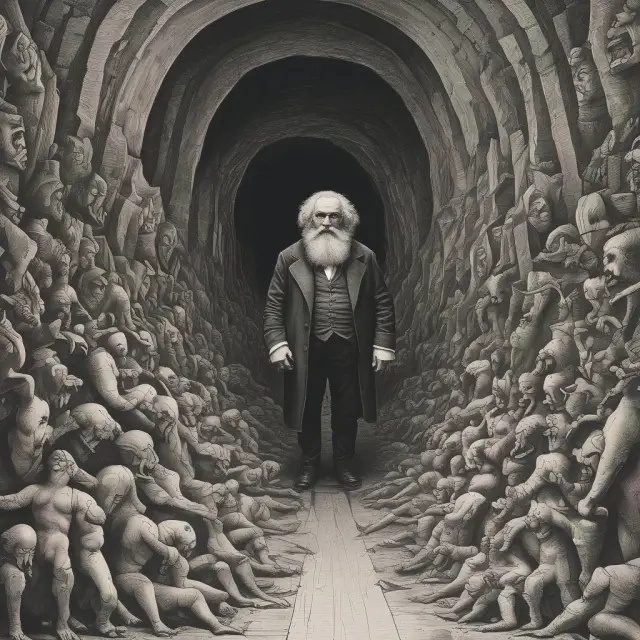
Marx’s Critique of Political Economy: Implications for Policy
One of the most profound criticisms of capitalism by Karl Marx lies in the realm of political economy, where he believed the system to be inherently exploitative and unsustainable. His theories on labor markets, income distribution, and economic growth have significant implications for policy design and implementation, even today.
Marx’s Critique of Labor Markets
Marx’s labor theory of value challenges the notion that wages are determined by free market forces in a competitive labor market (Das Kapital, Book 1, Chapter 7). Instead, he argued that surplus labor value is the root cause of profits and capital accumulation. In this framework, laborers create all value but only receive a fraction of it as wages. The remaining surplus value goes to the capitalist class, creating an unjust distribution of wealth.
Implications for Policy
Understanding Marx’s critique of labor markets highlights the need for policies aimed at ensuring fair wages and reducing income inequality. Some contemporary examples include minimum wage laws, progressive taxation systems, and social safety nets, all designed to ensure a more equitable distribution of resources and opportunities.
Marx’s Critique of Income Distribution
According to Marx, the capitalist mode of production leads to an inherent contradiction between the increasing productivity of labor and the stagnation or even decline in real wages for workers (Capital Vol. 3, Chapter 25). He predicted that capitalism would eventually lead to a situation where the rate of profit would fall as more workers were left without jobs, leading to widespread social unrest and ultimately, revolution.
Implications for Policy
Marx’s predictions about the potential negative consequences of unequal income distribution call for policies aimed at reducing poverty and increasing economic opportunities for all. This includes measures like investing in education and vocational training, expanding affordable housing, and implementing policies that promote job creation and upward mobility.
Marx’s Critique of Economic Growth
While Marx is often criticized for his pessimistic views on capitalism and its inherent contradictions, it is essential to recognize the importance of understanding the long-term implications of unchecked economic growth. He believed that the relentless pursuit of profit would eventually lead to a crisis point where the system could no longer sustain itself.
Implications for Policy
Marx’s critique of the inherent contradictions of capitalism, particularly in relation to economic growth, calls for policies aimed at promoting sustainable and equitable growth. This might include measures like implementing circular economy principles, investing in renewable energy sources, and designing regulations that encourage social and environmental responsibility among businesses.
In conclusion, Marx’s critiques of political economy continue to shape debates on economic policy, with his theories providing a framework for understanding the potential shortcomings and contradictions inherent in capitalism. As we navigate the complexities of our contemporary economic landscape, it is crucial to consider the insights provided by thinkers like Marx and engage in thoughtful and inclusive policy discussions that address issues such as labor markets, income distribution, and economic growth.

FAQ: Common Questions About Karl Marx and His Theories
Question 1: Who Was Karl Marx?
Answer: Karl Marx (1818-1883) was a prominent philosopher, economist, sociologist, and political theorist. He is best known for his theories on capitalism, socialism, and communism. Born in Prussia, Marx studied law but became interested in philosophy after being influenced by the Young Hegelians. Despite his radical beliefs, he was unable to secure a teaching position and instead worked as a journalist. He collaborated with Friedrich Engels and together they published The Communist Manifesto in 1848. Later in life, Marx wrote Das Kapital (published from 1867 to 1885), which explored the labor theory of value and historical materialism.
Question 2: What Were Marx’s Main Theories on Capitalism?
Answer: Marx believed that capitalism was characterized by two major flaws leading to worker exploitation. First, he argued that the chaotic nature of free market competition leads capitalists to pay workers less than the full value of their labor, creating surplus value that is extracted as profit. Second, Marx predicted that capitalism would eventually destroy itself due to increasing inequality and the decline in corporate profits.
Question 3: What Is Historical Materialism?
Answer: Historical materialism is a theoretical framework developed by Marx for understanding societal changes. According to this theory, societies are ordered by the type of technology used in production, such as industrial capitalism or feudalism, and these technological shifts lead to corresponding social structures and relations.
Question 4: What Were Marx’s Most Influential Writings?
Answer: The Communist Manifesto, published with Friedrich Engels in 1848, summarizes their theories about society and politics and is an attempt to explain the goals of Marxism. Das Kapital, a three-volume critique of capitalism written between 1867 and 1894, lays forth Marx’s theories on commodities production, labor markets, and the social division of labor.
Question 5: How Has Marx Influenced Modern Economics?
Answer: Despite being largely rejected by mainstream economics, Marx’s critiques of capitalism continue to influence modern thought in various fields including sociology, political economy, and heterodox economics. Many of his arguments on the exploitation of workers, unequal distribution of wealth, and the importance of historical context remain relevant today.
Question 6: What Is the Labor Theory of Value?
Answer: The labor theory of value states that the value of a produced economic good can be measured objectively by the average number of labor hours required to produce it. Marx argued that capitalists exploited workers by underpaying or overworking them, resulting in surplus value being extracted as profit. However, this theory has been largely abandoned due to its inconsistencies.
Question 7: Who Were Some Key Figures Influenced by Marx’s Ideas?
Answer: Marx’s ideas influenced various communist leaders such as Vladimir Lenin and Josef Stalin, who used his theories as a basis for political movements and revolutions. Marx’s work also laid the foundations for understanding economic growth and its impact on social structures, which has been further explored by economists like Thomas Piketty.
Question 8: What Is the Relationship Between Karl Marx and Friedrich Engels?
Answer: Karl Marx and Friedrich Engels were long-time friends and collaborators who worked together on many projects including The Communist Manifesto and Das Kapital. While Marx is best known for his theoretical contributions, Engels played a crucial role in financing and promoting Marx’s work.
Question 9: What Is the Significance of the Communist Manifesto?
Answer: The Communist Manifesto, published by Marx and Engels in 1848, summarizes their theories about the nature of society and politics and presents the goals of Marxism. It is considered an attempt to explain how capitalism would eventually be replaced by a socialist or communist society due to its inherent flaws and contradictions.
Question 10: What Was Karl Marx’s Vision for Society?
Answer: Marx envisioned a classless, communist society where the means of production were collectively owned and controlled by the workers. He believed that capitalism would inevitably lead to its own destruction as workers became alienated from their labor and revolted against their capitalist oppressors.
 Next entry · No. 2,677The Katie Couric Clause: Understanding Proposed SEC Rule on Executive Compensation Disclosure
See also
-
 No. 3,134
03 Mar 2025
21 min
Marxism: Understanding the Economic and Political Philosophy Behind Class Conflict, Socialism, and Communism
Economics
No. 3,134
03 Mar 2025
21 min
Marxism: Understanding the Economic and Political Philosophy Behind Class Conflict, Socialism, and Communism
Economics -
 No. 5,379
03 Sep 2025
22 min
Maximizing Utility: Understanding Economic Theory and Measuring the Value of Goods and Services
Economics
No. 5,379
03 Sep 2025
22 min
Maximizing Utility: Understanding Economic Theory and Measuring the Value of Goods and Services
Economics -
 No. 5,179
17 Aug 2025
21 min
Understanding Underemployment Equilibrium: The Persistent State of Unemployment Above Full Employment
Economics
No. 5,179
17 Aug 2025
21 min
Understanding Underemployment Equilibrium: The Persistent State of Unemployment Above Full Employment
Economics -
 No. 4,692
09 Jul 2025
22 min
Understanding Socialism: A Comprehensive Guide for Institutional Investors
Economics
No. 4,692
09 Jul 2025
22 min
Understanding Socialism: A Comprehensive Guide for Institutional Investors
Economics -
 No. 4,597
01 Jul 2025
20 min
Understanding Seigniorage: Profiting from Currency Production
Economics
No. 4,597
01 Jul 2025
20 min
Understanding Seigniorage: Profiting from Currency Production
Economics -
 No. 4,474
21 Jun 2025
19 min
Ricardian Equivalence: Understanding the Controversial Economic Theory
Economics
No. 4,474
21 Jun 2025
19 min
Ricardian Equivalence: Understanding the Controversial Economic Theory
Economics