Understanding Bar Charts: Techniques, Interpretations, and Comparisons

Explore the world of bar charts, understand their components, interpretations, advantages, and compare them with other chart types in this comprehensive…
Introduction to Bar Charts
A bar chart presents the open, high, low, and closing (OHLC) prices of an asset or security in a visual manner over a specified period. Each price bar on a bar chart consists of a vertical line that represents the highest and lowest price reached within the time frame. The left and right horizontal lines denote the opening and closing prices respectively. In some cases, the bars may be color-coded based on whether the close is above or below the open for easy interpretation. Bar charts are widely used in finance and investment to analyze market trends, evaluate potential trend reversals, and gauge volatility and price movements.
Understanding the Components of a Bar Chart:
A bar chart’s essential components include its vertical line, which signifies the high and low prices for a given time frame. The open price is displayed as a small horizontal line on the left side of the vertical line, while the close price is shown as a horizontal line on the right side. When the closing price is above the opening price, the bar may appear black or green. Conversely, if the closing price falls below the opening price, the bar could be colored red. Color-coding helps traders quickly identify trends and price movements.
Advantages and Disadvantages of Using Bar Charts:
Bar charts provide valuable insights into market trends, volatility, and potential trend reversals. They can help investors and traders make informed decisions based on historical data. However, bar charts do have their limitations, such as limited context provided compared to line or candlestick charts. Additionally, they might not be suitable for long-term investors seeking a more comprehensive view of the market.
Analyzing Long Vertical Bars in Bar Charts:
Long bars indicate high volatility during the corresponding time period. If an asset experiences significant price swings, it will likely have larger vertical bars on its bar chart. These longer bars can help traders identify potential trend reversals or periods of increased market activity. Conversely, smaller bars suggest low volatility and minimal price movements within a given time frame.
Interpreting the Location of the Close Relative to High and Low:
The location of the close relative to the high and low can provide valuable information about buying and selling pressure during the period. If an asset closes near its high for the period, it suggests strong buying interest, potentially indicating more upward momentum in future periods. Conversely, if the close is significantly lower than the high, it could indicate weak demand or a potential trend reversal.
Comparing Bar Charts to Candlestick Charts:
Bar charts and candlestick charts serve similar purposes but offer different visual presentations of price data. While both types display open, high, low, and close prices, bar charts represent them as rectangular bars while candlestick charts use vertical lines called wicks to indicate the open, high, and low values within a given time frame. The choice between using bar charts and candlestick charts depends on an investor’s personal preference and trading style.
Incorporating Bar Charts into Trend Analysis:
Bar charts can be employed to assess trends in various financial markets, including stocks, forex, indices, and commodities. By analyzing the historical data presented through bar charts, traders can identify uptrends, downtrends, and potential trend reversals. This information can help inform investment strategies and enable more informed decision-making.
Bar Charts for Short and Long-Term Investors:
Regardless of whether an investor has a short or long-term investment horizon, bar charts offer valuable insights into price movements and market trends. Day traders may prefer shorter time frames to capture intraday price action, while longer-term investors might look at weekly or monthly bars for broader market context. Ultimately, the choice of time frame depends on an investor’s individual investment objectives and risk tolerance.
Components of a Bar Chart
Bar charts, an essential tool for analyzing financial markets, consist of multiple bars, each representing price movements over a predefined time frame. The primary components of these charts are open, high, low, and closing (OHLC) prices. While some bar charts may only display high, low, and closing data, known as HLC charts, others present all four values for a more comprehensive visualization of the market’s price behavior.
The Open Price
The opening price is represented by a horizontal line on the left side of the vertical bar, marking the price at which trading began during the specified period. This value sets the foundation for potential price movements throughout the time frame.
High and Low Prices
Two additional data points to consider when interpreting bar charts are high and low prices. These values represent the highest and lowest prices reached within the defined time period, respectively. The vertical line of each bar signifies these extreme values, extending above (high) or below (low) the horizontal lines denoting open and close prices.
The Closing Price
The closing price is indicated by a horizontal line on the right side of the vertical bar, representing the final transaction price for the given time period. This value plays a crucial role in assessing trends and potential future price movements based on how it compares to other data points within the chart.
Color-Coding in Bar Charts
Bar charts may be enhanced by color-coding, which can help traders and investors more easily interpret trends and identify price movements. Color coding is commonly used when the close is above or below the open; if the close is higher than the open, bars are colored green or black, whereas lower closes result in red bars. This simple visual cue provides quick insights into the direction of price action within a specified time frame.
In conclusion, understanding bar charts’ components – open, high, low, and closing prices – is essential for analyzing financial markets effectively. The addition of color-coding further enhances the usability of this valuable tool for traders and investors alike. By examining these data points and their relationships within a chart, one can gain insights into price movements, trends, and potential future developments within a specific investment or security.

Color-Coding in Bar Charts
Bar charts are a versatile and widely used visual tool for displaying stock and asset price data over time. One essential aspect of bar charts is color-coding. This feature can help traders and investors identify trends, price movements, and significant events at a glance. In this section, we’ll delve deeper into the importance and interpretation of color-coded bar charts in finance and investments.
Color-coding adds an additional layer of information to traditional bar charts by representing changes in the closing prices. The color palette can be customized based on the user’s preferences or specific investment goals. For instance, a green color scheme indicates that the close is above the open (bullish), whereas a red color scheme suggests that the close is below the open (bearish).
The significance of color-coding in bar charts lies in its ability to quickly illustrate the overall trend and price direction within a given time frame. When looking at a sequence of bars with predominantly green or bullish colors, it indicates a generally upward trend. Conversely, a sequence of red or bearish bars may indicate a downward trend.
Color-coding can also help highlight specific events such as significant price reversals. For instance, if a long period of green bars (bullish) is followed by a red bar (bearish), it might signal an impending downturn or market correction. This visual cue can be vital for traders and investors looking to adjust their investment strategies accordingly.
Another useful application of color-coding in bar charts is the ability to compare price movements across various securities or asset classes. For instance, a side-by-side comparison of two stocks or ETFs with different colored bars can help identify which one is outperforming (or underperforming) over a given time frame.
Moreover, color-coding in bar charts is especially useful for tracking multiple securities in the same chart. In this context, each security can be assigned a distinct color, allowing for easy visual comparison of their price movements and trends. This feature can save valuable time when analyzing large datasets or monitoring numerous investments simultaneously.
When using color-coded bar charts, it’s important to remember that the choice of colors should not distract from the underlying data but rather complement it. Additionally, users must ensure they are comfortable with the chosen color scheme, as prolonged exposure to certain colors can cause visual fatigue or discomfort.
In conclusion, understanding how to utilize and interpret color-coding in bar charts is a valuable skill for traders and investors seeking to make informed decisions based on price movements and trends. By mastering this technique, users can gain deeper insights into their investments and effectively monitor market conditions, enabling them to adapt their strategies as needed.
Advantages and Disadvantages of Using Bar Charts
Bar charts offer numerous advantages for analyzing price movements in finance and investment, but they come with certain limitations as well. Understanding these strengths and weaknesses is crucial to effectively using bar charts for informative and successful trading strategies.
Advantages:
- Easy to read and interpret: Bar charts enable users to quickly grasp the essentials of a financial instrument’s price movements, including highs, lows, opens, and closes.
- Suitable for large data sets: Bar charts provide an organized presentation when dealing with extensive data, making it easier to recognize trends, identify patterns, and compare multiple securities at once.
- Color-coding option: Color coding can visually highlight the direction of price movements – upwards or downwards – providing a clearer understanding of the market conditions and allowing for easy trend recognition.
- Adaptability: Bar charts cater to traders with varying time horizons as they are available in different timeframes, ranging from intraday to long-term investments.
- Versatile: They can be used across multiple financial markets, including stocks, currencies, indices, and commodities, making them a valuable tool for investors and traders.
Disadvantages:
- Limited information display: Compared to other chart types like candlestick charts, bar charts lack additional information such as the volume data or shadow prices.
- Overlooking crucial details: The absence of volume data can lead traders to overlook important signals and miss potential entry or exit points.
- Inconsistent scaling: For large price movements, bar charts may require larger scales to accommodate the differences effectively, which could complicate interpretation and analysis.
- Limited visual representation of intraday movements: Bar charts don’t provide a detailed view of intra-day price action, making them less suitable for short-term traders focusing on minute-by-minute fluctuations.
- Less visually appealing: The basic design may not capture the attention of some investors or traders who prefer more aesthetically pleasing chart types, potentially limiting their interest and engagement with the data presented.
Upon recognizing these advantages and disadvantages, bar charts can be utilized effectively to make well-informed decisions in various financial scenarios based on the available information and desired time horizon.
Interpreting Long Vertical Bars in Bar Charts
Long vertical bars in bar charts depict considerable price volatility during a given period. When the difference between the high and low prices is substantial, it indicates greater market activity, leading to heightened investor interest. This section aims to unravel the significance of long price bars within the context of bar charts, emphasizing their relevance in identifying trends and evaluating price movements in various financial markets.
First, let us delve into the definition of a long vertical bar and its characteristics. A long vertical bar is one that displays an extended distance between the high and low prices for the specified time interval. The increased separation of these two points on the chart suggests a considerable fluctuation in the price throughout the period. This volatility can arise from various market factors, such as economic news releases, political events, or simply changes in investor sentiment.
Long vertical bars serve multiple purposes: they help investors and traders understand price movements, identify trends, and assess risk. In an uptrend, long vertical bars indicate significant buying pressure during the period, with bullish sentiments driving prices higher despite short-term volatility. Conversely, in a downtrend, long vertical bars illustrate substantial selling pressure, indicating bearish sentiment causing price declines.
One essential aspect of analyzing long vertical bars is their location within the context of the overall trend. If an asset rallies during a period but closes well below the high price for that period, it may signal that sellers entered the market late in the session. This could potentially indicate weakness and even a reversal of the short-term uptrend. On the other hand, if the close is near or at the high of the period, buyers’ conviction remains strong, reinforcing the continuation of the upward trend.
Color coding bar charts can offer additional insights by distinguishing between periods where prices rose (green/black bars) and declined (red bars). In an uptrend, a majority of green/black bars is typically observed, whereas a downtrend features more red bars. This color-coding visualization helps traders quickly assess trends and make informed investment decisions based on the prevailing market conditions.
In conclusion, long vertical bars in bar charts represent increased volatility during a specified time interval. They play a crucial role in identifying trends and evaluating price movements in financial markets, offering valuable insights for investors and traders alike. By analyzing long vertical bars carefully, one can effectively gauge the strength of market sentiment and make informed investment decisions based on the prevailing trends and price dynamics.
Analyzing the Location of the Close Relative to High and Low
Price bars in bar charts provide a wealth of information that can help traders make informed decisions. One key detail within a price bar is the close’s position relative to the high and low prices for a given period. Understanding this relationship can reveal crucial insights into the market dynamics, trends, and potential volatility.
Long Price Bars: When a vertical bar in a bar chart is unusually tall compared to other bars within its time frame, it indicates significant price movements or heightened volatility during that period. A larger-than-average difference between the high and low prices implies increased price swings and greater uncertainty, making it essential for investors and traders to pay close attention.
High Close Prices: A bar chart with a close near or at the high of its price range suggests strong buying pressure during that period. This can indicate a bullish trend, potentially foreshadowing higher prices in future periods. Conversely, a large gap between the closing and opening prices, with the close near the high, indicates that buyers dominated the market, absorbing available supply to push prices up.
Low Close Prices: A bar chart featuring a close close to or at the low of its price range signals selling pressure during the period. This could indicate a bearish trend, potentially indicating lower prices in future periods. In this scenario, the gap between the opening and closing prices is large with the close near the low, signaling that sellers controlled the market, pushing prices down.
Comparing High to Close: A significant difference between the high and close can also provide valuable context when analyzing a bar chart. If an asset rallied higher during the period but finished near the open or below the high, this signals weakness in buying pressure as sellers entered the market, potentially dampening further price gains. Conversely, if the close is significantly above the high for the period, it suggests that buyers were resilient and persistent throughout the period, which may lead to continued bullish momentum.
Color-coding: Color coding can make interpreting a bar chart more efficient by offering an immediate visual representation of price movements. For example, green bars indicate an uptrend with rising prices, while red bars reflect a downtrend, showing falling prices. The depth and intensity of the color may also convey insights into market sentiment and volatility, making it easier to identify trends and potential reversals.
In conclusion, examining the close’s position relative to high and low prices in bar charts provides traders and investors with valuable information regarding market dynamics, price movements, and overall trend direction. Understanding this relationship can help inform trading decisions and potentially enhance investment outcomes.
Comparison: Bar Charts vs. Candlestick Charts
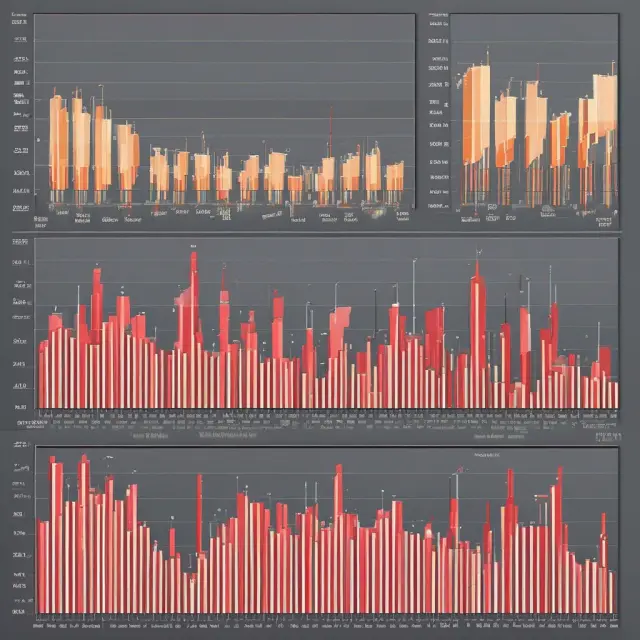
Bar charts and candlestick charts are two popular methods used to analyze price movements in financial markets. Both types convey valuable information about market trends, volatility, and price movements. Despite their similarities, they present this data differently, offering unique advantages depending on the user’s goals and preferences.
Bar Charts: Overview
Bar charts, as previously explained, use vertical bars to represent price movements over a specific time frame, typically displaying open, high, low, and close (OHLC) prices. This visual format allows users to easily interpret changes in market direction and volatility, as well as spot trends and potential reversals.
Bar Charts: Color-Coding
Color-coding is an optional feature that enhances the bar chart’s utility by representing price movements with distinct colors. Traders can visually differentiate between bullish and bearish periods, making it easier to identify trends at a glance. For example, green or black bars indicate rising prices (uptrends), while red bars signify falling prices (downtrends).
Advantages and Disadvantages of Bar Charts
Bar charts are versatile tools, catering to both short-term and long-term investors with their ability to display price movements over various time intervals. They offer a clear presentation of data and are easy to read. However, they might not provide as much detail as other chart types like candlestick charts when it comes to understanding intraday price movements and identifying specific patterns or reversals.
Understanding the Differences: Bar Charts vs. Candlestick Charts
Candlestick charts, a popular alternative to bar charts, use ‘candles’ instead of bars to represent price data. Each candlestick consists of a body and wicks (also known as shadows) that illustrate the opening, closing, highest, and lowest prices for each time interval. This unique representation offers more insight into intraday price movements, making it a preferred choice among technical traders who need to analyze short-term trends and patterns.
Bar Charts and Candlestick Charts: Similarities and Differences in Use
Both bar charts and candlestick charts can help investors visualize price data effectively by presenting essential information about market trends, volatility, and price movements. Despite their differences, they share some similarities. For example, both chart types display the open and close prices for each time interval and highlight price changes based on color or shading.
In conclusion, understanding how to use bar charts and candlestick charts effectively can significantly enhance your investment analysis skills. These tools offer distinct advantages depending on your investment goals and preferences. Bar charts provide a clear overview of market trends and allow easy interpretation of price movements across various time frames. Meanwhile, candlestick charts offer more detailed insights into intraday price movements and patterns that might go unnoticed with bar charts alone. By utilizing both chart types in your investment strategy, you can gain a comprehensive understanding of the markets and make informed decisions based on accurate and insightful data.

Applying Bar Chart Analysis to Trends
Understanding bar charts is crucial for traders and investors seeking insights into price movements in various financial markets. By utilizing this chart type effectively, one can decipher trends, identify potential trend reversals, and evaluate volatility levels. Let’s explore how bar charts can be applied to understanding trends in the market.
Bar charts are essential tools for analyzing trends as they show open, high, low, and closing prices for a particular time frame. These bars help to understand price action better and provide valuable information about market conditions. Long vertical bars indicate increased volatility, while short ones indicate lower volatility during the specified period. Furthermore, long bars with large distance between the open and close can denote significant price movements or strong trends.
The location of the closing price within a bar can also offer insights into market trends. For instance, if the close is significantly higher than the open, it may signal that buyers were more active during the period, potentially indicating further buying in future periods. Conversely, a close near the lows could suggest sellers dominated the activity and that selling pressure might persist.
Color-coding bar charts can further enhance trend analysis by offering a clear visual representation of price movements. In an uptrend, green or black bars are more common, while downtrends exhibit predominantly red bars. The overall trend direction is easily discernible through the color distribution in the chart.
It’s important to note that bar charts can be compared with other chart types like candlestick charts to gain a more comprehensive understanding of trends and price movements. While both bar charts and candlestick charts convey the same information, their presentation differs significantly. Bar charts consist of vertical lines representing high and low prices and small horizontal lines for open and close, whereas candlestick charts display bodies with shaded regions based on price movement directions.
In conclusion, utilizing bar charts to analyze trends is a vital part of market analysis in finance and investment. These charts not only provide essential information about price movements but also help traders and investors make informed decisions by offering insights into potential trend reversals, volatility levels, and overall market conditions.

Bar Charts: A Tool for Short and Long-Term Investors
Understanding how to use bar charts effectively is essential for both short and long-term investors in finance and investment. This section discusses the significance of bar charts in different time horizons, enabling you to make informed decisions based on market trends.
Bar charts, a popular visual representation of financial data, consist of multiple price bars with each bar representing the price movements over a specific period. Each bar comprises open, high, low, and close prices. While some charting platforms display all four values, others may only show high, low, and close (HLC) prices.
Color-coding is an optional feature that can greatly enhance the interpretation of bar charts. If the closing price is above the opening price, the bars are typically colored green or black; otherwise, they are red. This visual distinction makes it easier for traders to quickly identify trends and price movements.
Bar charts provide various advantages over other chart types, making them suitable for short and long-term investors alike:
- Easily interpret trends – Bar charts help investors recognize trends by showing the direction of price movement through the highs and lows.
- Determine support and resistance levels – The clear visualization of high and low prices enables investors to identify potential support and resistance levels.
- Monitor volatility – Longer bars indicate increased volatility, which can be crucial information for both short-term and long-term investment strategies.
- Spot trend reversals – Bar charts provide insight into trend reversals by revealing price movements that signal a change in market direction.
Analyzing bar charts over varying time horizons is vital for investors with different investment objectives. For instance, a day trader would be interested in short-term investments and would require frequent updates, so they may opt to view a 1-minute or 5-minute bar chart. In contrast, long-term investors may prefer weekly or monthly charts as these provide an overview of the broader market trends over extended periods.
Interpreting bar charts is essential for making informed investment decisions. Long vertical bars with large differences between high and low prices indicate increased volatility during that period. The location of the closing price in relation to the open price can also offer valuable insights, such as potential buying or selling opportunities.
In summary, bar charts serve as an indispensable tool for both short-term and long-term investors due to their ability to display historical market data with ease. By understanding the components of a bar chart, advantages, and techniques for interpreting them, you can enhance your investment strategy and gain a competitive edge in the financial markets.
FAQs on Bar Charts
What Is a Bar Chart?
A bar chart is a type of chart commonly used in finance and investment to represent the open, high, low, and close (OHLC) prices for an asset or security over a specified period. Each vertical line represents one time interval and displays the price range through rectangular bars with heights proportional to the magnitude of the value that they represent.
How is Color Coding Used in Bar Charts?
Color coding bar charts can provide additional insight by illustrating trends and price movements more clearly. If the close is above the open, the bar may be colored green or black. Conversely, if the close is below the open, it may be colored red to highlight a drop in price.
What Are the Advantages of Using Bar Charts?
Bar charts are beneficial for analyzing trends and spotting potential trend reversals by comparing prices over various time intervals. They offer an accessible and user-friendly visualization method, making it easy to identify patterns and interpret data. Additionally, their simplicity allows for efficient organization and comparison of large amounts of information.
What Are the Disadvantages of Using Bar Charts?
The primary drawback of bar charts is that they don’t show intraday price movements or candle patterns like candlestick charts do. As a result, this limitation may make it challenging to gain insights into short-term trends and price volatility.
What Does the Size of the Bar in a Bar Chart Represent?
The size of each bar in a bar chart represents the price range during the specified time interval. Longer bars indicate larger price differences (volatility), while shorter bars represent smaller price ranges.
Can I Use Different Colors for My Bar Chart?
Yes, you can color-code your bar chart to differentiate between various securities or assets being analyzed. This is helpful when comparing multiple charts side by side, allowing for a more effective visualization and interpretation of data.
How Long Should Each Time Interval Be in a Bar Chart?
The length of the time interval depends on the user’s objectives and investment horizon. Daily bars provide a clearer long-term trend view, while hourly or minute bars offer insights into short-term price movements and intraday trends.
How Can I Use Bar Charts for Trend Analysis?
Bar charts are useful in analyzing trends by displaying the prices’ historical progression. When looking at an uptrend, more green or black bars will typically be present, while a downtrend is characterized by more red bars. Monitoring the frequency and consistency of these colored bars can help determine the strength and directionality of the trend.
 Next entry · No. 354Understanding Bare Trusts: A Comprehensive Guide for Institutional Investors
See also
-
 No. 871
23 Jun 2024
22 min
Understanding Data Smoothing: Techniques, Advantages, and Disadvantages
Financial Tools
No. 871
23 Jun 2024
22 min
Understanding Data Smoothing: Techniques, Advantages, and Disadvantages
Financial Tools -
 No. 212
07 Apr 2024
20 min
Understanding the Aroon Indicator: Identifying Trend Changes in Finance and Investment
Financial Tools
No. 212
07 Apr 2024
20 min
Understanding the Aroon Indicator: Identifying Trend Changes in Finance and Investment
Financial Tools -
 No. 48
28 Mar 2024
19 min
Understanding the Accumulation/Distribution Indicator (A/D) for Institutional Investors
Financial Tools
No. 48
28 Mar 2024
19 min
Understanding the Accumulation/Distribution Indicator (A/D) for Institutional Investors
Financial Tools -
 No. 1,453
18 Sep 2024
21 min
Decoding the Mystery of Falling Knives in Finance and Investments
Finance Policy
No. 1,453
18 Sep 2024
21 min
Decoding the Mystery of Falling Knives in Finance and Investments
Finance Policy -
 No. 1,323
30 Aug 2024
19 min
Understanding Equity Risk Premiums: Definition, Calculation, and Special Considerations
Business Finance
No. 1,323
30 Aug 2024
19 min
Understanding Equity Risk Premiums: Definition, Calculation, and Special Considerations
Business Finance -
 No. 1,208
12 Aug 2024
22 min
Understanding Economic Equilibrium: Concept, Types, and Implications for Investors
Economics
No. 1,208
12 Aug 2024
22 min
Understanding Economic Equilibrium: Concept, Types, and Implications for Investors
Economics