Dormant Accounts: The Rules by State, the Federal Pieces, and How to Get the Money Back
A dormant account is sent to the state after 3 to 5 years with no owner activity. State law sets the clock; claims are free, with no deadline in most states.
A dormant account is a bank, brokerage or similar account in which the owner has done nothing — no deposit, withdrawal, login or letter — for a set number of years. For ordinary checking and savings accounts no federal rule sets that number. Each state's unclaimed property law does, usually at three to five years, and once it passes the bank must turn the balance over to the state. That transfer is called escheatment. The money is not lost: the state holds it for you, and in most states you can claim it back at no cost and with no deadline.
The rest of this page covers the dormant account rules by state, the handful of federal regulations that do apply, the timeline from last activity to the state treasury, and how to manage dormant business accounts from both sides — as a company that owns them and as a company that holds other people's money. Figures and rules are current as of September 2026. This is general information, not legal advice; the statute in your state governs.
What Makes an Account Dormant
The test is owner-initiated activity. Deposits, withdrawals, transfers, a signed letter to the bank, and in many states an online login or a call that the bank logs all count. What does not count is anything the bank does on its own: interest credited to a savings account, a dividend reinvested in a brokerage account, a monthly fee debited. An account can grow every month from interest and still be dormant.
Three different clocks run at once, and they are easy to confuse:
- The bank's internal clock. Many banks label an account "inactive" after 6 to 12 months and "dormant" later. That label can trigger an inactivity fee or restrictions on online access, but it does not move your money anywhere.
- The state banking rule. Some states regulate dormant accounts inside their banking code, separately from escheat. Georgia's Rule 80-1-8, for example, treats a demand deposit as dormant after twelve months without owner activity and caps the dormant-account maintenance charge at $5 a month or the standard charge on active accounts, whichever is greater, with written notice required first.
- The escheat clock. This is the one that matters most. When the state's dormancy period runs out, the property is "presumed abandoned" and the bank must report it and hand it over.
The OCC, which supervises national banks, puts the escheat clock plainly: an account is considered abandoned when there is no customer-initiated activity or contact for three to five years, depending on the state. The FDIC gives the same range in its guide to finding a long-lost bank account. Your deposits stay FDIC-insured while they sit at the bank, dormant or not.
Dormant Account Rules by State
The dormancy period depends on two things: the state and the type of property. Bank deposits are usually three years; the traditional five-year period survives in a handful of large states. Payroll is usually much shorter, because a paycheck nobody cashes for a year is a strong sign the payee is gone.
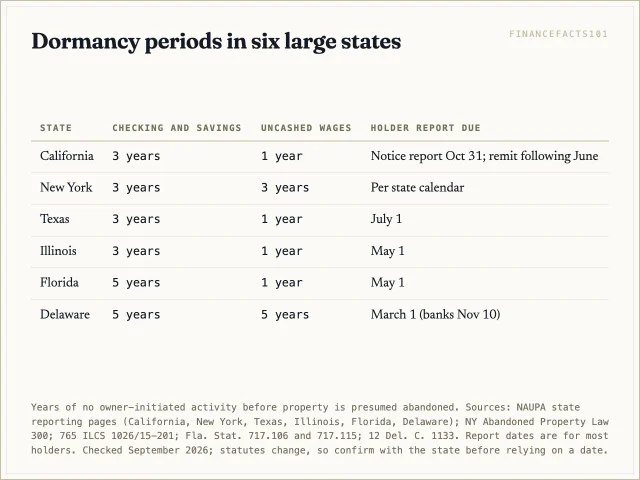
The trend is toward shorter periods. The Revised Uniform Unclaimed Property Act, the model law many legislatures now copy, uses three years for demand, savings and time deposits, and the compliance firm Sovos counts 17 jurisdictions that cut dormancy for banking property to three years, from five or seven, over the 16 years to 2020. Illinois, which adopted the revised act, adds a detail worth knowing if you own CDs: an automatically renewing CD is presumed abandoned three years after the end of its first renewal term, not three years after you opened it.
Which state's rule applies is its own question. The Supreme Court set the priority order decades ago, and restated it in Delaware v. Pennsylvania in February 2023: first the state of the owner's last known address in the holder's records; if there is no address, or that state's law does not reach the property, the state where the holder is incorporated. So a Californian's dormant account at a bank incorporated in Delaware follows California's three-year rule, not Delaware's five. Money orders and similar prepaid instruments are the exception — a federal statute sends them to the state where they were bought, which is how Pennsylvania and a coalition of other states beat Delaware in the 2023 case over MoneyGram official checks.
Federal Regulations on Dormant Accounts
People search for "federal regulations on dormant accounts" expecting one rule. There is none for ordinary bank accounts; Congress left escheat to the states. What exists instead is a set of federal rules that switch on in specific situations.
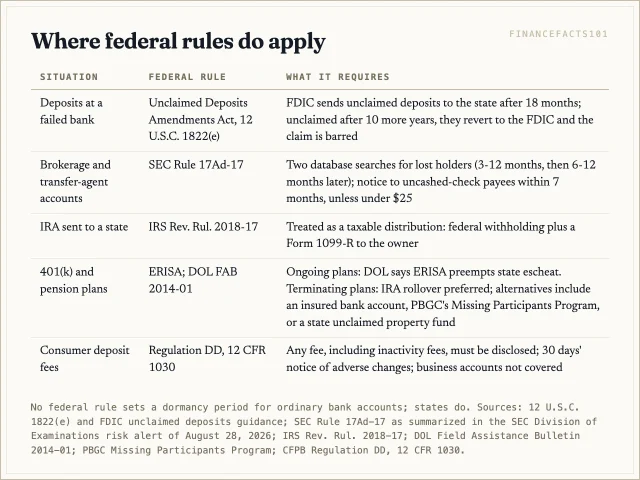
Failed banks. This is the one hard federal deadline. Under the Unclaimed Deposits Amendments Act, the FDIC mails notices to depositors of a failed bank, and if a deposit is still unclaimed 18 months after it starts paying out, it goes to the state of the depositor's last known address. The state then has ten years; if you do not claim the deposit in that window, it reverts to the FDIC and your claim is permanently barred. The FDIC confirms the 18-month transfer in its lost-account guide and cites the delivery-to-state rule in its Washington Mutual unclaimed deposits Q&A; the 18-month and ten-year limits are in the statute itself, 12 U.S.C. 1822(e).
Brokerage accounts and securities. SEC Rule 17Ad-17 makes transfer agents and broker-dealers search for "lost securityholders" — anyone whose mail comes back undeliverable. They must run two database searches, the first between three and twelve months after the holder is coded as lost and the second six to twelve months after that, and they may not charge the holder for those searches. Paying agents must also notify an "unresponsive payee" who has not cashed a check, no later than seven months after sending it, unless the check is under $25. The SEC's Division of Examinations published a risk alert on August 28, 2026 after finding firms that skipped the searches, missed the time frames, or ignored bounced emails when deciding who was lost.
IRAs. When a state takes custody of a dormant IRA, the IRS treats the transfer as a taxable distribution. Revenue Ruling 2018-17 walks through a $1,000 traditional IRA: the trustee withholds $100 of federal income tax, sends $900 to the state unclaimed property fund, and issues a Form 1099-R in the owner's name. You owe tax on money you did not know had moved.
Employer retirement plans. 401(k)s and pensions follow ERISA, and the answer depends on whether the plan is still running. The Department of Labor's Field Assistance Bulletin 2014-01 restates its position that ERISA preempts a state law that would require an ongoing plan to pay a missing participant's money to the state, so a balance in an active 401(k) is not escheated the way a bank account is. A plan that is terminating has to distribute every account, and the bulletin lists the options for participants who cannot be found: a rollover to an IRA, which the DOL calls the best approach; an interest-bearing federally insured bank account in the participant's name; or, as a further alternative, transfer to a state unclaimed property fund. Since 2018 a terminating plan can also send the account to the PBGC's Missing Participants Program, open to defined contribution plans that end on or after January 1, 2018. So an old 401(k) from an employer whose plan has closed can turn up in an IRA provider's records, at the PBGC, or on a state unclaimed property list.
Fee disclosure. Federal law does not ban inactivity fees on deposit accounts. Regulation DD (Truth in Savings) requires a bank to disclose the amount of any fee that may be imposed on the account, and to give at least 30 days' notice before a change that adversely affects you. Those protections cover only consumers: Regulation DD defines an account as one held by a natural person primarily for personal, family, or household purposes, so business accounts sit outside them.
Sunset Rules for Dormant Accounts: From Last Activity to the State
"Sunset rules" is not a term the statutes use, but the question behind the search is a fair one: at what point does a dormant account stop being yours to manage, and is there a point after which you can never get it back? The answer runs in five steps.
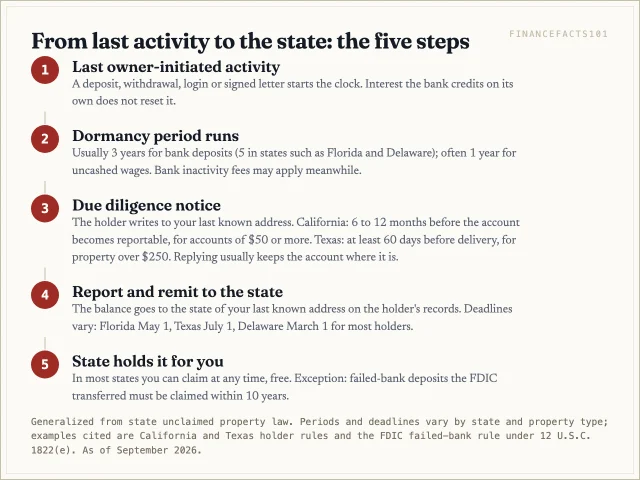
The dormancy period starts at the last owner-initiated activity. When it ends, the holder must try to reach you before reporting. California requires banks to send owners of inactive accounts worth $50 or more a notice 6 to 12 months before the account becomes reportable. Texas requires holders of property worth more than $250 to notify the owner at least 60 days before delivering it to the Comptroller — so by early May for property delivered on July 1 (Tex. Prop. Code § 74.1011). Respond to that letter — a signed reply or a small transaction usually restarts the clock — and the account stays where it is.
Report and payment deadlines then differ by state: Florida's is May 1, Texas's July 1, and Delaware's March 1 for most holders, per NAUPA's state-by-state reporting pages. California splits it in two, with a notice report due October 31 and the remittance the following June.
After the transfer, the practical sunset in most states is no sunset at all. California's Controller, for example, holds unclaimed property indefinitely and states there is no time limit for filing a claim. Two caveats. Some states sell securities they receive after a holding period, so a claim may pay the sale proceeds rather than return the shares, and you miss any gain since. And the FDIC's ten-year limit on failed-bank deposits described above is a real, permanent cutoff.
Dormant Savings and Bank Account Regulations: Fees, Interest and Closure
A dormant savings account keeps earning its stated interest while it sits at the bank, because it is still an open deposit account governed by its contract. What changes is the cost of neglect. A bank can charge an inactivity fee if the fee schedule allows it and the fee was disclosed; state law may cap or restrict it, as Georgia's rule does. A small balance charged a monthly fee for years can shrink to nothing before it ever reaches the escheat date.
Banks may also close an inactive account under the deposit agreement, mailing a check for the balance to the address on file. If that check goes uncashed, it becomes unclaimed property in its own right, on the check's own dormancy clock.
Once the balance reaches the state, the terms change again. States differ on whether they pay any interest on the cash they hold, and many pay little or none. That is the strongest argument for keeping accounts active rather than relying on the state as a custodian. If you keep savings spread across several institutions, a once-a-year review of every account — log in, move $1, confirm the address — costs a few minutes and resets every clock. An auto-renewing certificate of deposit can go dormant quietly while it keeps rolling over.
Managing Dormant Business Accounts
"Managing dormant business accounts" means two different jobs, and most companies have both.
Your company's own accounts. Businesses open accounts for projects, payroll, escrow and acquisitions, then forget them. A business deposit account falls outside Regulation DD's consumer protections, so the fee and notice terms in the account agreement are most of what you have. The dormancy letter goes to whatever address and contact the bank has on file — often a controller who left three years ago. The controls are simple: keep a register of every account with its bank, purpose, signers and last activity date; review it quarterly; update authorized signers and notice addresses when staff change; and close accounts you no longer need rather than letting them drift. Reconciling each account on the bank statement cycle catches the ones that have gone quiet.
Your company as a holder. Any business that owes money it cannot deliver is a holder under unclaimed property law: uncashed payroll checks, vendor checks, customer credit balances, refunds, unused deposits. Most states treat unclaimed wages as abandoned after one year; vendor payments and credits generally follow the three-to-five-year period. Holders must perform due diligence mailings, file annual reports, and remit to each state based on the owner's last known address. Some states require a report even if you have nothing to report — Florida and Texas both require these "negative reports." A minority of states exempt certain business-to-business credits, so the obligation varies by counterparty as well as by state.
The penalties are what make this a finance issue rather than a clerical one. Delaware, which audits aggressively because so many companies incorporate there, charges interest of 0.5% a month on late property, capped at 50% of the amount, plus a separate late-report penalty equal to the lesser of 5% a month up to 50%, or $100 a day up to $5,000, and 75% of any deficiency caused by fraud, under 12 Del. C. § 1183. A company that discovers $40,000 of stale vendor checks a year after they were due owes $2,400 of interest alone — 0.5% for twelve months — before any penalty. Voluntary disclosure programs, which Delaware and many other states run, generally reduce or waive interest and penalties for holders that come forward before an audit notice.
Institutional holders carry one more layer. Broker-dealers and transfer agents answer to the SEC's lost-securityholder rule described above, on top of state escheat law, and the August 2026 risk alert is a signal that examiners are testing it.
How to Find and Claim a Dormant Account
The scale is larger than most people expect. The National Association of Unclaimed Property Administrators reports that state programs returned $4.49 billion to owners in fiscal year 2024, and that roughly 1 in 7 Americans has unclaimed property waiting.
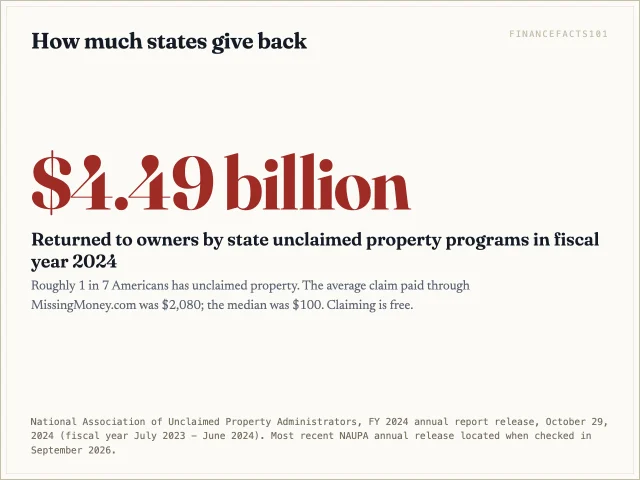
The same report shows why so much goes unclaimed: the average claim paid through MissingMoney.com was $2,080, but the median was $100. Most individual items are small, and people do not think them worth chasing. The large ones are worth an afternoon.
Search in this order. Start with MissingMoney.com, the multistate database run with NAUPA, then check each state's own site for every state you have lived or worked in, since not every item reaches the shared database. Check under old addresses, maiden names and a business's former names. For a bank that failed, search the FDIC's unclaimed funds records before the ten-year window closes. For old 401(k)s, search the state lists too — terminated plans may escheat balances — and use the Department of Labor's Retirement Savings Lost and Found database, created under the SECURE 2.0 Act and opened to the public at the end of 2024. For paper savings bonds, note that TreasuryDirect retired its Treasury Hunt search tool on September 30, 2025; lost-bond claims now start from TreasuryDirect's forms page.
Claiming is free. You will need proof of identity and proof of connection to the property — an old statement, a past address, an account number. Heirs need a death certificate and documents showing their right to the estate. Be wary of "finders" who offer to recover money for a percentage; they are legal in many states but charge for a search you can do yourself in minutes.
Recovered money is worth putting to work straight away. If it came from an account you had forgotten, it probably belongs in your emergency fund or a deposit account you actually watch.
FAQ
How long before a bank account becomes dormant?
It depends on your state and on what "dormant" means. Banks often label an account "inactive" after 6 to 12 months and "dormant" later, which can trigger fees. The legal escheat clock — after which the bank must send the balance to the state — is three years in states including California, New York, Texas and Illinois, and five years in states including Florida and Delaware, measured from your last owner-initiated activity.
Can a bank charge fees on a dormant account?
Yes, in most cases, if the fee is in the account's disclosed fee schedule. For consumer accounts, Regulation DD requires the fee to be disclosed and requires 30 days' notice before an adverse change. Some states restrict dormancy charges; Georgia, for example, caps them at $5 a month or the standard active-account charge. Business accounts do not get Regulation DD's protections.
Is there a deadline to claim money the state is holding?
In most states, no: states like California hold unclaimed property indefinitely and let you claim at any time, free. The main exception is a deposit from a failed bank that the FDIC transferred to a state; if you do not claim it within ten years of that transfer, it goes back to the FDIC and your claim is barred.
What happens to a dormant 401(k) or IRA?
They are treated differently. An IRA can be escheated to the state, and the IRS treats that as a taxable distribution with withholding and a Form 1099-R. A 401(k) or pension is covered by ERISA: the Department of Labor's position is that ERISA preempts state unclaimed property laws for ongoing plans, so an active plan does not escheat your balance. When a plan terminates, a missing participant's account can go to an IRA rollover (the DOL's preferred option), a federally insured bank account, the PBGC's Missing Participants Program, or a state unclaimed property fund — so check all of those.
I moved to another state. Whose dormancy rule applies to my old account?
The rule of the state in the bank's records as your last known address, under the priority order the Supreme Court set and restated in 2023. If you never updated your address after moving, your old state's clock applies and the money goes to your old state, which is why a search should cover every state you have lived in. If the bank has no address for you at all, the state where the bank is incorporated takes it.
Sources
- OCC, HelpWithMyBank.gov, When is a deposit account considered abandoned or unclaimed? — three-to-five-year state range
- FDIC, How to Find a Long Lost Bank Account or Safe Deposit Box — escheat range and the 18-month failed-bank transfer
- FDIC, Washington Mutual unclaimed deposits Q&A — citing 12 U.S.C. 1822(e) on delivery of unclaimed deposits to states
- 12 U.S.C. 1822(e), Unclaimed deposits — 18-month transfer to the state and 10-year reversion to the FDIC
- SEC Division of Examinations, Observations Regarding Lost Securityholder Rule Compliance, August 28, 2026 — Rule 17Ad-17 searches, $25 threshold, seven-month payee notice
- IRS, Revenue Ruling 2018-17 — withholding and Form 1099-R on IRAs paid to state unclaimed property funds
- U.S. Department of Labor, Field Assistance Bulletin 2014-01 — ERISA preemption for ongoing plans; distribution options for missing participants in terminated plans, including IRA rollover, bank accounts and state unclaimed property funds
- PBGC, Missing Participants Program for defined contribution plans
- CFPB, Regulation DD, 12 CFR 1030.4, Account disclosures, 12 CFR 1030.5, Subsequent disclosures and 12 CFR 1030.2, Definitions
- Texas Property Code, § 74.1011, Notice by property holder — $250 threshold, 60 days before delivery
- Sovos, Unclaimed property dormancy periods by state — 17 jurisdictions cut banking dormancy to three years
- TreasuryDirect, Treasury Hunt — tool retired September 30, 2025
- U.S. Supreme Court, Delaware v. Pennsylvania, No. 145, Orig., decided February 28, 2023 — priority rules and the federal money-order statute
- Georgia Department of Banking and Finance, Rule 80-1-8, Dormant Accounts
- Delaware Code, Title 12, § 1183, Interest and penalties and § 1133, dormancy periods
- New York Abandoned Property Law, § 300, bank deposits
- Florida Statutes, Chapter 717, Disposition of Unclaimed Property — §717.106 bank deposits, §717.115 wages
- NAUPA, State-by-state reporting information — dormancy periods and report dates for California, Texas, Florida and Delaware
- NAUPA, FY 2024 annual report release, October 29, 2024 — $4.49 billion returned, 1 in 7 Americans, average and median claim
 Next entry · No. 1,112Understanding the Dotcom Bubble and its Impact on the US Stock Market
See also
-
 No. 823
14 Jun 2024
17 min
Understanding Credit-Linked Notes: A Comprehensive Guide for Institutional Investors
Corporate Finance
No. 823
14 Jun 2024
17 min
Understanding Credit-Linked Notes: A Comprehensive Guide for Institutional Investors
Corporate Finance -
 No. 691
22 May 2024
18 min
Understanding Commercial Mortgage-Backed Securities (CMBS): A Comprehensive Guide for Institutional Investors
Financial Tools
No. 691
22 May 2024
18 min
Understanding Commercial Mortgage-Backed Securities (CMBS): A Comprehensive Guide for Institutional Investors
Financial Tools -
 No. 1,223
14 Aug 2024
18 min
Understanding Economic Rent: A Comprehensive Guide for Institutional Investors
Business Finance
No. 1,223
14 Aug 2024
18 min
Understanding Economic Rent: A Comprehensive Guide for Institutional Investors
Business Finance -
 No. 1,204
11 Aug 2024
20 min
Understanding Economic Capital: Definition, Calculation and Importance for Institutional Investors
Business Finance
No. 1,204
11 Aug 2024
20 min
Understanding Economic Capital: Definition, Calculation and Importance for Institutional Investors
Business Finance -
 No. 985
11 Jul 2024
19 min
Understanding Demand Drafts: Prepaid Instruments for Institutional Transfers
Business Finance
No. 985
11 Jul 2024
19 min
Understanding Demand Drafts: Prepaid Instruments for Institutional Transfers
Business Finance -
 No. 1,132
01 Aug 2024
19 min
Understanding Direct Participation Programs (DPPs): A Comprehensive Guide for Institutional Investors
Investments
No. 1,132
01 Aug 2024
19 min
Understanding Direct Participation Programs (DPPs): A Comprehensive Guide for Institutional Investors
Investments