Understanding Line Charts: A Visual Representation of Asset’s Historical Price Action
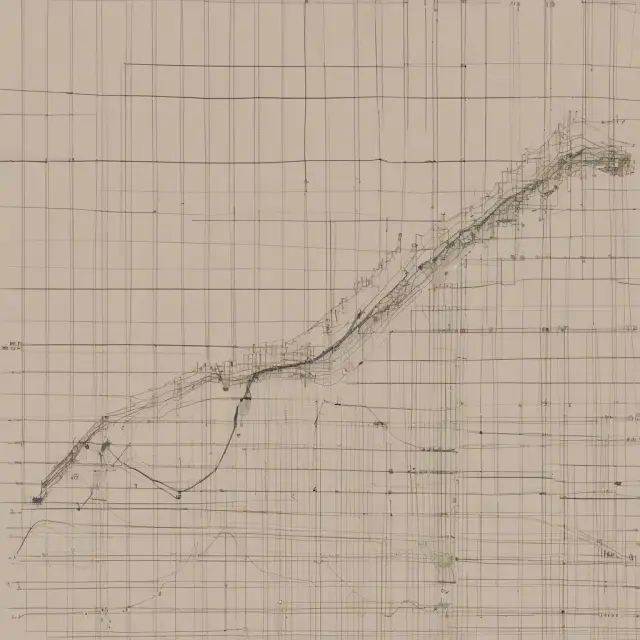
Explore the power of Line Charts in understanding financial markets with definitions, components, advantages, and creation steps.
What Is a Line Chart?
A line chart is a graphical representation of historical price data for financial securities, connecting data points using a continuous line. It’s the most fundamental type of chart used in finance and trading. This section will delve into the definition, purpose, and essential features of line charts while highlighting their applications within the financial world.
Definition
A line chart shows an asset’s price history as a series of connected data points. These charts typically display closing prices, making them a popular choice for understanding trends and identifying support and resistance levels in the market. By illustrating historical trends and patterns, line charts enable investors and traders to make informed decisions regarding their investments.
Purpose
The primary purpose of using line charts is to represent an asset’s price history over a specified time frame, which may range from days to years. Line charts can be used for various financial instruments, including stocks, indices, currencies, and commodities, as well as for analyzing trends in economic data like interest rates or employment figures.
Key Features
Line charts consist of two axes: the horizontal (X-axis) representing time and the vertical (Y-axis) representing price. Each data point is plotted as a single point on the chart, with the line connecting successive points to form a trendline. This continuous line offers insights into trends, making it easier for analysts and traders to identify uptrends, downtrends, and support and resistance levels.
Line charts provide a simplified way of understanding price action by visually representing historical data points. They are especially useful for beginners or those seeking an uncluttered charting style compared to other chart types like candlestick or bar charts. Line charts may not offer as much detail as other chart styles but can be an effective tool when looking at long-term trends and understanding broad market movements.
Components of a Line Chart
In finance and investing, a line chart is an essential visual tool to understand asset price changes over time. This section delves deeper into line charts, focusing on their components.
A line chart displays historical financial data as a continuous series of points connected by a single line. The primary function of a line chart is to represent the trend or direction in which prices are moving. To construct a line chart, we need three key components: data points, horizontal axis (x-axis), and vertical axis (y-axis).
Data Points
Data points refer to the individual price values plotted on both the horizontal and vertical axes. Each data point represents a specific date or time interval and the corresponding closing price. As new data becomes available, the line is updated accordingly, allowing for real-time monitoring of price changes.
Horizontal Axis (X-axis)
The horizontal axis, or x-axis, is the timeline that runs from left to right on a line chart. It displays dates or time intervals as labeled points and helps users understand when each data point was recorded. By default, Excel assigns the first column of data inputted in a table as the X-axis.
Vertical Axis (Y-axis)
The vertical axis, or y-axis, represents the value or price scale on a line chart. It is usually located on the left side and runs from bottom to top. The Y-axis helps investors visualize the magnitude of each data point by displaying its corresponding closing price. Adjusting the minimum and maximum values on the vertical axis can improve the visual clarity of the line chart.
Continuous Line
The continuous line connecting each data point is crucial for understanding trends in asset prices. It enables traders to identify uptrends, downtrends, or sideways movements in price action. A rising line indicates an uptrend, while a falling line suggests a downtrend. Flat lines indicate no discernible trend, or a range-bound market.
Line charts are a versatile visualization tool for analyzing financial data. Their simplicity and ease of use make them popular among investors and traders looking to quickly identify trends and patterns within their securities’ historical price action. By understanding the components of line charts, users can effectively utilize this powerful financial tool to inform their investment decisions.
Using Line Charts to Identify Trends and Support/Resistance Levels
A line chart is an effective visual tool for traders looking to identify trends and support/resistance levels within their financial data. By plotting a series of closing prices and connecting them with a continuous line, this chart style simplifies the price action by reducing noise from less critical times in the trading day, such as open, high, and low prices. This section will explore how line charts help traders make informed decisions based on market trends and identify crucial levels in financial markets.
Components of Line Charts
Before diving into trend analysis, it’s essential to understand a line chart’s structure. A line chart displays information as a series of data points connected by straight-line segments. The horizontal axis represents the time scale, while the vertical axis measures the price or other relevant value. Each point on the line signifies the closing price at that specific time.
Identifying Trends with Line Charts
Line charts play a significant role in recognizing trends within financial data. A trend refers to a persistent directional movement in asset prices over an extended period. By observing a series of closing prices, traders can determine whether an asset is experiencing an uptrend (higher highs and higher lows) or downtrend (lower highs and lower lows).
Support and Resistance Levels with Line Charts
Support levels represent the price level at which buyers are willing to enter the market, while resistance levels act as a barrier for sellers. These crucial price levels can be identified using a line chart. By examining the horizontal axis, traders can spot potential support and resistance levels based on previous price action or trend lines. For example, a significant drop in prices followed by a bounce back to a previously tested level could indicate a potential support area. Conversely, a noticeable resistance level might be identified where price action has repeatedly failed to break above.
Simplicity and Beginner-Friendly
Line charts are popular among traders due to their straightforward nature. Their simplicity makes them an excellent choice for new investors looking to learn chart reading skills. Additionally, the visual representation of historical data simplifies the process of recognizing trends and identifying support/resistance levels. As traders progress in their financial journey, they may choose to explore other advanced charting techniques such as candlestick charts or bar charts for further analysis.
Comparing Line Charts with Other Chart Styles
While line charts have various advantages, they do share some limitations when compared to other popular chart styles. For example, line charts may not fully capture price patterns and trends as effectively as other types of charts, such as candlestick or bar charts. However, a line chart remains an essential tool for investors and traders seeking to identify long-term trends and support/resistance levels in their financial data.
Stay tuned for the next section on creating a line chart using Microsoft Excel!
Simplicity and Beginner-Friendly
A line chart is an excellent choice for new investors and traders due to its simplicity and ease of use. This basic visualization tool, which plots a security’s historical closing prices using a continuous line, is not only simple but also beginner-friendly.
Line charts can be particularly beneficial for novice investors, as they provide essential insights into market trends and key support and resistance levels. By focusing on the closing price rather than other price information like open, high, or low prices, these charts simplify analysis without overwhelming newcomers with excessive data.
Additionally, line charts are versatile in their application. They can be used for any time frame and can easily be supplemented with other charting styles to offer a more comprehensive technical view of an asset’s price action. Moreover, various tools and software like Microsoft Excel make creating line charts simple, ensuring accuracy and efficiency.
Line charts stand out for their ability to help traders identify trends, which is crucial knowledge for both long-term and short-term strategies. A clear upward trend indicates a bullish market, while a downward trend signals a bearish one. These trends can provide valuable guidance when making investment decisions or setting stop loss levels.
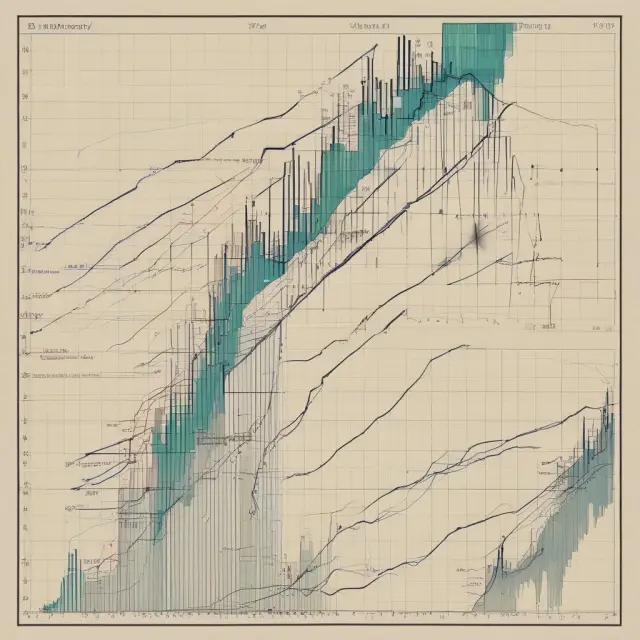
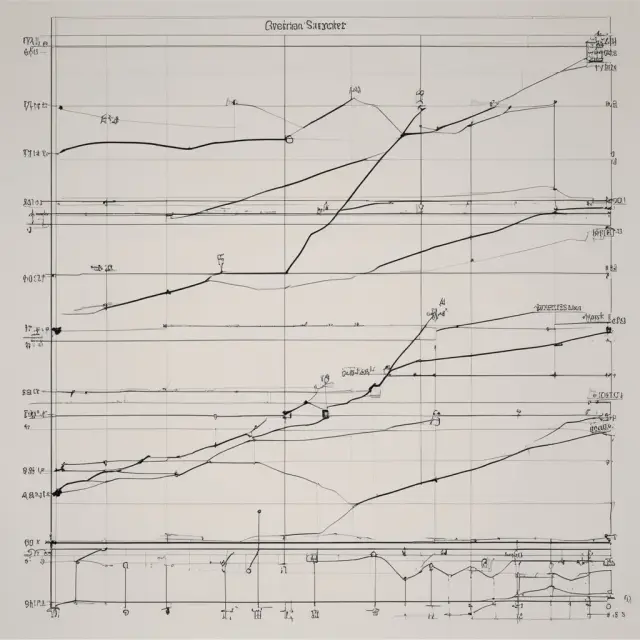
For instance, in the line chart below, it’s evident that the stock experienced an uptrend from around $30 to nearly $45 before undergoing a steep decline. This information can be instrumental for traders, as they can use this knowledge to make informed decisions based on the trend and potential support/resistance levels.
However, line charts are not perfect for every situation, as they don’t provide in-depth insights into other critical aspects like price volatility or intraday movements. For more advanced analysis that requires detailed information about open, high, low, and closing prices, other charting styles, such as candlestick charts, might be preferred.
Despite their limitations, line charts are an essential educational tool for new investors, helping them learn the basics of chart reading and providing a solid foundation to expand their knowledge in finance and trading.
Comparing Line Charts to Other Chart Styles
Understanding the Differences Between Line, Bar, Candlestick, and Point & Figure Charts
A line chart is just one of various chart styles used for financial analysis. While each type of chart offers its unique benefits, it’s crucial to know their differences in order to choose the most suitable chart for specific investment research or trading needs. In this section, we will discuss the primary distinctions between line charts and other popular chart styles: bar charts, candlestick charts, and point & figure charts.
A line chart displays information as a series of data points connected by straight line segments. It is the most basic type of chart, used to represent an asset’s price history over time (usually closing prices). Line charts reduce noise from open, high, and low prices, making them ideal for identifying key support and resistance levels and recognizing trends.
Bar Charts
Bar charts use rectangular bars to depict the price action between a specific time frame. Each bar has two parts: the vertical height representing the price change (upward for gains and downward for losses), and the horizontal section displaying the corresponding time period. Bar charts provide more comprehensive information than line charts, as they show both the opening and closing prices, highs and lows, and market volume.
Candlestick Charts
Candlestick charts represent price action using rectangular bars called candles that consist of an open, high, low, and close for each time frame. These charts display more information than line or bar charts, revealing essential details about the price movement during a specific period. The shape and colors (upward-facing for gains and downward-facing for losses) within the candlestick chart offer insights into buying and selling pressure, volatility, and trend reversals.
Point & Figure Charts
Point & figure charts are unique because they do not represent time directly but instead focus on changes in price. These charts use X and O symbols to signify price movements; an ‘X’ represents a rising price while an ‘O’ represents a falling one. Point & figure charts can be filtered by setting price filters, making them ideal for tracking specific support and resistance levels or identifying trend reversals.
In conclusion, each type of chart style has its distinct advantages. Line charts offer simplicity and are beginner-friendly, but they might not provide as much information as other charts. Bar charts offer more comprehensive data while maintaining ease of reading. Candlestick charts deliver valuable insights into market sentiment and buying/selling dynamics, but they can be visually complex. Point & figure charts cater to specific investment needs by focusing on price movements without considering time directly. Investors and traders should consider their objectives and analytical preferences when selecting the appropriate chart style for their financial analysis or trading strategy.
Creating a Line Chart in Excel
A line chart is a graphical representation of an asset’s historical price action that connects data points using a continuous line. This section focuses on creating a line chart within Microsoft Excel to help traders visualize the price history of their investments more effectively.
Prerequisites:
- Ensure you have the latest version of Microsoft Excel installed on your computer or device.
- Organize your data in Excel with the date and closing prices in separate columns (e.g., “Date” and “Closing Price”).
- Prepare a blank cell for the chart’s title, if desired.
Steps to create a Line Chart in Excel:
Step 1:
Select the range of cells containing your data – this includes column headers (Date and Closing Price) and the entire dataset below. For example, A1:B8.
Step 2:
Navigate to the “Insert” tab within the ribbon menu at the top of Excel. In the Charts group, click on the line chart icon (“Insert line chart”) – specifically, choose “Line with Markers.” This option plots both a line and markers for each data point.
Step 3: (Optional) Customize your chart’s appearance by adding a title. Click anywhere within the chart area to activate the Chart Tools tab that appears above the ribbon menu. In the Layout group, click on “Chart Title.” In the drop-down menu, select the desired format for your title and type it in the input box.
Step 4: Adjust chart axis titles by clicking on the “Add Chart Element” button within the Layout group. Select “Axis Titles” and then choose the appropriate axis to label (X or Y). Input the desired axis label and press Enter.
Step 5: Customize colors, fonts, or other visual aspects of your chart through the Format Data Series option under the Chart Tools tab. You may also add gridlines and data labels by accessing the same menu.
Your line chart is now ready to use within Excel for further analysis, comparison, or sharing with others. This user-friendly method simplifies the process of creating and customizing line charts that can help traders make informed decisions based on their investment data.

Line Charts’ Pros and Cons
A line chart is an essential visual tool for financial analysis, offering several advantages over other chart types. This section will discuss both the pros and cons of using line charts to understand asset trends and patterns.
Pros:
- Simplistic Design: Line charts display information as a series of connected data points, making it easy to quickly identify trends and price movements. The simple design allows traders to focus on essential details without being overwhelmed by excessive information.
- Trend Identification: By analyzing the line chart’s slope, traders can easily identify uptrends (when the line is ascending) or downtrends (when it is descending). This information can help investors make informed decisions about their portfolios based on market trends.
- Support and Resistance Levels: Line charts can help identify significant support and resistance levels, crucial price points that can influence future price movements. These levels are essential for traders looking to enter or exit positions in the market.
- Beginner-Friendly: Line charts offer an excellent starting point for new investors and traders learning technical analysis. Their simplicity makes it easier to understand key concepts and visualize trends without requiring extensive knowledge of more complex charting techniques.
- Multiple Chart Applications: Line charts can be used in conjunction with other chart types, such as bar or candlestick charts, to provide a more comprehensive understanding of an asset’s price action.
Cons:
- Limited Price Information: While line charts are effective for tracking closing prices, they lack the detailed price information that other chart types, like candlestick charts, provide. For traders focusing on intraday movements or specific price actions, such as open and close prices, other charting methods may be more suitable.
- Misinterpretation of Trends: Due to their simplicity, line charts can sometimes lead to misinterpretations of trends. Traders must pay close attention to context and confirm any trends using additional data or indicators before making investment decisions based on the chart alone.
- Potential for Errors in Data Entry: Manually creating a line chart involves entering raw data, which introduces a risk of errors or inconsistencies. Ensuring accuracy is crucial when analyzing financial information and can be time-consuming when working with large datasets.
- Limited Depiction of Volatility: Line charts do not directly display volatility in the way that other chart types, such as bar charts or candlestick charts, do. Traders looking for a more accurate representation of price swings and ranges should consider using these alternatives.
Despite their limitations, line charts offer numerous benefits for financial analysis, making them an essential tool for traders and investors seeking to understand asset trends and identify potential opportunities. By understanding the pros and cons of using line charts, traders can make informed decisions on when and how to best incorporate this powerful charting method into their investment strategies.
Line Chart vs. Time Series Data
A line chart is an excellent visual tool when it comes to time-series data representation. It’s a simple yet powerful graph that helps investors and traders understand the historical trends of asset prices over a specified period. Time series data refers to data points collected at successive observations in time order. Line charts, as mentioned previously, are perfect for illustrating these trends since they utilize closing prices to generate a continuous line connecting each point on the chart.
The continuous line allows easy recognition and visualization of patterns or trends that might be present within the data. Trends such as uptrends, downtrends, and consolidation phases are all easily identified when looking at a line chart. Moreover, support and resistance levels can also be determined through this type of chart analysis.
Support and resistance levels represent key price points where buyers or sellers enter the market in large numbers. These levels can help predict future price movements as they act as strong psychological barriers for the asset’s price action. By using a line chart to identify these levels, traders can make informed decisions based on historical data. For instance, if a particular support level has held strong in the past and is currently being tested, traders may choose to enter the market with a long position if they believe the price will continue to bounce back above this level.
When compared to other chart styles like bar charts, candlestick charts, or point & figure charts, line charts offer some unique advantages. For one, their simplicity makes them an excellent starting point for new investors or traders who are just beginning their journey in financial markets. Additionally, line charts do not require much data manipulation since they only utilize closing prices for charting purposes. This means that the creation process is typically faster and more straightforward than with other chart styles.
While line charts may not provide as much detail as other chart types, such as candlestick or bar charts, they remain a valuable tool in financial analysis. Their simplicity makes them easily understandable for those new to the world of finance, while their ability to identify trends and support/resistance levels provides valuable insights for even the most experienced traders.
In conclusion, line charts serve an essential role when working with time-series data. They offer a clear visual representation of historical price trends and are simple enough for beginners to understand. Whether you’re just starting out in the financial markets or looking for a quick way to identify long-term trends, line charts are an excellent choice for your analysis needs.

Common Misconceptions About Line Charts
Despite their widespread popularity among traders and investors, there are common misconceptions about line charts that can lead to misunderstandings or missed opportunities for valuable insights. In this section, we will address some of the most common myths and misconceptions surrounding line charts.
1. Myth: Line Charts Only Show Closing Prices
Fact: While it’s true that line charts often depict only closing prices, they can also be modified to display other price information such as open, high, low, or volume data. The choice of what data points are plotted on the chart depends on the user and their preferred style of analysis.
2. Myth: Line Charts Provide No Volume Information
Fact: Although line charts primarily show price movements, volume data can be added to a line chart as an additional series or using candlestick charts to better understand the relationship between price and volume.
3. Myth: Line Charts Are Inadequate for Technical Analysis
Fact: While some technical indicators may not be easily applied to line charts, they can still provide valuable insights into trends and patterns through simple visual analysis. Additionally, they can be used in conjunction with other chart types like candlestick charts or bar charts for a more comprehensive view of the market.
4. Myth: Line Charts Are Limited to Historical Data
Fact: In addition to historical data, line charts can also represent real-time data and are commonly found in financial news websites and stock tickers. This makes them an excellent choice for monitoring current market trends and making informed decisions based on up-to-date information.
5. Myth: Line Charts Are Unsuitable for Comparing Multiple Assets
Fact: To compare multiple assets, line charts can be transformed into multiple line charts or combined with other chart types like bar charts or candlestick charts to effectively visualize the differences and similarities in their price movements.
By understanding the truth behind these common misconceptions, investors and traders will have a more accurate perception of line charts’ capabilities, allowing for more effective use in financial analysis.

Line Chart Applications in Finance and Trading
Line charts are widely used across various financial markets as a tool for identifying trends and support/resistance levels. They have become an essential component of technical analysis, providing traders and investors with valuable insights into the price action of securities. In this section, we will delve deeper into how line charts are utilized in finance and trading scenarios.
Firstly, line charts play a crucial role in identifying trends within financial markets. By analyzing historical data, one can spot long-term trends using line charts. These trends could indicate potential buying or selling opportunities, as well as help in determining entry and exit points for various strategies. For example, if a security’s price has been consistently increasing over a specific time frame, it might be considered an uptrend. Conversely, if the price is decreasing, it would be considered a downtrend. Identifying these trends early on can give traders a significant advantage in making informed decisions.
Secondly, line charts help in determining support and resistance levels. Support levels represent the price level where buyers enter the market and push prices up. Resistance levels, on the other hand, are areas where sellers enter the market and push prices down. Line charts can reveal these levels by illustrating patterns like horizontal trends or identifying price levels where the stock price frequently bounces back. These levels provide critical guidance for traders looking to enter or exit positions based on price action.
Lastly, line charts are particularly useful for new investors and traders due to their simplicity. Unlike more complex chart types such as candlestick charts or bar charts, line charts display only closing prices. This makes them an excellent starting point for beginners learning about financial markets and chart analysis techniques. Additionally, line charts can be easily created using various software tools like Microsoft Excel, which simplifies the process of analyzing price data.
Line charts also have their limitations. Since they only show closing prices, some traders may find that they lack sufficient detail for their trading strategies. For instance, strategies that require information about open, high, and low prices would not be fully feasible using line charts alone. In such cases, other chart types like candlestick charts or bar charts might be preferred to gain a more comprehensive view of price action.
In conclusion, line charts serve as an essential visual representation of asset’s historical price action in finance and trading. They offer valuable insights into trends, support/resistance levels, and are a great starting point for new investors. Understanding the capabilities and limitations of line charts can help traders make informed decisions when navigating financial markets.

FAQ
What is a line chart?
A line chart is a graphical representation of an asset’s historical price action, connecting data points with a continuous line. It simplifies the display of price data by showing only closing prices, reducing noise from less critical times like open, high, and low prices.
What are the components of a line chart?
A line chart consists of horizontal and vertical axes, data points, and a single continuous line that connects all the data points.
How do line charts help identify trends and support/resistance levels?
Line charts enable traders to quickly locate major price support and resistance levels by illustrating trend direction and recognizable chart patterns. They can also indicate potential buying and selling opportunities based on price movements.
Why are line charts ideal for beginners?
Due to their simplicity, line charts are a great starting point for learning chart analysis skills. They provide an easy-to-understand visual representation of historical asset prices, making it simpler for new investors and traders to make informed decisions.
What other chart styles can be used alongside line charts?
While line charts offer valuable insights on their own, they may not capture all patterns or trends, so combining them with other chart styles, such as bar charts, candlestick charts, or point & figure charts, can provide a more comprehensive technical analysis perspective.
What are the advantages and disadvantages of line charts?
Line charts’ primary benefits include their simplicity, beginner-friendly nature, ease of use in software like Excel, and ability to identify trends and support/resistance levels. However, their main disadvantage is that they only represent closing prices and may not provide sufficient detail for advanced technical analysis strategies or traders requiring more price information than just the close.
How does a line chart compare to time-series data?
Line charts are ideal for visualizing time-series data as they connect data points, illustrating trends over a specified period. They help users understand how values change with respect to time and reveal patterns that can inform investment decisions based on past performance.
What common misconceptions exist regarding line charts?
A common misconception is that line charts are outdated or less effective compared to other chart styles, such as candlestick charts. However, line charts remain a valuable tool for traders and investors, offering various benefits, including simplicity, ease of use, and quick visual representation of price trends.
 Next entry · No. 2,902Understanding Line of Credit (LOC): A Comprehensive Guide for Institutional Investors
See also
-
 No. 4,911
27 Jul 2025
20 min
A Comprehensive Guide to Technical Analysis: Understanding Chart Patterns, Indicators, and Strategies
Finance Policy
No. 4,911
27 Jul 2025
20 min
A Comprehensive Guide to Technical Analysis: Understanding Chart Patterns, Indicators, and Strategies
Finance Policy -
 No. 4,000
14 May 2025
19 min
Understanding Point-and-Figure Charts: A Powerful Tool for Technical Analysis
Financial Data Analysis
No. 4,000
14 May 2025
19 min
Understanding Point-and-Figure Charts: A Powerful Tool for Technical Analysis
Financial Data Analysis -
 No. 2,285
25 Dec 2024
22 min
Understanding the Functionality and Significance of the Ichimoko Cloud in Technical Analysis
Financial Data Analysis
No. 2,285
25 Dec 2024
22 min
Understanding the Functionality and Significance of the Ichimoko Cloud in Technical Analysis
Financial Data Analysis -
 No. 4,456
20 Jun 2025
20 min
Understanding Reversals: Spotting and Utilizing Trend Changes in Finance and Investment
Business Finance
No. 4,456
20 Jun 2025
20 min
Understanding Reversals: Spotting and Utilizing Trend Changes in Finance and Investment
Business Finance -
 No. 4,434
18 Jun 2025
18 min
Retracements vs. Reversals: Understanding Short-Term Price Movements in the Stock Market
Markets
No. 4,434
18 Jun 2025
18 min
Retracements vs. Reversals: Understanding Short-Term Price Movements in the Stock Market
Markets -
 No. 4,412
16 Jun 2025
21 min
Understanding Resistance Levels in Technical Analysis: Identifying, Trading and Breaking Through
Markets
No. 4,412
16 Jun 2025
21 min
Understanding Resistance Levels in Technical Analysis: Identifying, Trading and Breaking Through
Markets