Loan Officers: What They Do, From Application to Approval

A loan officer takes your application, checks your finances and guides the loan to approval. Median pay was $76,690 in May 2025. Duties, licensing, pay rules.
A loan officer is the person at a bank, credit union or mortgage lender who takes your loan application, helps you choose a loan, gathers and checks your financial information, and moves the file toward a decision. Depending on the loan and the lender, the loan officer either approves it within a personal lending limit or sends it to an underwriter or loan committee. The Bureau of Labor Statistics puts it in one line: loan officers "evaluate, authorize, or recommend approval of applications for personal and business loans."
It is a large and well-paid occupation. Loan officers held about 283,000 jobs in 2025, and the median annual wage was $76,690 in May 2025, according to the BLS Occupational Outlook Handbook. This page covers what a loan officer does, how a bank lending officer's job differs, the path from application to approval, how loan officers are paid and licensed, and the rules they work under. It is general information, not advice about any particular loan or lender.
What Is a Loan Officer?
A loan officer, also called a lending officer, is a lender's employee who works directly with borrowers. The two titles mean the same job. Banks often prefer "lending officer" or "relationship manager" for business lending; mortgage companies use "loan officer" or, in the language of federal law, mortgage loan originator (MLO).
The job sits between you and the institution's money. A lender's loan officer represents the lender, not you, but the lender only makes money if loans close, so a good loan officer spends much of the job explaining options and getting a complete, accurate application in front of the decision-maker.
Loan officers are easy to confuse with the other people who touch a loan, especially on a mortgage, where four or more roles are involved.

The difference that matters most to you as a borrower: the loan officer is your point of contact and can tell you what a lender is likely to approve, but on most mortgages the credit decision is made by an underwriter who never meets you. A mortgage broker is different again. A broker arranges loans with several outside lenders rather than lending its own money; the entry on mortgage originators covers how brokers, lenders and the secondary market fit together.
Types of Loan Officers
The BLS describes three main specialties, plus two related roles:
- Commercial loan officers specialize in loans to businesses, for things such as buying supplies or expanding.
- Consumer loan officers handle loans to individuals, such as auto and education loans.
- Mortgage loan officers specialize in loans to buy or refinance real estate. They are the only group that must be licensed or registered under federal law.
- Loan collection officers contact borrowers who have fallen behind on their payments.
- Loan underwriters evaluate whether applicants are creditworthy, using the financial information collected and underwriting software.
Where they work shapes the job. Eighty percent of loan officers worked in credit intermediation (banks, credit unions and other lenders) in 2025, 4% in management of companies and 4% at automobile dealers, per the BLS. Consumer loan officers mostly work in offices; mortgage and commercial loan officers often meet clients at their homes or businesses.
Loan Officer Responsibilities and Duties
What does a loan officer do day to day? The BLS lists six core duties, and each hides real work:
- Finding borrowers. Contacting businesses or people about their loan needs. For mortgage and commercial loan officers, this is sales: referrals from real estate agents, builders, accountants and past clients.
- Interviewing applicants. Gathering information about income, debts, assets and the purpose of the loan.
- Explaining loan options. Fixed or adjustable rate, term length, points, fees and what each costs over time. Comparing an ARM with a fixed-rate loan or deciding whether to pay discount points is exactly the conversation a loan officer should walk you through.
- Obtaining and verifying financial information. Pay stubs, tax returns, bank statements, credit reports and, for a business, financial statements and tax returns for several years.
- Checking compliance. Reviewing the loan and its disclosures against lending laws and the lender's own policy.
- Approving or referring. Approving applications within their authority or passing them to management or underwriting.
Two more responsibilities run through all six. The first is accuracy: a loan officer who inflates income or overlooks a debt creates a loan that can fail, and exposes the lender to losses and legal risk. The second is keeping borrowers informed, including telling them promptly when something is missing and when the answer is no.
Bank Lending Officer Responsibilities
A bank lending officer, especially one making business loans, carries responsibilities that a mortgage loan officer at a nonbank lender usually does not: the loan stays on the bank's books, and the officer is accountable for it after closing.
Credit analysis. For a business loan, the lending officer analyzes cash flow, collateral, the owners' finances and the industry, then structures the loan: amount, term, rate, collateral and covenants. Whether a loan is secured or unsecured, and how firm the commitment is, is part of that structure; the entry on loan commitments explains the difference.
Lending authority. A bank lending officer can approve loans only up to the limit the bank has set for that officer. The FDIC's examination manual for loans lists the items a bank's lending policy typically addresses, including the "lending authority of each loan officer," the authority of a loan or executive committee, and the board of directors' role in approving loans. Larger or riskier loans go to a committee. The bank as a whole has a ceiling too: a national bank's loans to one borrower generally may not exceed 15% of its capital and surplus, plus another 10% if fully secured by readily marketable collateral, under the OCC's lending limits rule.
Monitoring the loan after closing. This is the part outsiders miss. In the FDIC's words, "Loan officers are generally responsible for ongoing credit analysis and the prompt identification of emerging problems." That means reviewing the borrower's updated financial statements, checking covenants and flagging trouble early. The same manual adds that banks should avoid over-reliance on loan officers and have significant loans reviewed by people outside the approval process, which is why larger banks run a separate loan review function.
Relationship management. A commercial lending officer is often the business's main contact at the bank, selling deposit accounts, treasury services and future loans. For very large loans, the officer may work with other banks in a syndicate led by a lead bank.
From Application to Approval: How a Loan Moves
The path depends on the loan. A small personal loan can be decided in minutes; a commercial loan can take weeks. A mortgage has the most defined steps, because federal rules set deadlines at several points.
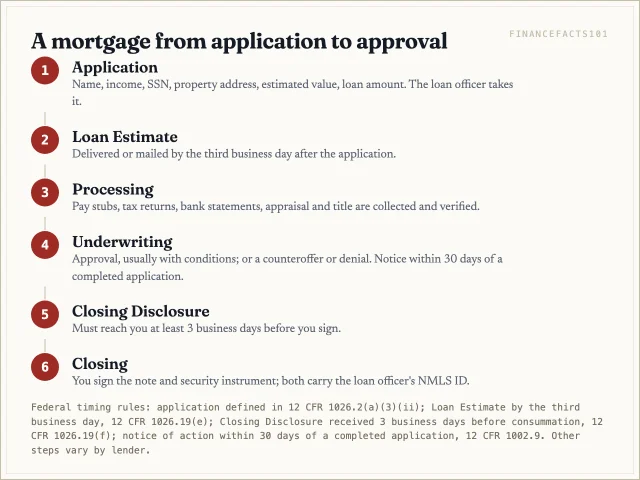
Application. For a mortgage, federal rules define an application as six pieces of information: your name, income, Social Security number (to pull a credit report), the property address, an estimate of the property's value, and the loan amount, per 12 CFR 1026.2(a)(3). Once the lender has those six, clocks start.
Loan Estimate. The lender must deliver or mail a Loan Estimate no later than the third business day after it receives the application, under 12 CFR 1026.19(e). It shows the rate, monthly payment and closing costs, so you can compare lenders.
Processing and underwriting. A processor collects and verifies documents; the underwriter decides. Many lenders run the application through automated underwriting software first, then an underwriter reviews the result and the documents. Approval usually comes with conditions, such as an updated pay stub or an explanation of a large deposit, and the loan officer's job is to get those conditions cleared.
Closing Disclosure and closing. You must receive the Closing Disclosure no later than three business days before you sign. These two forms replaced the older Good Faith Estimate and HUD-1 settlement statement for most mortgages with applications received on or after October 3, 2015, per the CFPB's TILA-RESPA rule guide. Reverse mortgages and home equity lines of credit are outside that rule, which is why reverse mortgages still use the Good Faith Estimate and HUD-1.
The decision itself. Under the Equal Credit Opportunity Act's Regulation B, a lender must tell you what it decided (approval, counteroffer or denial) within 30 days after receiving a completed application, per 12 CFR 1002.9. A denial must come with the reasons or tell you how to get them.
If you are buying a home, you can speed this up by knowing your numbers before you meet a loan officer: the debt-to-income calculator and the guide to how much house you can afford show roughly what a lender will look at.
How Loan Officers Are Paid

The BLS reports that some loan officers are paid a flat salary and others are paid on commission, and that loan officers may also receive extra commission or bonuses based on how many loans they originate or how well those loans perform. Pay varies widely: the lowest 10% earned less than $39,430 and the highest 10% more than $153,180 in May 2025. Among the industries employing the most loan officers, the median was highest at automobile dealers, at $106,000.
Mortgage loan officers are paid under specific federal rules, because pay once pushed borrowers into costlier loans. Before 2011, lenders commonly paid originators more when the borrower accepted a higher interest rate than the lender required, a payment called a yield spread premium. The Federal Reserve's loan originator compensation rules, effective April 1, 2011, ended that. Today, under 12 CFR 1026.36(d):
- A loan originator may not be paid based on a term of the transaction, such as the interest rate, or on a proxy for a term.
- Pay may be a fixed percentage of the loan amount, and that percentage may have a minimum or maximum dollar amount.
- If you pay the loan originator directly, the originator may not also be paid by the lender or anyone else for the same loan.
- A loan originator may not steer you into a loan because it pays them more, unless that loan is in your interest.
A worked example shows what that means. Say a loan officer earns 1% of the loan amount. On a $400,000 mortgage, that is $4,000, whether you take the loan at 6.25% or at 6.75%. Under the pre-2011 system, the higher rate could have paid the originator more. The rule removes the incentive to sell you the higher rate; it does not stop a loan officer from preferring a larger loan, which is one reason to check any loan amount against your own budget.
Licensing and Registration: The SAFE Act
Every mortgage loan officer needs an NMLS ID, a unique number from the Nationwide Mortgage Licensing System and Registry. How they get it depends on who employs them.

Loan officers at nonbank lenders and brokers must hold a state license. The federal minimum standards in 12 CFR 1008.105 require at least 20 hours of approved pre-licensing education, including 3 hours of federal law, 3 hours of ethics (covering fraud, consumer protection and fair lending) and 2 hours on nontraditional mortgage products. Applicants must score at least 75% on a national written test, submit fingerprints for an FBI background check, and authorize a credit report. A felony conviction in the previous 7 years is disqualifying, as is one at any time involving fraud, dishonesty, breach of trust or money laundering. Licensed loan officers must complete at least 8 hours of continuing education every year to renew, under 12 CFR 1008.107. States can require more.
Loan officers at banks, savings associations and credit unions register instead of getting a state license. Under 12 CFR 1007.103, each employee who acts as a mortgage loan originator must register with the registry and get a unique identifier. Registration includes fingerprints and a 10-year employment history, but not the national test or the education hours. An employee who has never been registered or licensed can originate up to 5 residential mortgages in 12 months before registration is required.
You can look up any mortgage loan officer. The CFPB points borrowers to NMLS Consumer Access, a free search that shows whether a company or individual is authorized in your state, along with employment history and public disciplinary actions. The loan officer's name and NMLS ID must appear on your credit application, your Loan Estimate and Closing Disclosure, the note and the security instrument.
Commercial and consumer loan officers have no comparable federal license. The BLS lists a bachelor's degree as the typical entry-level education for the occupation.
Ethics and Fair Lending Rules
The legal duties that shape a loan officer's ethics are specific.
No discrimination or discouragement. Regulation B bars lenders from discriminating on a prohibited basis in any part of a credit transaction. The prohibited bases are race, color, religion, national origin, sex, marital status, age (if the applicant can legally contract), receiving public assistance income, and having in good faith exercised a right under the Consumer Credit Protection Act. Under 12 CFR 1002.4, a lender may not discourage anyone from applying on those grounds, in advertising or in conversation. For a loan officer, that rule covers the first phone call, not just the decision.
No steering for pay. On mortgages, the anti-steering rule described above means a loan officer who offers you a more expensive loan because it pays them more is breaking federal law, unless the loan is in your interest.
Honest disclosure. Loan officers must present rates and fees accurately and should not promise an approval only the underwriter can give. If the lender revises the terms, federal rules set deadlines for giving you updated disclosures.
Confidentiality. Loan officers handle your Social Security number, tax returns and bank statements. Under the Gramm-Leach-Bliley Act, financial institutions must explain their information-sharing practices to customers and safeguard sensitive data.
Interesting Facts About Loan Officers

- About 283,000 people worked as loan officers in 2025, and the BLS projects just 1% employment growth from 2025 to 2035, though it still expects about 17,100 openings a year as people retire or change jobs.
- The best-paid loan officers are not at banks. The median wage at automobile dealers ($106,000) beat the median in credit intermediation ($76,070) in May 2025.
- A mortgage loan officer's pay cannot depend on your interest rate, and has not been allowed to since April 1, 2011.
- Bank loan officers skip the licensing exam. Registered originators at banks and credit unions register through the same system but do not take the national test that state-licensed loan officers must pass at 75% or better.
- Failing the test has a waiting period. An applicant may take it three times in a row, at least 30 days apart; after three failures, they must wait at least 6 months.
- A loan officer's name is on your mortgage. The individual loan originator's name and NMLS ID must appear on the note and the security instrument, not just the application.
- A bank loan officer's approval power has a ceiling. Bank lending policies typically set each loan officer's lending authority, and larger loans go to a committee or the board.
FAQ
What is the difference between a loan officer and an underwriter?
The loan officer works with you: explains loan options, takes the application and collects documents. The underwriter works for the lender behind the scenes and decides whether the loan meets its credit standards, often after running it through automated underwriting software. On most mortgages the underwriter, not the loan officer, makes the credit decision.
Do loan officers need a license?
Mortgage loan officers do. Those at nonbank lenders and brokers need a state license, with 20 hours of education, a national test and a background check. Those at banks and credit unions register with the NMLS instead. Consumer and commercial loan officers who do not make home loans need no federal license.
How much do loan officers make?
The BLS median was $76,690 in May 2025, with the lowest 10% under $39,430 and the top 10% over $153,180. Pay may be salary, commission or both. Mortgage loan officers are often paid a percentage of the loan amount, which federal rules allow as long as it does not depend on the interest rate or other loan terms.
Can a loan officer approve my loan?
Sometimes. At a bank, a consumer or commercial loan officer can approve loans up to the personal lending authority in the bank's loan policy; larger loans go to a committee. On a mortgage, the loan officer usually takes and supports the application, and an underwriter makes the credit decision.
Sources
- U.S. Bureau of Labor Statistics, Occupational Outlook Handbook: Loan Officers — duties, types, 283,000 jobs in 2025, median wage $76,690 in May 2025, wage range, industry medians, 1% projected growth 2025–35, 17,100 annual openings, pay structure, education
- FDIC, RMS Manual of Examination Policies, Section 3.2: Loans — lending policy elements including each loan officer's lending authority; loan officers' responsibility for ongoing credit analysis; loan review independence
- OCC lending limits, 12 CFR 32.3 — 15% of capital and surplus to one borrower, plus 10% if fully secured by readily marketable collateral
- CFPB, Regulation Z § 1026.2 — the six-item definition of a mortgage application
- CFPB, Regulation Z § 1026.19 — Loan Estimate by the third business day; Closing Disclosure three business days before consummation
- CFPB, TILA-RESPA Integrated Disclosure rule, small entity compliance guide (July 2015) — effective October 3, 2015; excludes HELOCs and reverse mortgages
- CFPB, Regulation B § 1002.9 — notice of action within 30 days of a completed application
- CFPB, Regulation B § 1002.4 — discrimination and discouragement; prohibited bases defined in § 1002.2(z)
- CFPB, Regulation Z § 1026.36 — loan originator compensation, dual compensation, anti-steering, name and NMLS ID on loan documents
- Federal Reserve, Final rules on loan originator compensation, August 16, 2010 — yield spread premiums, effective April 1, 2011
- CFPB, Regulation H § 1008.105 and § 1008.107 — minimum state license and annual renewal requirements
- CFPB, Regulation G § 1007.103 — registration of mortgage loan originators at covered financial institutions; de minimis exception in § 1007.101
- CFPB, Is there any way I can check to see if the company or person I contact is permitted to make or broker mortgage loans? — NMLS Consumer Access
 Next entry · No. 2,958Understanding Loan Participation Notes: A Collaborative Investment Vehicle for Community Banks and Credit Unions
See also
-
 No. 5,746
04 Oct 2025
23 min
Uncovering the Power of Windows of Opportunity in Finance and Investment
Business Finance
No. 5,746
04 Oct 2025
23 min
Uncovering the Power of Windows of Opportunity in Finance and Investment
Business Finance -
 No. 2,945
16 Feb 2025
18 min
Understanding Loan Commitments: Secured vs. Unsecured
Business Finance
No. 2,945
16 Feb 2025
18 min
Understanding Loan Commitments: Secured vs. Unsecured
Business Finance -
 No. 2,820
06 Feb 2025
21 min
Understanding Lenders: Types, Decision Making Processes and Where to Find Them
Business Finance
No. 2,820
06 Feb 2025
21 min
Understanding Lenders: Types, Decision Making Processes and Where to Find Them
Business Finance -
 No. 2,785
04 Feb 2025
18 min
Understanding Lead Banks: Role, Functions, and Significance in Finance and Investment
Business Finance
No. 2,785
04 Feb 2025
18 min
Understanding Lead Banks: Role, Functions, and Significance in Finance and Investment
Business Finance -
 No. 5,966
30 Sep 2026
12 min
Assumable Mortgage Value: What a 3% Loan Is Worth in a 6.76% Market
Mortgage
No. 5,966
30 Sep 2026
12 min
Assumable Mortgage Value: What a 3% Loan Is Worth in a 6.76% Market
Mortgage -
 No. 5,963
27 Sep 2026
12 min
ARM vs Fixed-Rate Mortgage: Pricing the Bet on a 5/1 ARM
Mortgage
No. 5,963
27 Sep 2026
12 min
ARM vs Fixed-Rate Mortgage: Pricing the Bet on a 5/1 ARM
Mortgage