Does Closing a Credit Card Hurt Your Credit?
Closing a $10,000-limit card while owing $3,600 lifts utilization from 15% to 25.7%. Pay it off first and it is 8.6%. Late payments stay either way.
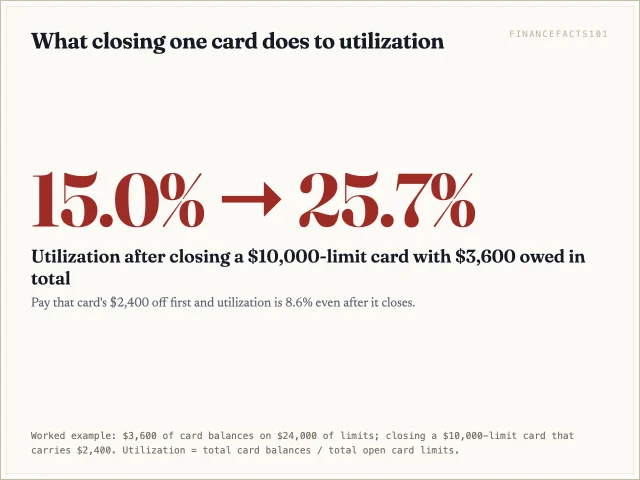
Does closing a credit card hurt your credit? It can, almost always through utilization: on $3,600 of balances across $24,000 of limits, closing a $10,000-limit card lifts the ratio from 15.0% to 25.7% (worked example, October 2026), because the card's limit leaves the calculation while your balances stay. Pay that card off first and the ratio is 8.6% even after it closes. What closing does not do is erase anything. As checked in October 2026, Equifax and Experian both say a closed account in good standing can stay on your report for up to 10 years, and a late payment stays for up to seven years whether the card is open or closed.
So the real question is rarely "does closing a credit card affect my credit score" in the abstract. It is which card, with what balance on it, and what you are about to apply for. This guide is general information built on stated assumptions, not personal advice; your own score depends on your whole report.
Does Closing a Credit Card Hurt Your Credit? The Short Answer
Closing a card touches two of the things scoring models measure and leaves the biggest one alone.
It touches amounts owed, through utilization: total card balances divided by total card limits. It can eventually touch length of credit history, but slowly, because the closed account stays on the report and, for FICO, keeps counting while it is there. It does not touch payment history: a closed card's on-time record and any late payment on it both stay.
The Consumer Financial Protection Bureau's own answer to whether closing a card hurts your credit (last reviewed December 31, 2024) is careful in both directions. Closing can make sense, it says, for a card with an annual fee or poor terms, or one that makes debt harder to avoid, but you should not assume closing will raise your score, and it can lower it. The reason it gives is utilization: less available credit means a higher share of it in use.
Who This Is For, and Who It Isn't
This guide is for someone with two or more credit cards who wants to close one: an annual-fee card that no longer earns its keep, an old card in a drawer, a card shared with an ex, or a card that keeps getting used when it shouldn't. It assumes you pay on time and want to know what the closure costs your score and how to keep that cost small.
It is not for someone carrying balances they cannot pay down. The order in which to clear several cards is debt avalanche vs snowball, and moving a balance to a 0% card or a loan is balance transfer vs personal loan. If the minimums are already more than you can pay, the credit card payoff guide covers nonprofit credit counseling, where the cards are usually closed as part of a debt management plan; that closure is a cost worth paying.
What FICO and VantageScore Say They Weigh
The two scoring companies publish their category weights, and both describe them as averages rather than a formula you can apply to yourself.
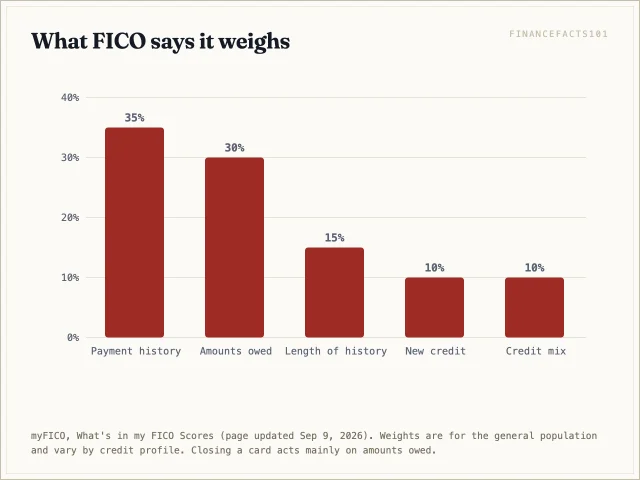
myFICO's page on how FICO Scores are calculated (updated September 9, 2026) gives payment history 35%, amounts owed 30%, length of credit history 15%, new credit 10% and credit mix 10%. It adds that these weights "are for the general population and may be different for different credit profiles." Closing a card works mostly on the 30% bucket, partly on the 15% one, and not at all on the 35% one.
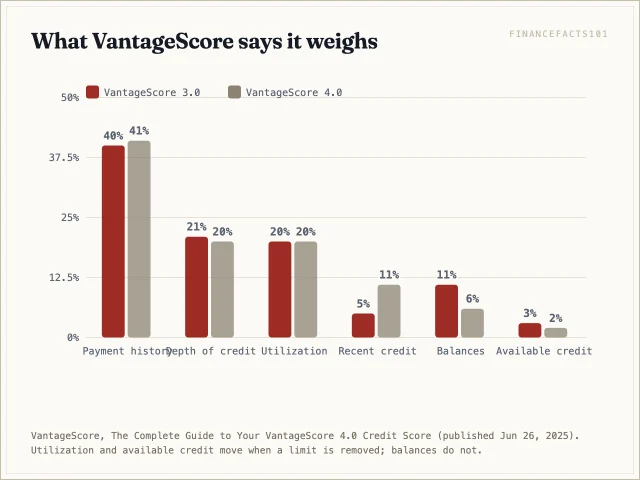
VantageScore's guide to its 4.0 model (published June 26, 2025) lists payment history 41%, depth of credit 20%, credit utilization 20%, recent credit 11%, balances 6% and available credit 2%, against 40%, 21%, 20%, 5%, 11% and 3% in VantageScore 3.0. Two of those six categories, utilization and available credit (22% of the 4.0 weights), move as soon as a limit disappears; balances, the total owed, do not. "Depth of credit," in VantageScore's words, covers "your average, oldest, and youngest account age" along with the mix of revolving and installment accounts.
The Worked Example: Three Cards, $3,600 Owed
Maya has three cards on her report in November 2026. All three are in good standing today, though Card C had one 30-day late payment, for its March 2025 due date.
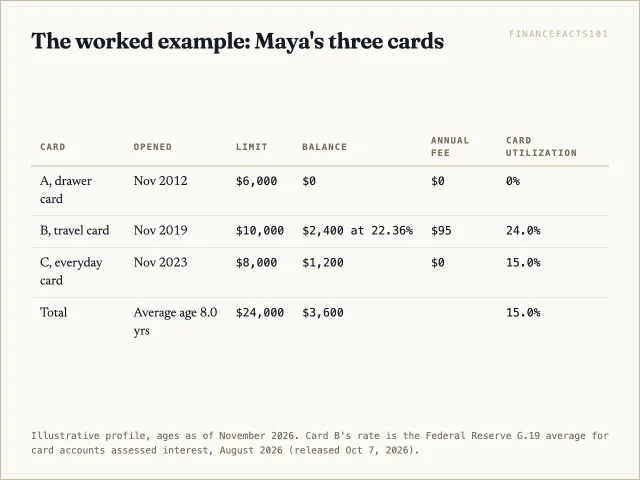
Card A is a no-fee card from 2012 that lives in a drawer. Card B is a 2019 travel card with a $95 annual fee whose benefits she no longer uses; it is the one she wants to close. Card C is her everyday card. Her balances total $3,600 against $24,000 of limits: 15.0% utilization. The cards are 14, 7 and 3 years old, an average of 8.0 years. The interest rate on Card B is 22.36%, the Federal Reserve's average for card accounts charged interest in August 2026, from the G.19 release of October 7, 2026. Every number below comes from a script that holds those inputs in one place, and the payoff figures use the same monthly method as the credit card payoff calculator.
Utilization: How Closing Changes the Ratio
Here is Maya's ratio under each choice she is weighing.
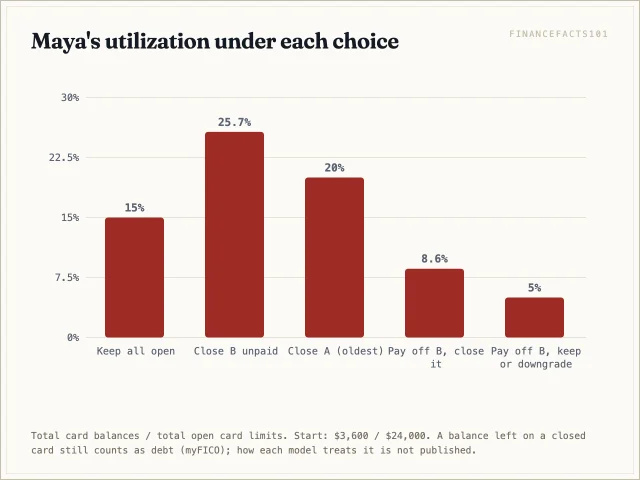
Closing Card B today, with its $2,400 still owed, takes her to $3,600 of balances against $14,000 of open limits: 25.7%. The debt does not leave with the card. myFICO's answer on closing a card says "FICO Scores still consider payment history and balances on accounts with a closed status." Exactly how each model handles a balance on a closed card is not published, so treat 25.7% as the ratio a lender would see on her open cards, not as a precise model input.
Paying Card B to zero and then closing it gives $1,200 against $14,000: 8.6%. That is lower than where she started. Paying it off and keeping it open, or downgrading it with the same limit, gives $1,200 against $24,000: 5.0%. Closing the old drawer card instead, Card A, leaves all the debt and removes $6,000 of limit: 20.0%.
The break-even is simple. To close Card B without her overall ratio rising above today's 15.0%, Maya's remaining balances need to be $2,100 or less. Paying B off gets her to $1,200, well inside that.
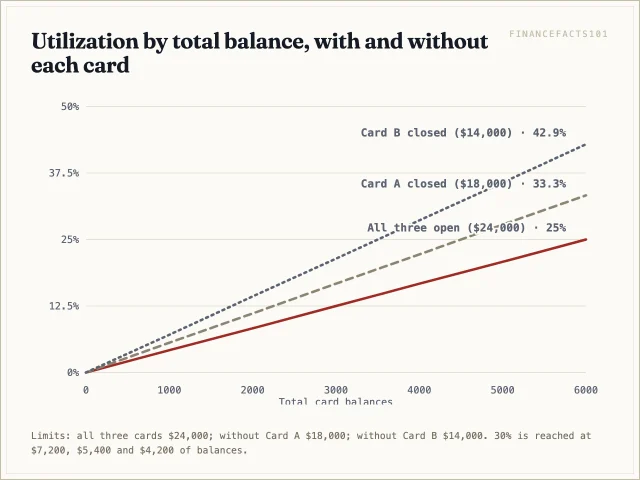
With all three cards open, Maya's ratio reaches 30% only at $7,200 of balances; with Card B closed, at $4,200. Someone who runs $5,000 through their cards each month feels a closure far more than someone who runs $500. myFICO's own example: $2,000 owed on $6,500 of limits, which its page rounds to 30%, becomes 57% when an unused $3,000 card is closed.
Two details help. First, the ratio uses the balance your issuer reports, which myFICO's guide to closing a card (June 12, 2023) notes is typically the balance on your statement closing date, so paying before the statement closes lowers it even if you pay in full every month. Second, lower is better only up to a point: myFICO's page on amounts owed says that in some cases a low ratio helps more than "not using any of your available credit at all," and VantageScore's guide advises staying under 30% "as long as it remains above 0%." There is more on how the ratio works in the entry on your credit card balance and your credit score.
Length of History: Closed Accounts Stay on Your Report
The common fear is that closing your oldest card wipes out its years. It doesn't, at least not right away.
Experian's page on how long closed accounts stay on your report (updated July 30, 2026) says: "When an account is closed and it isn't past due, the account can stay in your credit report for up to 10 years." Equifax's help page on how long information stays puts it as "up to 10 years from the date it was reported by the lender to Equifax" for closed accounts reported as paid as agreed. Note the words "up to": this is each bureau's own policy, not a federal requirement, and an account can come off sooner.
While it is there, it still counts. myFICO's guide to closing a card calls the idea that a canceled card instantly drops out of your length of history a myth: "FICO Scores generally consider the age of both open and closed accounts," and the card stops helping only once it comes off the report. VantageScore's guide describes depth of credit by account age but does not say how it treats closed accounts, so this guide does not claim it.
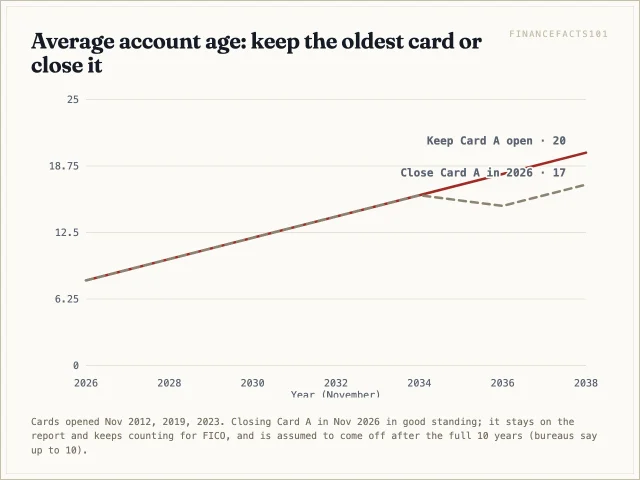
For Maya, closing Card A in November 2026 changes nothing in her age figures for as long as the bureaus keep it. If it stays the full 10 years and comes off in late 2036, her average age at that point is 15.0 years instead of 18.0, and her oldest account is 17 years old instead of 24. That is a real cost, but it arrives a decade out and is gradual compared with the immediate utilization change. Closing Card B instead would actually raise her average age once B came off, because B is younger than the average.
Does Closing a Credit Card Remove Late Payments? No
This is the most common hope behind closing a card after a bad patch, and it doesn't work.
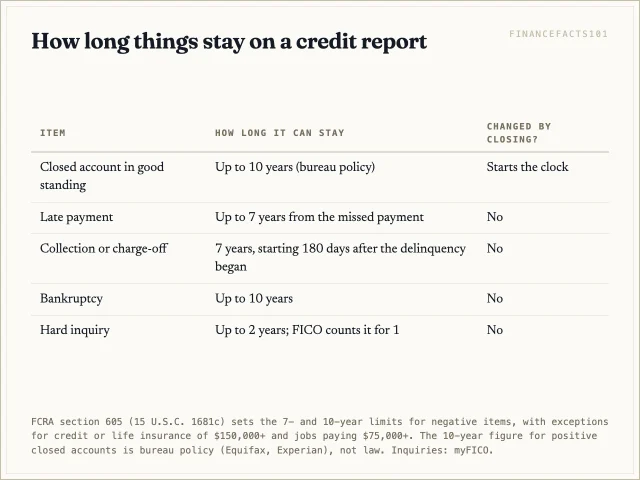
The late payment is part of the account's history, and the history stays when the account closes. Equifax says late payments remain "for up to 7 years from the original delinquency date," the date of the missed payment. Experian says an account that is past due when it is closed comes off "seven years from the initial missed payment." Maya's March 2025 late payment on Card C stays until about March 2032 whether she closes the card tomorrow or keeps it for twenty years. If she closes it, she loses the years of on-time payments that would otherwise build up after that late mark, and keeps the late mark anyway.
The federal limit is section 605 of the Fair Credit Reporting Act, 15 U.S.C. 1681c. It bars reporting "any other adverse item of information" more than seven years old; for accounts placed for collection or charged off, the seven years start 180 days after the delinquency began, and bankruptcies can stay 10 years. The limits do not apply to reports used for credit or life insurance of $150,000 or more, or a job paying $75,000 or more. The CFPB's summary of how long negative information stays (last reviewed September 2, 2026) agrees. The law sets no 10-year rule for positive accounts; that number is the bureaus' practice.
If a late payment on your report is wrong, the remedy is a dispute under the FCRA, covered in our entry on the Fair Credit Reporting Act, not a closure.
When the Issuer Closes It for You: Inactivity
Leaving a card in a drawer is not the same as keeping it open. Federal rules let the issuer close it.
Regulation Z, at 12 CFR 1026.11(b), bars closing an account "solely because the consumer does not incur a finance charge," which protects people who pay in full. But it allows closing an account "that is inactive for three or more consecutive months," meaning no purchase, cash advance or balance transfer and no balance. The CFPB says plainly that card issuers generally can close an account without notice (last reviewed September 23, 2024), and that most issuers reserve the right to close an account at any time (last reviewed August 28, 2020).
Three months is the legal floor, not a schedule; issuers set their own policies. The effect on your score is the same as closing it yourself: the limit goes, the history stays. Regulation Z at 12 CFR 1026.52(b)(2)(i)(B) does at least treat inactivity and account closure as violations with no dollar amount attached, so the issuer cannot charge a penalty fee for either.
The fix for Card A is cheap: put one small recurring bill on it, such as a streaming subscription, and set up autopay for the full statement balance. myFICO's guide recommends using an account "every once in a while" for this reason, and the CFPB suggests checking the statements of cards you keep open, so an unused account doesn't become an identity-theft blind spot.
Annual-Fee Cards: Downgrade Before You Close
Card B costs Maya $95 a year. Closing it removes the fee and $10,000 of limit. A product change, which issuers often call a downgrade, can remove the fee and keep the limit.
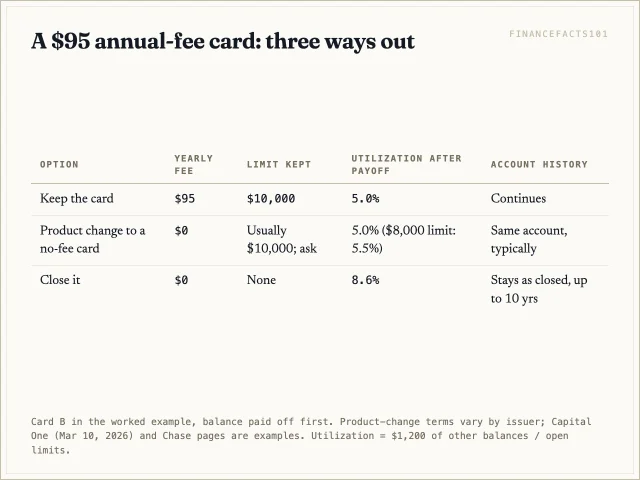
Terms differ by issuer, so take these as two examples, not an industry rule. Capital One's page on product changes (March 10, 2026) says "the card number and account number typically remain the same," that a product change "typically doesn't involve a hard inquiry," and that "a product change won't affect your credit scores if your credit limit remains the same and it doesn't trigger a hard inquiry." Chase's page on credit card downgrades says that "in some cases" the account number stays and the original card's history "continues to contribute to your credit score," and warns that a lower limit after the switch, $10,000 to $8,000 in its example, can raise utilization. For Maya, that cut would mean 16.4% before paying B off, still better than closing.
Ask before you call it done. A no-fee card in the same issuer's family is the usual target; some issuers will waive or reduce the fee instead, and myFICO's guide suggests asking. Redeem points first, since many issuers require rewards to be used before an account closes, and a downgrade may convert or forfeit them.
Timing matters too. Under 12 CFR 1026.9(e), an issuer that charges an annual renewal fee must send notice at least 30 days or one billing cycle, whichever is less, before the statement on which the fee is first charged, and the notice must say "how and when the cardholder may terminate credit availability under the account to avoid paying the renewal fee." Read that notice. It tells you the deadline for downgrading or closing without paying another year.
Pay It Off Before You Close It
Closing a card does not close the debt. The CFPB's answer on interest after closing (last reviewed January 22, 2024) says a balance left on a closed account must still be paid off on schedule, and the issuer can keep charging interest on it. The balance keeps reporting, and the limit that used to offset it is gone.
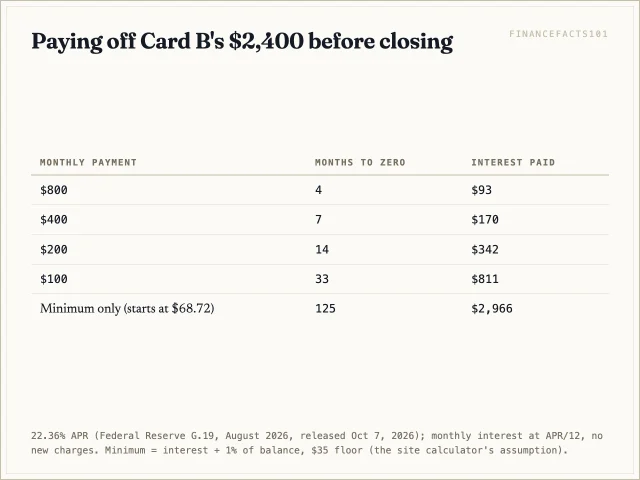
At 22.36%, Card B's $2,400 costs $44.72 of interest in the first month. Paying $200 a month clears it in 14 months with $342 of interest. Paying $400 a month clears it in 7 months with $170. Paying only a minimum of interest plus 1% (with a $35 floor, the calculator's assumption) starts at $68.72 and takes 125 months, more than ten years, at a cost of $2,966. Why the minimum path stretches so far, and how much each extra $50 buys, is covered in how long it takes to pay off a credit card.
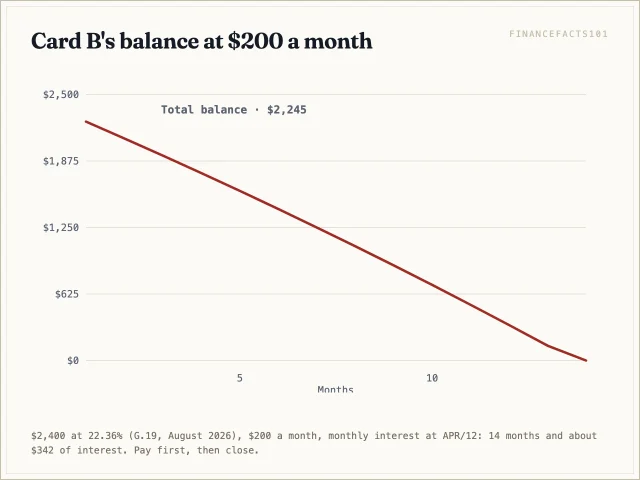
So the sequence is: pay first, close after. The exception is an annual fee about to renew with no downgrade on offer, since any payoff of 12 months or more crosses a renewal date. If Maya has no application planned for the next year, closing B now saves the next $95 at the cost of a ratio near 25.7% that falls as she pays down. If she is about to apply for a mortgage or car loan, she should pay first: the lender sees her report as it stands on the day it is pulled.
Can You Close a Credit Card You Just Opened?
Yes, and sometimes it costs nothing beyond the application. Regulation Z's official interpretation of 12 CFR 1026.5(b)(1)(iv) covers the case where you paid or agreed to a membership or application fee before receiving the account-opening disclosures: after you receive them, you may reject the plan and owe no membership fee, application fee "or any other fee or charge." The catch is in the next sentence: a consumer "who has received the disclosures and uses the account, or makes a payment on the account after receiving a billing statement, is deemed not to have rejected the plan." Activating the card is not using it; a purchase is.
You cannot undo the application. myFICO's page on credit checks and inquiries says a hard inquiry stays on the report for up to two years and affects FICO Scores for one, and that for most people one more inquiry takes "less than five points" off. The entry on hard inquiries explains how they are counted. If the issuer has already reported the account, it will show as closed. Opening and closing quickly leaves the inquiry and gives you no extra limit, so if the card has no fee, keeping it is usually better.
When Closing Is the Right Call
Closing is not a mistake when the reason is bigger than a few points. Four reasons hold up.
An annual fee with no downgrade. If the issuer offers no no-fee version and won't waive the fee, $95 a year for a card you don't use is a real cost against a utilization change you can offset by paying down balances first.
A card you keep overspending on. myFICO's answer on closing a card says that if you are tempted to charge more than you should, "getting rid of that temptation by closing some credit cards might be your best course of action." A few points of score are worth less than a balance that keeps growing.
A joint card in a divorce or separation. The CFPB's answer on joint card charges (last reviewed January 22, 2024) explains that each holder of a joint account is responsible for the full balance, whoever made the charges. Closing stops new charges, but both of you still owe what was on it. A divorce decree can assign the debt to one spouse, but the CFPB's answer on debts after a divorce (last reviewed April 14, 2023) notes that this does not stop a creditor from collecting from anyone whose name is on the account. If you were only an authorized user, you are generally not responsible for the balance and can ask to be removed. myFICO's guide notes that some issuers can open a new account in one spouse's name carrying the same "date open" as the old joint card; ask.
Poor terms you can replace. The CFPB names a card with poor terms as a reasonable candidate for closing, especially if you don't plan to apply for credit soon. Replace it before you close it, so the new limit is in place before the old one goes.
How to Close a Card With the Least Damage
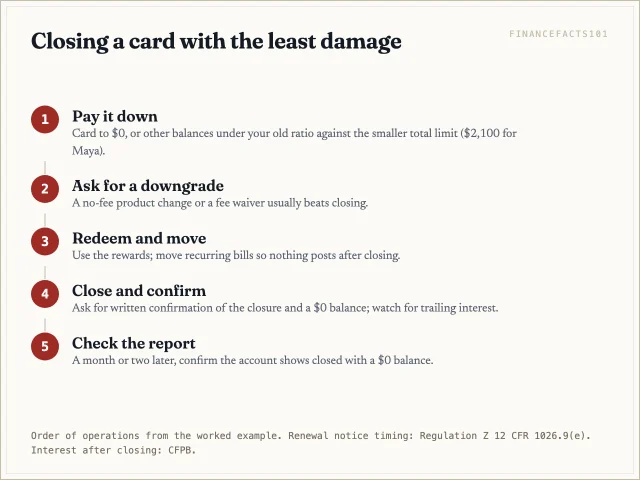
When you do close, the order of operations decides most of the cost. Get your remaining balances under your old ratio against the smaller total limit first; for Maya that ceiling is $2,100. Move recurring charges so nothing posts after closing, ask the issuer to confirm the closure and the $0 balance, and check your report a month or two later. Avoid closing several cards at once, and if you need a mortgage, car loan or refinance in the next few months, wait until after it closes.
The Decision
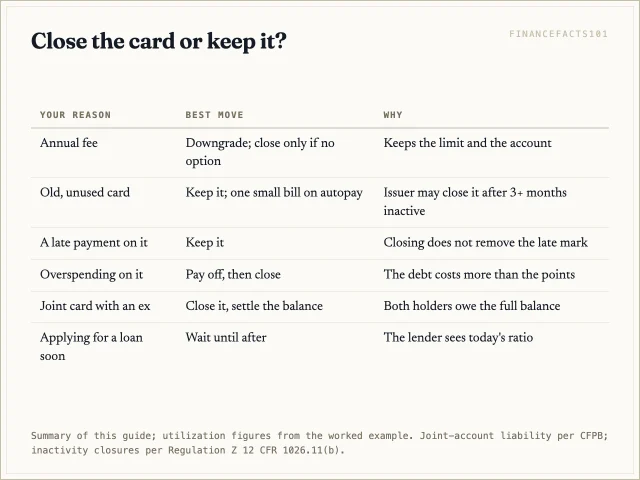
Start with why you want the card gone. An annual fee: ask for a downgrade first. A late payment: closing doesn't help, so keep the card and let on-time payments build up behind the mark. Old and unused: keep it alive with one small bill on autopay. Overspending, or a joint account with an ex: close it, because there the account itself is the risk. In every case, pay the balance off first, then close, and leave a few months before any important application.
FAQ
Does closing a credit card affect your credit score right away?
Usually only through utilization, which changes once the issuer reports the closure: from 15.0% to 25.7% in the example above. The account's age and payment history stay on the report, for up to about 10 years if it was in good standing, so any length-of-history effect comes much later.
Does closing a credit card remove late payments?
No. Late payments stay on your report for up to seven years from the missed payment whether the account is open or closed, and FICO Scores still consider payment history on closed accounts. Closing does not shorten that clock; an incorrect late payment should be disputed with the credit bureau.
Is it better to cancel an annual-fee card or downgrade it?
Downgrading is usually better if the issuer offers a no-fee version, because a product change typically keeps the same account and its history, according to Capital One's and Chase's own pages, and Capital One says it typically involves no hard inquiry. Check whether the limit changes and redeem rewards first. Close the card only if no downgrade or fee waiver is available.
Can my credit card company close my account for not using it?
Yes. Regulation Z lets an issuer close an account that has had no purchases, advances or transfers and no balance for three or more consecutive months, and the CFPB says issuers generally can close accounts without notice. A small recurring charge paid in full each month keeps the card active.
Sources
- CFPB, Does it hurt my credit to close a credit card? (last reviewed December 31, 2024)
- CFPB, How long does negative information remain on my credit report? (last reviewed September 2, 2026)
- CFPB, My card issuer closed my account without notice. Can they do that? (last reviewed September 23, 2024)
- CFPB, My card issuer told me it is closing my account. Can they do that? (last reviewed August 28, 2020)
- CFPB, Can a credit card company charge me interest after I close my account? (last reviewed January 22, 2024)
- CFPB, Am I responsible for charges on a joint credit card account? (last reviewed January 22, 2024)
- CFPB, Can a debt collector contact me about a debt after a divorce? (last reviewed April 14, 2023)
- CFPB, Regulation Z § 1026.11, Treatment of credit balances; account termination
- CFPB, Regulation Z § 1026.52, Limitations on fees
- CFPB, Regulation Z § 1026.9, Subsequent disclosure requirements: renewal notice for annual-fee cards
- CFPB, Official interpretation of Regulation Z § 1026.5: rejecting a plan after account-opening disclosures
- Fair Credit Reporting Act § 605, 15 U.S.C. 1681c, Requirements relating to information contained in consumer reports (govinfo)
- Federal Reserve, G.19 Consumer Credit, released October 7, 2026: credit card accounts assessed interest, 22.36%, August 2026 (preliminary)
- myFICO, What's in my FICO Scores? (updated September 9, 2026)
- myFICO, How owing money can impact your credit score
- myFICO, Will closing a credit card help my FICO Score?
- myFICO, How to decide whether it's time to close a credit card (June 12, 2023)
- myFICO, Credit checks and inquiries
- VantageScore, The complete guide to your VantageScore 4.0 credit score (published June 26, 2025)
- Experian, How long do closed accounts stay on your credit report? (updated July 30, 2026)
- Equifax, How long does information stay on my Equifax credit report?
- Capital One, What is a credit card product change? (March 10, 2026)
- Chase, Understanding credit card downgrades
 Next entry · No. 6,007401(k) vs IRA: Which Should You Fund First?
See also
-
 No. 5,975
09 Oct 2026
19 min
Balance Transfer vs Personal Loan: Which Clears Card Debt Cheaper
Personal Finance
-
 No. 5,942
13 Sep 2026
19 min
How Long It Takes to Pay Off a Credit Card at $8,000 and 22.15%
Personal Finance
-
 No. 829
16 Jun 2024
19 min
Understanding Credit Scores: The Key to Securing Finances and Investments
Credit & Loans
-
 No. 955
07 Jul 2024
20 min
Understanding Delinquent Account Credit Cards: Consequences and Mitigation Strategies
Personal Finance
-
 No. 815
13 Jun 2024
19 min
Understanding Your Credit Card Balance and its Impact on Your Credit Score
Personal Finance
-
 No. 3,206
09 Mar 2025
21 min
Understanding Minimum Monthly Payments on Revolving and Non-Revolving Credit Accounts: Pros, Cons, and Best Practices
Business Finance