401(k) vs IRA: Which Should You Fund First?
401(k) vs IRA: take the full match, then compare fees. A 1.47% plan costs our saver $115,687 over 30 years against a 0.05% IRA. 2026 limits inside.
Fund the 401(k) first up to the full employer match, then a health savings account if you have an HSA-eligible health plan, then an IRA up to its 2026 limit of $7,500 ($8,600 at 50 or older) if the IRA can hold cheaper or better funds than your plan, then go back to the 401(k) toward its $24,500 limit. In the 401(k) vs IRA decision, the plan's annual cost settles the IRA step: in our worked example, a saver whose plan costs 1.47% a year ends 30 years $115,687 richer by sending $4,800 a year of post-match savings to a 0.05% IRA instead, while a saver in a 0.25% plan gains only $18,615 by doing the same.
The limits are the IRS's 2026 figures from Notice 2025-67; as of October 9, 2026 the IRS had not yet announced its 2027 limits. Below: the limits, the fee arithmetic, income rules, creditor protection, early access, RMDs and the Saver's Credit. It is general information built on stated assumptions, not personal advice.
401(k) vs IRA: the funding order in one picture
A 401(k) is your employer's plan: payroll contributions, a possible match, and the plan's fund menu. An IRA is an account you open yourself, holding almost any fund the provider sells. You can have both, with separate limits, so the question is which gets each dollar first.
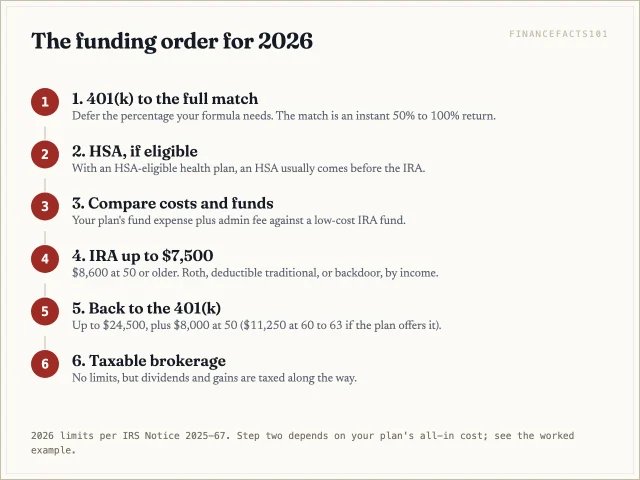
The match is an instant 50% or 100% return no fund can beat. If your health plan qualifies, an HSA usually comes next, because money spent on medical costs can skip tax on the way in and the way out; HSA vs 401(k) works that through. After that, the IRA usually wins on cost and choice, and the 401(k) wins on room: its limit is more than three times larger.
Who this is for — and who it is not for
This is for a US employee with a 401(k), 403(b) or similar plan, deciding where the next retirement dollar goes. It assumes an emergency fund and no 20% card debt; those come first.
It is not the place to decide Roth against traditional: that turns on your tax rate now and later, worked in Roth vs traditional IRA and, for plan deferrals, Roth 401(k) vs traditional 401(k). It is not for the self-employed with no employees. And if you already max both accounts, brokerage account vs Roth IRA prices the taxable account: the Roth wins for money left until 59½, and the brokerage takes the overflow and money needed sooner.
The 2026 contribution limits, side by side
Notice 2025-67 sets the numbers. The 401(k) deferral limit is $24,500, shared by pre-tax and Roth deferrals across all your 401(k) and 403(b) plans. Workers 50 and older can add $8,000. Anyone who reaches 60, 61, 62 or 63 during 2026 can add $11,250 instead, but only if the plan has adopted the higher limit; the preamble to the final regulations in Internal Revenue Bulletin 2025-40 says plans may offer it but are not required to. All additions to your account, employer money included, are capped at $72,000, not counting catch-ups.
The IRA limit is $7,500 across all your traditional and Roth IRAs combined, plus $1,100 at 50 or older, which the IRS's November 13, 2025 announcement notes is now indexed for inflation under SECURE 2.0. You need taxable compensation at least equal to what you put in, though on a joint return a working spouse's pay can fund a non-working spouse's IRA. Contributions for 2026 are allowed until the April 2027 filing deadline, not including extensions.
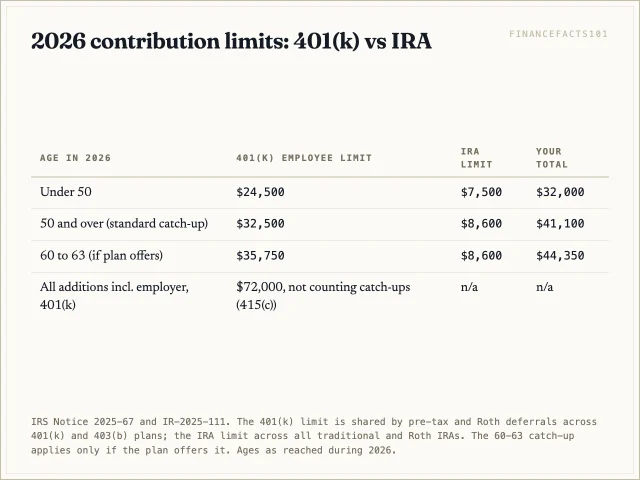
Together, a worker under 50 can shelter $32,000 of their own money in 2026, $41,100 at 50, and $44,350 at 60 to 63 if the plan offers the higher catch-up.
Step one: the employer match
Defer enough to collect every dollar of match before an IRA gets anything. On a "100% of the first 4%" formula, an $80,000 earner who defers 4% receives $3,200 a year; deferring 3% forfeits $800 a year. Formulas, vesting and the front-loading trap are worked through in the 401(k) employer match guide, so this guide starts with the next dollar.
After the match: compare fees and the fund menu
After the match, a 401(k) dollar and an IRA dollar of the same type, pre-tax or Roth, are taxed alike. What differs is the cost of holding the money and the funds on offer.
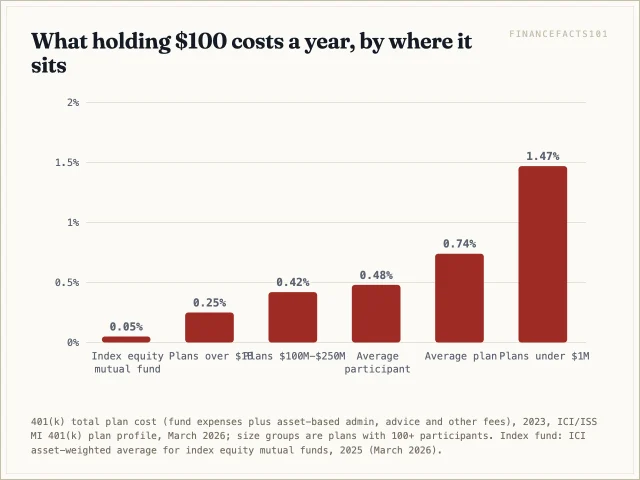
Plan costs vary widely, and you cannot shop for another plan. The ICI/ISS MI 401(k) plan profile, published March 2026 with 2023 data from Form 5500 filings, puts the average total plan cost at 0.74% of assets per plan and 0.48% for the average participant. Plan size drives it: among plans with 100 or more participants, those with less than $1 million of assets averaged 1.47%, plans of $100 million to $250 million 0.42%, and plans over $1 billion 0.25%. Total plan cost there means fund expenses plus asset-based administrative, advice and other fees. In an IRA, you choose the fund: index equity mutual funds charged an asset-weighted average of 0.05% in 2025, per ICI's fund expense study of March 2026.
The Department of Labor makes the same point in A Look at 401(k) Plan Fees: $25,000 left for 35 years at 7% grows to $227,000 if fees take 0.5% a year, and to $163,000 if they take 1.5%. One point of fees, 28% less money.
You do not have to guess your own plan's number. Under 29 CFR 2550.404a-5, the plan must give you each fund's expense ratio at least annually and, at least quarterly, a statement of the dollar fees actually charged to your account. Add the expense ratio of the fund you would hold to the administrative fee on that statement, expressed as a percentage of your balance, and you have the number to compare.
The menu matters too. A plan with a cheap broad index fund can match an IRA; one offering only actively managed funds near 1% cannot.
Worked example: two savers, two plans, 30 years
Every assumption, named. Two savers, both 35, each earning $80,000 and saving 10% of pay, $8,000 a year, for 30 years. Each employer matches 100% of the first 4% of pay, $3,200 a year. Investments return 7% a year before costs, compounded monthly, with costs deducted monthly; contributions are level and monthly. Saver A's plan costs 0.25% a year, the ICI average for plans over $1 billion. Saver B's costs 1.47%, the average for plans under $1 million. The IRA holds an index fund at 0.05% with no account fee.
Each saver compares two paths. "All in the 401(k)" sends the full $8,000 through payroll. "Match, then IRA" defers $3,200 to collect the match and puts the other $4,800 in a traditional IRA.
Tax drops out. Each saver is single and covered by the plan; with $3,200 deferred, modified AGI is $76,800, below the $81,000 where the IRA deduction starts to phase out, so the $4,800 is fully deductible. Either way $8,000 comes off taxable income, taking it from $63,900 to $55,900 after the $16,100 standard deduction and saving $1,760 of 2026 federal tax, all at 22%. Withdrawals are taxed alike too.
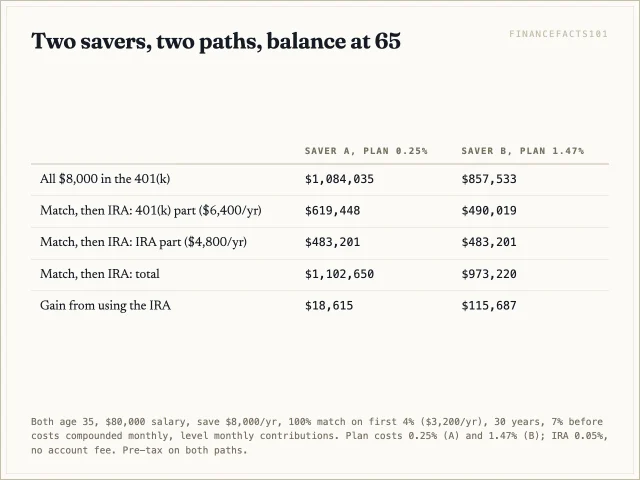
For Saver A the split adds $18,615, about 1.7%. For Saver B it adds $115,687, or 13.5% on top of $857,533. Same pay, same savings, same match. The only difference is what the plan charges on the money that did not need to be there.
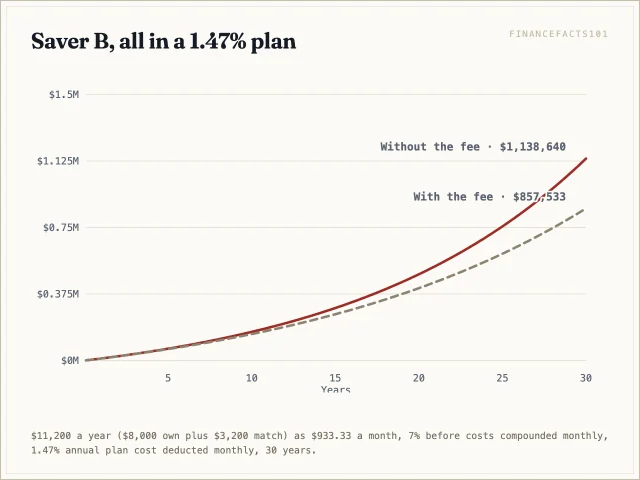
The chart above prices Saver B's all-in path: $11,200 a year at 7% grows to $1,138,640 with no costs, and $857,533 at 1.47%, a gap of $281,107, or 24.7% of the no-cost balance. The 401(k) calculator has no fee input, so enter the return net of your plan's cost: at 5.53% it shows about $836,000 for Saver B, a little lower than $857,533 because it compounds on a slightly different basis.
How large does the fee gap have to be before the IRA is worth the extra account? Here is the post-match $4,800 slice alone, against a 0.05% IRA:
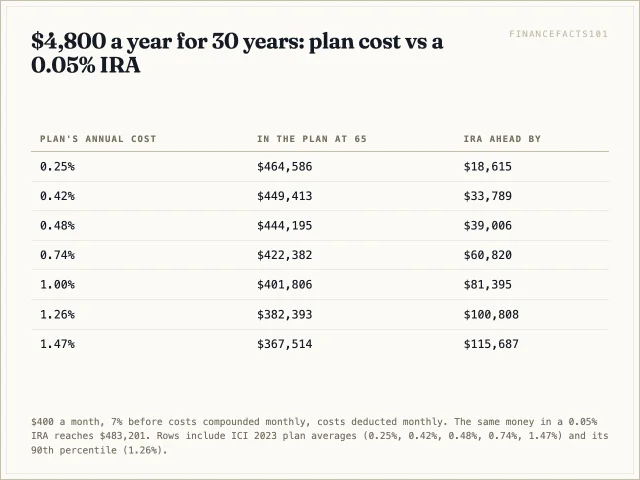
Tenure changes the answer, because a high-cost plan only charges while you stay. If Saver B leaves after five years, rolls the plan balance into a 0.05% IRA and keeps saving at that cost, the five expensive years cost the $4,800 slice $5,805 by 65. After ten years in the plan the cost is $20,544. The full $115,687 is the price of staying 30 years.
Who can deduct a traditional IRA, and who can use a Roth IRA
Anyone with compensation can put money in a traditional IRA. Being covered by a workplace plan limits only the deduction, and coverage is shown by the "Retirement plan" box on your W-2, per Publication 590-A. Roth IRA contributions phase out by income whether or not you have a plan. For 2026:
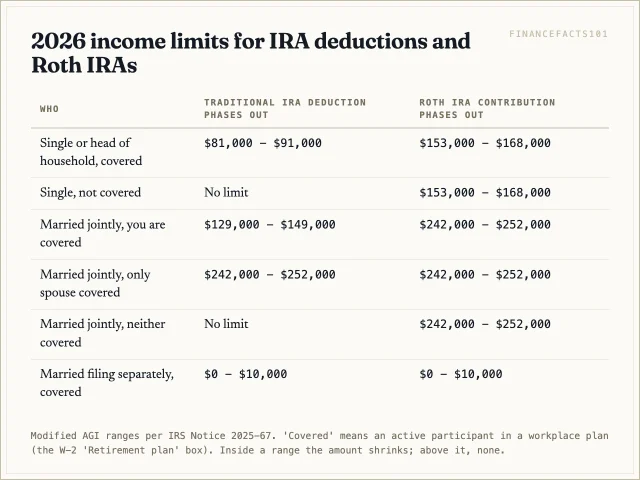
A lost deduction changes the order. A nondeductible traditional IRA defers tax only on growth and leaves basis to track on Form 8606, usually worse than a pre-tax 401(k) dollar unless it is step one of a backdoor Roth, covered in the backdoor Roth IRA guide; that works cleanly only with no pre-tax IRA money on December 31. Between the deduction range and the Roth range, the Roth IRA is the one you can still use in full. Pre-tax 401(k) deferrals lower modified AGI, so they can pull you back under either limit.
Catch-ups at 50 and 60 to 63, and the Roth rule for high earners
From 2026, catch-ups in a 401(k) come with a condition for higher earners. Under section 414(v)(7), if your 2025 Social Security wages from the employer sponsoring the plan exceeded $150,000, your 2026 catch-up contributions to that plan must be designated Roth; the regular $24,500 stays pre-tax, Roth or any mix. The final regulations announced September 15, 2025 apply generally from 2027, the IRS's administrative transition period generally ended December 31, 2025, and plans follow a "reasonable, good faith interpretation" of the statute in between. A plan with no Roth option may instead bar those workers' catch-ups. The details are in Roth 401(k) vs traditional 401(k).
The rule does not reach IRAs. The $1,100 IRA catch-up can go to a traditional or Roth IRA at any income, subject only to the deduction and Roth limits above. A single high earner covered by a plan cannot deduct a traditional IRA anyway, and most married ones can deduct little or none, so for pre-tax savings at 50 or later the 401(k)'s regular $24,500 is the place.
When the IRA is full: back to the 401(k), then a brokerage account
Once the IRA is full, return to the 401(k). Even Saver B's 1.47% plan shelters growth from yearly tax, and a pre-tax deferral cuts this year's tax at your top rate. Most of a high saver's money ends up here, so choose the cheapest broad fund on the menu.
Only then does a taxable brokerage account enter. It has no limits or withdrawal rules, but pays tax on dividends every year and on gains when you sell. Brokerage account vs Roth IRA prices that drag.
Creditor protection: ERISA vs IRA
An ERISA-covered 401(k) is shielded from most creditors in and out of bankruptcy by its anti-alienation rule, while traditional and Roth IRA contributions are protected in bankruptcy only up to $1,711,975 for cases filed from April 1, 2025, with money rolled over from an employer plan outside that cap under 11 U.S.C. 522(n), and outside bankruptcy only as far as state law allows. The exceptions, such as divorce orders and IRS levies, and what this means for a rollover are covered in 401(k) rollover or leave it.
Getting money out early: rule of 55, loans and Roth contributions
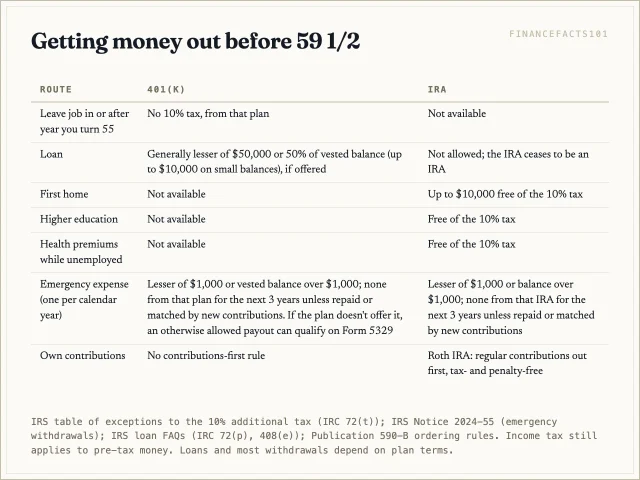
Before 59½, withdrawals from either account generally owe a 10% additional tax on top of income tax, but the exceptions differ. The IRS's table of exceptions lists which apply where.
The 401(k)'s big one is the rule of 55: leave your job during or after the year you turn 55 (50 for qualified public safety workers) and withdrawals from that employer's plan escape the 10% tax. IRAs have no such exception, so rolling that plan into an IRA at 56 gives it up until 59½.
The 401(k) can also lend. If the plan offers loans, you can generally borrow the lesser of $50,000 or 50% of your vested balance (plans may allow up to $10,000 on smaller balances), per the IRS loan FAQs. An IRA cannot: "If the owner of an IRA borrows from the IRA, the IRA is no longer an IRA," and its whole value becomes income.
The IRA's advantages: penalty-free withdrawals for up to $10,000 toward a first home, for higher education, and for health premiums while unemployed, none of which a 401(k) offers. Both allow one emergency withdrawal per calendar year, up to the lesser of $1,000 or the balance above $1,000, free of the 10% tax. Under Notice 2024-55, no further one can come from the same plan or IRA in the next 3 calendar years unless the first is repaid or matched by new contributions, and if your plan does not offer it, a payout the plan otherwise allows can still be treated as one on Form 5329. A Roth IRA goes further: under Publication 590-B ordering rules, your regular contributions come out first, free of tax and penalty at any age.
RMDs, and what changes when you leave a job
Required minimum distributions start at 73, or at 75 for anyone who reaches 74 after 2032 under 26 U.S.C. 401(a)(9)(C)(v), and the accounts differ for anyone still working. The IRS RMD FAQs say participants in a workplace plan "can delay taking their RMDs until the year they retire, unless they're a 5% owner," while traditional IRA owners must start on time whether or not they still work. IRA RMDs can be totalled and taken from any one IRA; 401(k) RMDs must come out of each plan separately. Roth IRAs and, since 2024, Roth 401(k)s have no RMDs during the owner's life.
When you change jobs, rolling the old plan into an IRA buys the IRA's menu and fees but gives up the rule of 55, loan access and ERISA's protection outside bankruptcy, and a pre-tax IRA balance spoils a later backdoor Roth. 401(k) rollover or leave it weighs those trade-offs.
The Saver's Credit in 2026, and the Saver's Match from 2027
Lower earners get a credit for contributing to either account, so it does not tip the choice. For 2026 the credit is 50%, 20% or 10% of up to $2,000 of contributions ($4,000 for a married couple), so at most $1,000 per person. The AGI tiers come from Notice 2025-67, and the IRS Saver's Credit page sets the rules: you must be 18 or older, not a dependent and not a student, rollovers do not count, and recent withdrawals reduce the eligible amount.
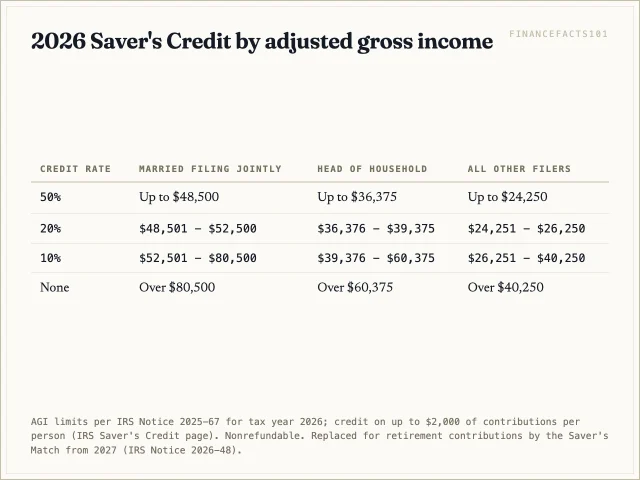
The credit cannot exceed your income tax. Pre-tax contributions help twice: they also lower AGI, which can move you into a higher tier.
From tax year 2027, the credit is replaced for retirement contributions by the Saver's Match. Under IRS Notice 2026-48, the Treasury will deposit up to 50% of the first $2,000 of contributions into a retirement account, even for someone who owes no income tax, and eligibility for 2027 ends at modified AGI of $35,500 single and $71,000 joint. The Treasury pays it directly only into pre-tax accounts, the non-Roth part of a plan or a traditional IRA, and the process for IRAs is still under development.
The decision, step by step
- Collect the full match.
- Fund an HSA if your health plan qualifies.
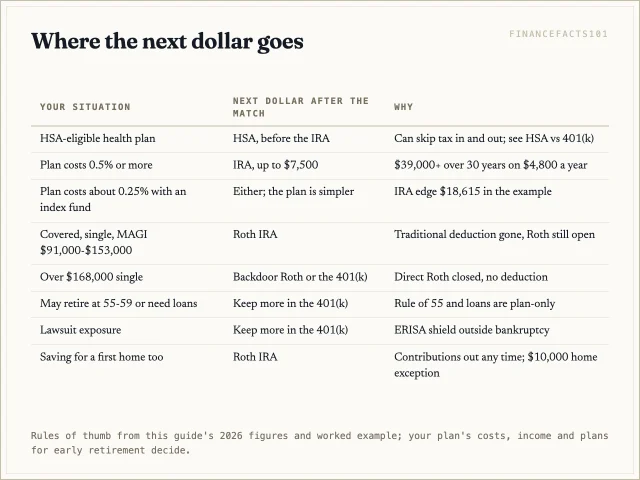
- Find your plan's all-in cost. Fund expense ratio plus the admin fee on your quarterly statement. At about 0.25% with a broad index fund available, the IRA's edge is small, $18,615 over 30 years in the example, and keeping everything in the plan is a reasonable simplification.
- If the plan costs more, fund an IRA next. Roth or deductible traditional by the rules in Roth vs traditional IRA; the backdoor above the Roth range.
- Return to the 401(k) toward $24,500, in its cheapest broad fund.
- Weigh the non-fee differences. Early retirement at 55 to 59, loans or lawsuit exposure favor the 401(k); the first-home and education exceptions, or Roth contributions you can withdraw any time, favor the IRA.
- Then, and only then, a taxable account.
FAQ
Is a 401(k) or an IRA better?
Neither always. The 401(k) wins on the match, room above $7,500, creditor protection, loans and the rule of 55. The IRA usually wins on cost and fund choice. Most savers should use both, in the order above.
Can I contribute to a 401(k) and an IRA in the same year?
Yes. The limits are separate: $24,500 in the 401(k) and $7,500 in IRAs for 2026, plus catch-ups. Being covered by the 401(k) can reduce or remove your traditional IRA deduction from $81,000 of modified AGI for single filers, but it never stops you from contributing, and it does not affect Roth IRA eligibility.
Is a 401(k) safer from creditors than an IRA?
Generally, yes. An ERISA 401(k) is shielded from most creditors in and out of bankruptcy. An IRA is protected in bankruptcy up to $1,711,975 of contributory money, with rollovers from employer plans exempt without that cap, but outside bankruptcy its protection depends on state law.
Should I roll my old 401(k) into an IRA?
Often, for the menu and cost, but not automatically: you give up the rule of 55, loans and ERISA's shield outside bankruptcy, and a pre-tax IRA complicates a backdoor Roth. A good new-employer plan keeps those features; 401(k) rollover or leave it works through the choice.
Sources
- IRS, Notice 2025-67: 2026 amounts relating to retirement plans and IRAs — $24,500, $8,000, $11,250, $72,000, $7,500, $1,100, IRA deduction and Roth IRA phase-outs, Saver's Credit tiers, the $150,000 Roth catch-up wage threshold
- IRS, 401(k) limit increases to $24,500 for 2026, IRA limit increases to $7,500 (IR-2025-111)
- IRS, Internal Revenue Bulletin 2025-40 (T.D. 10033) — the 60–63 catch-up is optional for plans; applicability dates
- IRS, Final regulations on the Roth catch-up rule (IR-2025-91)
- IRS, Publication 590-A — IRA contributions, the W-2 "Retirement plan" box, deadlines
- IRS, Publication 590-B — Roth IRA ordering rules
- IRS, Retirement topics: exceptions to tax on early distributions
- IRS, Retirement plans FAQs regarding loans
- IRS, Notice 2024-55: emergency personal expense distributions — one a year up to $1,000, the 3-year bar, Form 5329 when the plan does not offer it
- U.S. Code via GovInfo, 26 U.S.C. 401(a)(9)(C)(v) — RMD applicable age 73 or 75
- IRS, Retirement plan and IRA required minimum distributions FAQs
- IRS, Retirement Savings Contributions Credit (Saver's Credit)
- IRS, Notice 2026-48: Saver's Match contributions
- U.S. Code via GovInfo, 29 U.S.C. 1056(d) — ERISA anti-alienation rule and its exceptions
- U.S. Code via GovInfo, 11 U.S.C. 522 — retirement-fund exemptions and the 522(n) IRA cap
- Judicial Conference of the United States, Adjustment of certain dollar amounts applicable to bankruptcy cases, 90 FR 8941 (February 4, 2025) — $1,711,975 from April 1, 2025
- eCFR, 29 CFR 2550.404a-5 — participant fee disclosures
- U.S. Department of Labor, A Look at 401(k) Plan Fees
- Investment Company Institute, The ICI/ISS MI Defined Contribution Plan Profile: A Close Look at 401(k) Plans, 2023 (March 2026) — total plan cost by plan size
- Investment Company Institute, Trends in the Expenses and Fees of Funds, 2025 (March 2026) — index equity mutual funds 0.05%
 Next entry · No. 6,008Does Closing a Credit Card Hurt Your Credit?
See also
-
 No. 5,979
13 Oct 2026
17 min
Roth 401(k) vs Traditional 401(k): Which Should You Choose?
Retirement
-
 No. 5,987
21 Oct 2026
19 min
Should I Do a Backdoor Roth IRA? How to Avoid the Pro-Rata Tax
Retirement
-
 No. 5,982
16 Oct 2026
16 min
HSA vs 401(k): Where Should Your Next Dollar Go?
Retirement
-
 No. 5,969
03 Oct 2026
19 min
Should I Do a Roth Conversion in 2026? How Much to Convert
Retirement
-
 No. 5,941
12 Sep 2026
16 min
401(k) Employer Match: How Much of Your Salary to Defer
Retirement
-
 No. 948
06 Jul 2024
19 min
Understanding Defined Contribution Plans: Types, Advantages, Limitations and Examples
Personal Finance