Islamic Banking: What It Is and How Shariah-Compliant Banking Works
Islamic banking follows Shariah: no interest, no gambling-like risk, no banned industries. Its assets reached $3.05 trillion in 2025. How the products work.
Islamic banking is banking that follows Shariah, the body of Islamic law. Its core rule is that a bank may not charge or pay interest (riba). It must also avoid excessive uncertainty (gharar), gambling-like bets (maysir), and financing for businesses Islam prohibits, such as alcohol, pork and gambling. Instead of lending money at interest, an Islamic bank buys and resells assets, leases them, or goes into partnership with its customer, and earns a profit, rent or share of returns tied to a real asset.
It is no longer a niche. Islamic banks held about $3.05 trillion of assets in 2025, part of a $4.4 trillion Islamic finance industry, according to the Islamic Financial Services Board's 2026 stability report. This page explains what Shariah banking is, the principles behind it, the main Sharia-compliant banking products, how an Islamic home purchase works with real numbers, how it compares with conventional banking, and how it works in the United States.
What Is Shariah Banking?
Shariah banking, also called Islamic banking or Sharia-compliant banking, offers the same basic services as any bank: accounts to hold money, ways to save, and financing for homes, cars, businesses and trade. What changes is the legal form of each contract. A conventional bank lends $100 and asks for $107 back. An Islamic bank cannot, because a guaranteed return on money lent is riba. So it restructures the deal around an asset or a shared venture:
- To finance a car, the bank buys the car and sells it to you at a disclosed markup, payable in installments.
- To finance a home, the bank may buy it and lease it to you, or buy it jointly with you and sell you its share bit by bit.
- To pay savers, the bank may invest their money and share the actual profits, rather than promise a fixed rate.
People sometimes describe it as "banking in the name of faith," and religious compliance is the reason it exists. But customers do not have to be Muslim; nothing in the product rules limits who can open an account or apply for financing. Compliance is checked by a Shariah supervisory board, a panel of scholars that approves each product. Many institutions also follow standards from the Accounting and Auditing Organization for Islamic Financial Institutions (AAOIFI), based in Bahrain, and prudential guidance from the IFSB in Kuala Lumpur.
The Shariah Principles Behind Islamic Banking and Financing
The Shariah principles of Islamic banking and financing come down to a short list. An IMF overview of Islamic finance groups them under three principles, including equity and participation, and they apply to every contract a bank writes.
No riba. Riba covers any predetermined increase on a loan of money. The IMF paper describes it as "an increase in wealth that is not related to engaging in a productive activity." The one true loan in Islamic banking is qard hasan, a benevolent loan repaid with no increase.
No gharar. Contracts must be clear about the price, the asset and what each side delivers. Excessive ambiguity voids a contract. In many scholars' view this rules out most conventional derivatives and conventional insurance.
No maysir. Outcomes that depend on pure chance, such as gambling or speculation detached from real assets, are barred.
Asset-backing and risk-sharing. Profit has to come from bearing some real risk: owning an asset, trading goods or sharing in a venture. That is why the bank takes title to a house, even briefly, before selling or leasing it to you.
Halal activities only. The IMF paper lists activities prohibited on moral grounds, including tobacco and other drugs, alcohol, pork products, gambling, speculation, pornography, and armaments. An Islamic bank cannot finance those businesses or invest in them.
In practice these rules push Islamic finance toward trade, leasing and partnership, and away from pure money-for-money lending. They also make Islamic banking a close cousin of ethical investing, which screens out certain industries for different reasons.
Sharia-Compliant Banking Products
Each Sharia-compliant banking product maps to a classical contract. The table below covers the ones you will meet most often.
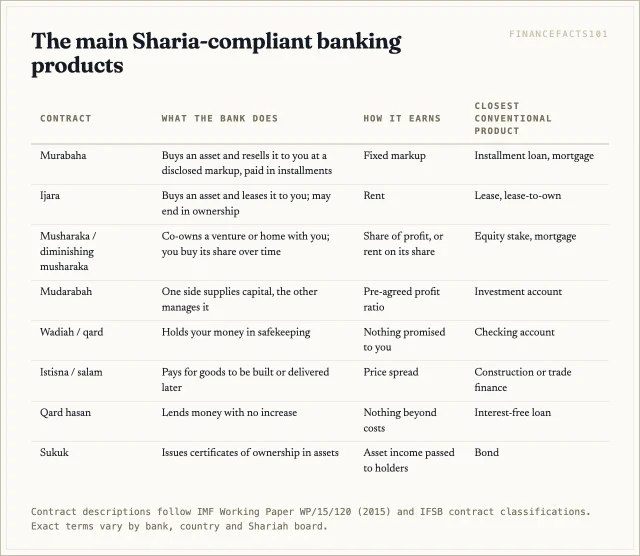
On the deposit side, current accounts usually run as wadiah (safekeeping) or qard accounts: your money is guaranteed but earns no promised return. Savings and term accounts often run as mudarabah investment accounts. You provide capital, the bank manages it, and profits are split by a pre-agreed ratio. In a true mudarabah, a loss on the investments reduces what you get back. Many banks also offer term deposits structured as commodity murabaha or wakalah (agency), which pay an expected profit rate much like a conventional term deposit.
On the financing side, the IMF paper splits products into profit-and-loss sharing contracts (musharakah and mudarabah), sale- and lease-based contracts (murabaha, ijara, istisna, salam), and fee-based services. The IMF calls profit-and-loss sharing "closest to the spirit of Islamic finance," but it is not what banks mostly sell. The IFSB's 2026 report notes that murabaha and commodity murabaha "account for significant portion of financing contracts globally."
Beyond banking, sukuk are the Islamic counterpart to bonds: certificates that represent ownership in underlying assets or a venture, paying investors from the asset's income. Takaful is Islamic insurance, organized as a mutual pool of members' contributions, closer to a mutual company than to a shareholder-owned insurer.
How an Islamic Home Purchase Works: A Worked Example
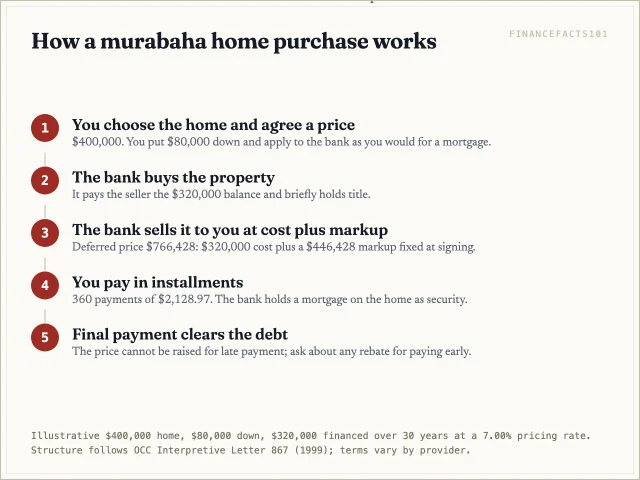
In the US, retail Islamic finance has mostly meant home financing. Take a $400,000 home with a 20% down payment of $80,000, leaving $320,000 to finance over 30 years. For comparison, assume a pricing rate of 7.00%, close to the 7.03% average 30-year fixed conventional rate in Freddie Mac's Primary Mortgage Market Survey for the week of September 24, 2026. Rates at any provider, Islamic or not, will differ.
Here is how a murabaha version runs, step by step:
And here is how the three structures compare on the same house:
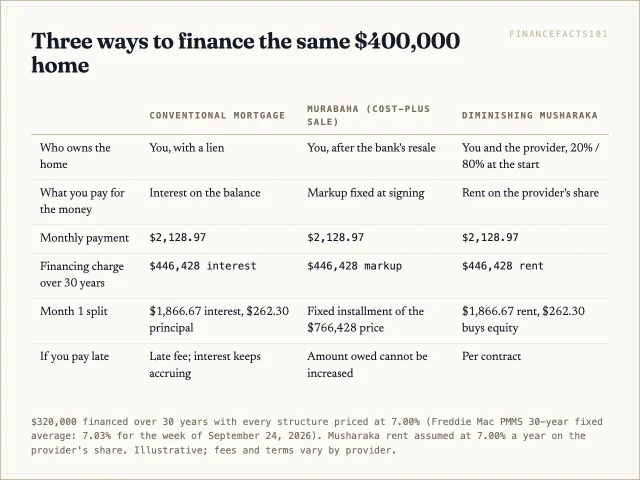
The monthly payment is $2,128.97 in all three, because each is priced at the same 7.00%. That assumption is realistic. The IMF paper notes that "the expected return on murâbaḥah is usually aligned with interest payments on conventional loans," and the OCC letter approving a US murabaha product said the bank would set its profit by adding a margin to its cost of funds, in most cases based on LIBOR.
The differences are in the legal form and who bears which risk:
- Murabaha. The bank sells you the house for $766,428, paid over 360 months. The $446,428 markup is fixed at signing. According to the IMF paper, the amount financed cannot be increased if you pay late or default, and no penalty can be imposed unless you deliberately refuse to pay. Because the price is fixed, paying off early does not automatically cut the markup; ask whether the provider gives an early-settlement rebate before you sign.
- Diminishing musharaka (co-ownership). You and the provider buy the house together, 20% and 80%. Each month you pay rent on the provider's share and buy a little more of it. With rent set at 7.00% a year on the provider's share, in month one $1,866.67 is rent on the $320,000 share and $262.30 buys equity. After five years you own about 24.7% of the house. Your ownership share climbs slowly at first, just as a conventional loan balance falls slowly at first.
- Ijara (lease-to-own). The provider holds title and leases the home to you, and ownership passes to you once the final payment is made.
The takeaway: an Islamic home financing contract changes the relationship from lender and borrower to seller and buyer, or co-owners. It does not usually make the house cheaper. Compare the total cost and fees of any offer the way you would a mortgage, and use the site's guide to how much house you can afford with the monthly payment it quotes.
Islamic Banking vs Conventional Banking
The differences between Islamic and conventional banking are real, but they are narrower in practice than the theory suggests.
Where they differ. An Islamic bank cannot earn interest, so every financing must be tied to a sale, lease or partnership. It cannot finance prohibited industries. It cannot increase a debt as a penalty for late payment. Its savers may, in a true profit-sharing account, bear investment losses. A conventional bank, by contrast, promises depositors a fixed return and charges borrowers interest that grows over time, the same compounding that works for savers and against borrowers.
Where they converge. The IMF paper found that similarities "arise from the close alignment of the competitive rates paid by Islamic banks on investment deposits with deposit rates at conventional banks, as well as with the benchmarking of Islamic financing rates on the asset-side of the balance sheet to the LIBOR." The IFSB's 2026 report adds that "debt-based remunerative deposits constitute the dominant share of Islamic banks' funding composition." Most Islamic bank balance sheets are built on markup sales and deposits with expected returns, not on profit-and-loss partnerships. LIBOR was retired in 2023, and newer contracts reference its replacements, such as SOFR in the US.
Critics inside and outside the industry call this "form over substance." Supporters answer that the form matters: the bank really does own the asset for a period, carries the risk that goes with ownership, and cannot profit from a borrower's distress through penalty interest.
Islamic Windows vs Full-Fledged Islamic Banks
There are two ways to deliver Islamic banking.
A full-fledged Islamic bank operates entirely under Shariah. Its whole balance sheet, every deposit and financing, must comply, and its Shariah board oversees the entire institution. Dubai Islamic Bank and Kuwait Finance House are long-running examples.
An Islamic window is a unit inside a conventional bank that offers Shariah-compliant products alongside the bank's regular business. The IMF paper notes that large banks such as Citibank and HSBC have operated Islamic banking windows. The window's funds should be kept separate from the conventional side so that depositors' money is not used for interest-based lending. Windows let a conventional bank serve Muslim customers without a separate license, but some customers and scholars prefer a full-fledged bank because the separation depends on the bank's internal controls.
Islamic Banking in the United States
The US has no separate Islamic banking law. Shariah-compliant products are offered under ordinary banking rules, and regulators judge them by their economic substance. The Office of the Comptroller of the Currency approved a residential lease-to-own (ijara) product in Interpretive Letter 806 on October 17, 1997, and murabaha financing in Interpretive Letter 867, dated June 1, 1999. The OCC concluded that the murabaha transactions were "functionally equivalent to either a real estate mortgage transaction or an inventory or equipment loan agreement," and so permissible for national banks.
Some structures fit less easily. In a 2005 speech, the New York Fed's general counsel, Thomas Baxter, noted that US commercial banks are generally restricted from entering partnerships or taking equity stakes, which makes musharakah and mudarabah hard to offer. He described a profit-and-loss sharing deposit that its developer redesigned so the bank guaranteed the principal, after, by the developer's account, the FDIC was not prepared to accept a deposit that could lose value. For you, that means a US deposit account marketed as Islamic, held at an FDIC-insured bank, is insured like any other deposit: the FDIC says deposits are "automatically insured to at least $250,000 at each FDIC-insured bank." The site's guide to deposit accounts covers how that coverage works across account types.
Several US Islamic home financing providers are specialist companies rather than banks. One of the largest, Guidance Residential, says it has helped more than 40,000 families through a co-ownership model, and that it sells part or all of its ownership stake to Freddie Mac. On the investment side, SEC-registered funds such as the Amana Mutual Funds Trust state that Islamic principles require investors to "share in profit and loss," receive "no usury or interest," and avoid prohibited businesses, and they screen out interest-based banks, alcohol, gambling and similar industries.
Shares, Stocks and Share Premium in Islamic Finance
Owning shares is permitted in Islamic finance, because a shareholder owns part of a real business and shares its profits and losses. That is the equity participation Islamic finance prefers to lending.
The question "does Islamic banking support share premium" has a direct answer in AAOIFI's Shari'ah Standard No. 21 on shares and bonds. Clause 2/3 permits a company to issue new shares "at a price that is equivalent to the value of the old shares, which is worked out through expert valuation of the assets of the corporation or on the basis of the market-value whether this is at a premium or at a discount." So yes: a company, including an Islamic bank raising capital, may sell shares above their nominal value, and the excess is recorded as share premium like at any other company. The same standard forbids preference shares that get priority in profits or liquidation.
For investors, Standard 21 also sets screens for buying shares of companies whose main business is permitted but that still use conventional finance. Interest-based borrowing must not exceed 30% of market capitalization, interest-bearing deposits must not exceed 30%, and income from prohibited sources must stay under 5% of total income.
A Short History of Islamic Banking
Profit-sharing trade partnerships are centuries old, but modern Islamic banking began in Egypt in the early 1960s. The Mit Ghamr savings associations, usually dated to 1963, gathered small savers' money and paid returns without interest; the IMF paper reports that their deposits grew by more than 100% a year in the first three years. Malaysia's Pilgrims Fund followed, letting Muslims save for the Hajj in Shariah-compliant investments.
The commercial industry dates from the mid-1970s. Dubai Islamic Bank, the first major Islamic commercial bank, opened in the UAE just before the Islamic Development Bank was established in 1975. Faisal Islamic Bank in Sudan and Kuwait Finance House followed in 1977. Pakistan began reforms in the late 1970s. Iran passed a law in August 1983 requiring interest-free banking, and Sudan began converting its whole system in 1984. Standard-setters came later: AAOIFI in Bahrain for Shariah, accounting and governance standards, and the IFSB in Kuala Lumpur for prudential regulation.
How Big Is Islamic Banking Today?
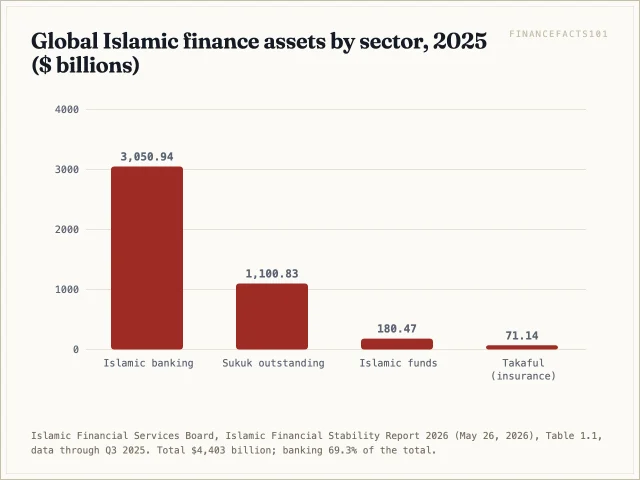
The IFSB's 2026 report, published on May 26, 2026, puts the global Islamic financial services industry at about $4.4 trillion in 2025 (data through the third quarter), up 13.4% from a year earlier. Banking is 69.3% of the total. Sukuk outstanding passed $1 trillion for the first time, and issuance hit a record $234.5 billion.
The industry is concentrated. The Gulf Cooperation Council and East Asia–Pacific regions hold 75% of global assets, and the GCC alone accounts for about $2.37 trillion. The IFSB counts 16 jurisdictions where Islamic banking has more than 15% of domestic banking assets. In Iran and Sudan the whole banking system is meant to be Shariah-compliant.
Risks and Challenges in Islamic Banking
Islamic banks face the credit, liquidity and market risks every bank does, plus several of their own.
- Shariah non-compliance risk. If a Shariah board later finds a product non-compliant, the bank may have to give up the income and restructure contracts. Standards differ between countries and even between Shariah boards.
- Contested structures. The IMF paper notes that tawarruq, a multi-step commodity trade used to produce cash, is "not considered compliant" in some jurisdictions.
- Liquidity management. Islamic banks cannot park spare cash in interest-bearing government bills or borrow overnight at interest. The IFSB's 2026 report says "structural limitations present constraints in effective liquidity management."
- Hybrid risk. The same report warns that new products and balance-sheet structures increasingly resemble conventional banking in ways that change the risk profile of Islamic banks.
- Rate risk. Once a murabaha markup is agreed it cannot be changed, so a bank holding fixed-price contracts is exposed if benchmark rates rise.
For a customer, the practical risks are simpler. Check who stands behind your money, compare total costs against conventional offers, and read what happens if you pay late, pay early or need to sell.
FAQ
Is Islamic banking only for Muslims?
No. The products follow Shariah rules, but eligibility follows ordinary banking rules on identity, credit and affordability. Non-Muslims can open accounts and apply for financing at Islamic banks and windows, and some choose them for the fixed pricing or the industry screens.
Is Islamic banking really interest-free?
No interest is charged or paid in the legal sense. Profit comes from a markup on a sale, rent on a lease or a share of a venture's returns. Economically, that profit is usually priced off the same benchmarks as interest, so costs are often similar to a conventional loan.
Are Islamic bank accounts FDIC insured in the US?
A deposit account at an FDIC-insured bank is covered up to the standard limit, at least $250,000 per bank, whether or not it is marketed as Islamic. Sukuk, Islamic mutual funds and other investments are not deposits and are not FDIC insured.
Does Islamic banking allow shares to be issued at a premium?
Yes. AAOIFI Shari'ah Standard No. 21 allows new shares to be issued at a price based on an expert valuation or market value, whether at a premium or a discount. Preference shares with priority in profits or liquidation are not allowed.
Sources
- Islamic Financial Services Board, Islamic Financial Stability Report 2026 and press release (May 26, 2026) — industry assets of $4,403 billion including $3,051 billion of Islamic banking (Q3 2025 data), 13.4% growth, 75% concentration in GCC and East Asia–Pacific, contract and funding mix, liquidity and hybrid risks
- Mumtaz Hussain, Asghar Shahmoradi and Rima Turk, International Monetary Fund, An Overview of Islamic Finance, WP/15/120 (June 2015) — principles, contract types, history, LIBOR benchmarking, murabaha late-payment rule, tawarruq
- Office of the Comptroller of the Currency, Interpretive Letter 867 (June 1, 1999; published November 1999) — murabaha financing permissible for national banks; references Interpretive Letter 806 (October 17, 1997) on net-lease home financing
- Thomas C. Baxter Jr., Federal Reserve Bank of New York, Regulation of Islamic Financial Services in the United States (March 2, 2005) — OCC letters, partnership limits on US banks, profit-sharing deposit and FDIC
- FDIC, Deposit Insurance — coverage of at least $250,000 at each insured bank
- Freddie Mac, Primary Mortgage Market Survey — 30-year fixed average 7.03% as of September 24, 2026
- AAOIFI, Shari'ah Standard No. 21: Financial Paper (Shares and Bonds) — clause 2/3 on share issues at a premium, 2/6 on preference shares, 3/4 on screening thresholds
- Amana Mutual Funds Trust, Form 485APOS filed with the SEC (2025) — Islamic investment principles and industry exclusions
- Guidance Residential, Why Does Guidance Sell Its Contracts to Freddie Mac? — co-ownership model; more than 40,000 families
 Next entry · No. 2,559Understanding the Basics of the IS-LM Model in Economics
See also
-
 No. 5,210
20 Aug 2025
20 min
Understanding Underwriting Groups: A Temporary Association of Investment Bankers and Broker-Dealers
Business Finance
No. 5,210
20 Aug 2025
20 min
Understanding Underwriting Groups: A Temporary Association of Investment Bankers and Broker-Dealers
Business Finance -
 No. 5,201
19 Aug 2025
20 min
Underwithstanding Taxes: Underwithholding vs Overwithholding
Taxation
No. 5,201
19 Aug 2025
20 min
Underwithstanding Taxes: Underwithholding vs Overwithholding
Taxation -
 No. 4,863
23 Jul 2025
23 min
Maximizing Your Tax Savings: A Comprehensive Guide to Tax-Deductible Interest
Taxation
No. 4,863
23 Jul 2025
23 min
Maximizing Your Tax Savings: A Comprehensive Guide to Tax-Deductible Interest
Taxation -
 No. 4,799
17 Jul 2025
18 min
Understanding Sukuk: An Introduction to Shariah-Compliant Bonds
Business Finance
No. 4,799
17 Jul 2025
18 min
Understanding Sukuk: An Introduction to Shariah-Compliant Bonds
Business Finance -
 No. 4,112
23 May 2025
19 min
Understanding Profit Before Tax (PBT) in Corporate Finance
Corporate Finance
No. 4,112
23 May 2025
19 min
Understanding Profit Before Tax (PBT) in Corporate Finance
Corporate Finance -
 No. 3,987
13 May 2025
19 min
Understanding Principal, Interest, Taxes, and Insurance—PITI in Real Estate Finance
Real Estate
No. 3,987
13 May 2025
19 min
Understanding Principal, Interest, Taxes, and Insurance—PITI in Real Estate Finance
Real Estate