Understanding Limit Down Trading: A Comprehensive Guide to Trading Halts and Circuit Breakers

Understand the importance of Limit Down trading, a crucial concept in finance that influences trading halts and circuit breakers. Learn how it works, its…
What is Limit Down?
Limit down refers to a significant decrease in the price of a security or futures contract that activates trading restrictions based on exchange rules. These restrictions, known as circuit breakers, are designed to curb excessive price volatility and offer traders time to digest market-moving news (Kirkpatrick, 2013). A limit down is measured relative to a reference price, usually the closing price of the previous day or session. It’s expressed either as a percentage of the reference price or an absolute dollar value.
Understanding Limit Down Trading
Limit down measures are intended to mitigate self-reinforcing market moves based on investor behavior and new information. Once the limit down threshold is met, trading restrictions come into effect (Goyal & Sukhtankar, 2016). These restrictions can include anything from a brief halt of five minutes to an extended halt lasting the rest of the day or session. Some rules enable continued trading at the minimum price (the limit down).
Futures Markets: Limit Down in Practice
For instance, the London Metal Exchange introduced a limit down rule in March 2022 for nickel futures, restricting trade to a predetermined percentage decline from the prior closing price (Bloomberg News, 2022). Similarly, CME Group imposes two-minute trading pauses when energy futures experience price swings of more than 10% within an hour. For lumber and agricultural products, CME sets limit downs in dollar terms relative to the settlement price from the preceding session (CME Group, n.d.).
Circuit Breakers: U.S. Stock Markets
In the realm of US stock markets, circuit breakers are triggered by substantial intraday declines in the S&P 500 index. Specifically, a 7% drop from the previous day’s close initiates a 15-minute trading halt for all stocks. A more drastic decline of 13% from the preceding close necessitates a 15-minute halt in all equity trading. The most severe circuit breaker is triggered when the S&P 500 falls by 20%, halting trade for the remainder of the day (Securities Industry and Financial Markets Association, n.d.).
Limit Up-Limit Down Rule: Protecting Individual Stocks
The Limit Up-Limit Down rule, implemented in 2012, imposes trading starts of five to ten minutes on securities experiencing high volatility (Securities Industry and Financial Markets Association, n.d.). For stocks priced over $3, a price change of 5% from the average price during the preceding five minutes triggers a halt in trading. The rule applies to securities included in the S&P 500 or Russell 1000 indices and some exchange-traded funds (ETFs).
Limit Down: History and Significance
The introduction of limit down measures is often linked to the 2010 flash crash, during which the S&P 500 index plummeted nearly 9% within minutes. The sudden drop was attributed to a series of automated trades triggered by market-moving news (Huang & Moussa, 2013). In response, regulatory bodies worldwide implemented circuit breakers and other measures to mitigate the risk of similar events in the future.
In conclusion, limit down is an essential concept that plays a crucial role in safeguarding financial markets from excessive volatility. Understanding its mechanics, applications, and implications can help investors and traders navigate market conditions more effectively.

How Does Limit Down Work?
Limit down represents a decline in price that triggers trading restrictions under exchange rules to mitigate extreme volatility and provide traders with time to react to significant market-moving news. The logic behind these measures is to halt or limit the self-reinforcing plunges and surges caused by other market participants and late-breaking information. Once a limit down price is hit, trading restrictions can last from a few minutes to the remainder of the day, depending on the exchange rules in question.
Limit Down Trading curbs, such as trading halts, play an essential role in various financial markets. For instance, the London Metal Exchange introduced a rule restricting nickel futures’ trading to a set percentage decline from the prior closing price in March 2022 due to volatile market conditions. Similarly, CME Group imposes two-minute trading pauses when energy futures experience hourly moves exceeding 10%. For lumber and agricultural products, the Chicago Mercantile Exchange sets limit down as a change in dollar terms from the settlement price in the previous session.
The U.S. stock markets employ circuit breakers that trigger trading restrictions based on large intraday declines in the S&P 500 index:
– A 7% decline from the preceding day’s close before 3:25 p.m. Eastern time initiates a 15-minute pause for all stocks.
– A 13% decline from the previous day’s close at any point during the trading session also requires a 15-minute halt in all equity trading.
– A 20% intraday drop halts stock market trading for the remainder of the day.
The S&P 500 experienced four trading pauses, each lasting 15 minutes, when it fell by 7% during the sell-off triggered by the COVID-19 pandemic in March 2020.
In individual stocks, the Limit Up-Limit Down rule requires trading halts for securities experiencing excessive volatility. This rule applies to securities priced above $3:
– A move of 5% from the five-minute average price initiates a trading halt of five minutes for securities priced above $3.
– For other stocks priced above $3, a 10% deviation from the same reference price triggers a five-minute halt.
The Limit Up-Limit Down rule and market-wide circuit breakers emerged after the infamous flash crash of May 6, 2010, in which the S&P 500 dropped nearly 9% at intraday lows. The trading restrictions were implemented to prevent self-reinforcing plunges and surges in market prices caused by other market participants and late-breaking news.

Limit Down in Futures Markets
Limit down is a critical concept for traders dealing with futures markets as it affects their ability to trade based on price movements. Limit down refers to the minimum price level that a futures contract can reach before trading restrictions kick in. These rules are implemented by various exchanges to manage extreme volatility and protect investors from excessive price swings.
One of the most prominent examples of limit down implementation can be seen at the London Metal Exchange (LME), which introduced a percentage decline limit for nickel futures trading in March 2022 in response to volatile market conditions. This rule restricts trading when prices fall by a predetermined amount below the prior closing price.
At the CME Group, which manages numerous energy and agricultural futures markets, limit down is expressed as a change in dollar terms from the settlement price in the preceding session. The rules are reset twice a year based on a percentage of the average price over a preceding 45-day period. If a two-minute trading pause is triggered due to an hourly price movement exceeding 10%, trading can resume once prices recover beyond the limit down level.
For instance, in the case of energy futures such as crude oil and natural gas, the CME Group imposes a two-minute trading halt when the market moves up or down by more than 10% in an hour. Limit down is not only essential for managing extreme volatility but also provides traders with a clear understanding of their risk exposure and potential price targets.
In summary, limit down plays a vital role in futures markets by setting minimum price levels that can trigger trading restrictions to mitigate excessive volatility and protect investors. Different exchanges have different ways of implementing these rules based on market conditions and the specific asset class being traded. Understanding how limit down works is crucial for any trader or investor active in the futures market.

Stock Market Circuit Breakers: Limit Down in Equities
Limit down is a critical concept in finance and investment that refers to the decline in the price of a stock or futures contract large enough to trigger trading restrictions under exchange rules, commonly known as circuit breakers. These mechanisms are designed to prevent excessive market volatility, particularly during times when markets react strongly to major news events or unexpected market conditions. Understanding how limit down works and its significance for traders and investors is essential in navigating the complex world of financial markets. In this section, we will delve deeper into stock market circuit breakers, focusing specifically on their application in equities markets.
What Are Stock Market Circuit Breakers?
Stock market circuit breakers are rules put in place by exchanges to halt trading or limit the price movement of stocks during extreme market conditions. These rules aim to prevent rapid declines and surges that could potentially cause widespread panic among traders, leading to chaotic trading environments and potential disruption to market integrity. The U.S. stock markets employ circuit breakers based on percentage declines in the S&P 500 index.
How Do Circuit Breakers Work?
Circuit breakers are triggered when there is a significant decline in the value of the S&P 500 index. These thresholds were established to help maintain order and stability during volatile markets, offering traders a chance to assess market conditions before resuming trading activities. When a circuit breaker is activated, trading for all stocks is halted or restricted until the conditions improving. The circuit breakers are calibrated such that they halt trading in increments – 7%, 13%, and 20% – depending on the severity of the market decline.
The 7% Threshold: A trading halt for all stocks is initiated when the S&P 500 index experiences a decline of 7% from the previous day’s closing price before 3:25 p.m. Eastern Time (ET). This halt lasts for 15 minutes, allowing market participants to reassess market conditions and adjust their positions accordingly.
The 13% Threshold: If the S&P 500 index falls by more than 13% from its previous day’s close before 3:25 p.m. ET, a 15-minute trading halt is initiated for all equity instruments. Additionally, during this period, the price of individual stocks cannot trade below their last traded price before the halt or above their limit down price – a calculation based on the 10% decline from the previous day’s closing price.
The 20% Threshold: If the S&P 500 index declines by 20% or more at any point during the trading session, trading is halted for the remainder of the day. In this case, the circuit breaker rule aims to prevent a potential market rout, providing ample time for investors and traders to consider their next steps in an orderly manner.
The Role of Limit Down in the S&P 500 Circuit Breakers:
Limit down plays a crucial role within the context of the S&P 500 circuit breakers. When a trading halt is initiated at either the 7% or 13% thresholds, trading for individual stocks can resume only if their price remains above their limit down price – a percentage decline from their previous closing price. For example, if the S&P 500 index falls by 7%, the limit down price for an individual stock would be its closing price multiplied by 93% (i.e., a 7% discount).
Understanding Limit Down and Its Application in Equities Markets
Limit down is an essential concept when discussing stock market circuit breakers as it is the mechanism that determines when trading halts are triggered. It sets the foundation for understanding how to navigate volatile markets, particularly in light of potential price movements large enough to trigger trading restrictions. In this section, we discussed the significance of limit down in equities markets and explored its role within the context of U.S. stock market circuit breakers.
The Limit Up-Limit Down Rule
Another crucial concept related to limit down is the Limit Up-Limit Down rule. This rule applies to individual stocks that experience excessive volatility, requiring trading halts lasting 5 to 10 minutes. These pauses are triggered when a stock’s price moves up or down by more than the specified percentage threshold – either 5% or 10%, depending on the stock’s price level – from its average price during the preceding five-minute period.
The Limit Up-Limit Down rule and the S&P 500 circuit breakers were implemented following the flash crash of May 6, 2010. This event saw the S&P 500 index drop nearly 9% intraday, highlighting the need for such regulations to maintain market orderliness and stability in times of significant market volatility.
In conclusion, limit down plays a critical role in the functioning of stock market circuit breakers, which are designed to mitigate the effects of extreme price movements in securities markets. By understanding how these mechanisms work and their implications for traders and investors, we can better navigate the complex financial landscape and make informed decisions when faced with volatile market conditions.
Limit Up-Limit Down Rule
The Limit Up-Limit Down rule is a regulatory measure introduced by stock exchanges to restrict trading in individual securities when prices experience significant volatility. This rule acts as a safety net against extreme price movements, ensuring that markets maintain an orderly and fair trading environment for all participants.
Under the Limit Up-Limit Down rule, if a stock’s price experiences a sudden and large increase or decrease, trading in that security is halted until market conditions stabilize. The threshold for triggering this halt varies depending on the specific exchange and the stock’s price level.
For example, in the case of stocks priced above $3, a 5% movement from the average price over the previous five minutes triggers a trading halt lasting between five to ten minutes. Alternatively, for lower-priced stocks, a 10% price change over that same time frame may initiate the trading pause instead.
These halts are designed to prevent rapid price swings and help restore normal market conditions by giving investors, traders, and market makers an opportunity to reevaluate their positions in light of any new information or developments. The Limit Up-Limit Down rule also contributes to overall market stability, as it can reduce the potential for panic selling or buying during periods of heightened volatility.
It is important to note that the Limit Up-Limit Down rule applies only to individual securities and not to entire markets like the S&P 500 index or other broader equity benchmarks. Instead, market-wide circuit breakers come into play when significant declines in broad indices occur. This topic will be discussed further in a subsequent section.
Historically, the Limit Up-Limit Down rule was adopted by U.S. stock exchanges in response to the “flash crash” of May 6, 2010, during which the S&P 500 index experienced an unexpected and dramatic decline of nearly 9% within minutes. The introduction of this rule demonstrated regulators’ commitment to maintaining orderly markets and protecting investors from extreme price movements.
In summary, the Limit Up-Limit Down rule is a vital tool in ensuring a fair, efficient, and orderly marketplace for individual securities. By setting clear guidelines for trading halts during periods of significant volatility, it helps prevent unnecessary panic and allows market participants to react more thoughtfully to new information and price movements.
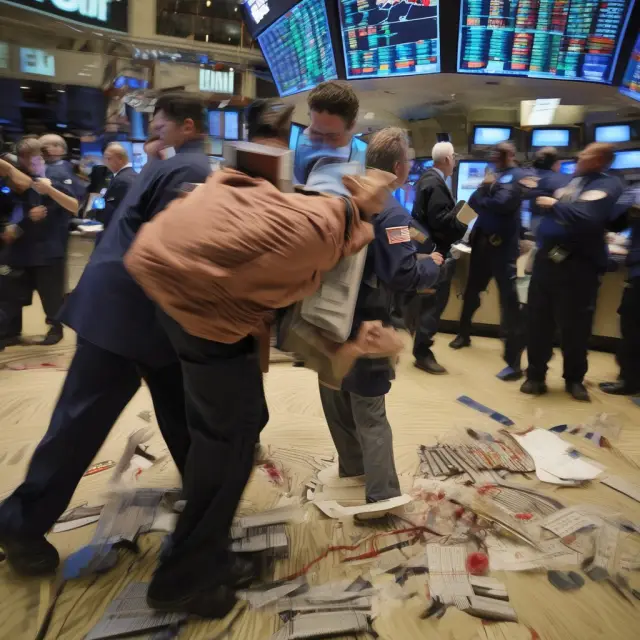
History of Limit Down Trading: Flash Crash of 2010
On May 6, 2010, an event now infamously known as the flash crash took place in financial markets. The day began like any other, with U.S. stocks trading in a relatively calm manner. However, things took a dramatic turn when, around 2:30 p.m., the Dow Jones Industrial Average plummeted by nearly 1,000 points within minutes. This sudden and severe drop triggered circuit breakers, causing trading to come to a halt for the remainder of the day.
The flash crash was not due to any fundamental news or developments; it was instead caused by a combination of factors, including automated trading algorithms, human panic, and a significant increase in sell orders. Many market participants mistakenly believed that there was an impending disaster, leading them to sell their holdings en masse, exacerbating the decline.
The incident raised concerns about the stability and resilience of financial markets. As a response, regulatory bodies took measures to strengthen market oversight and prevent similar events from occurring in the future. One such measure was the introduction of limit down rules, designed to slow down market declines and allow time for traders to digest new information before reacting.
The flash crash serves as an important reminder of the power of emotions and automated trading systems in financial markets. It also illustrates how quickly things can spiral out of control when there’s a lack of clear communication and coordination among market participants. By understanding the lessons from this event, investors can better prepare themselves for potential market disruptions and make more informed decisions when faced with uncertainty.
The flash crash marked a turning point in the history of financial markets, leading to significant regulatory changes, including the implementation of circuit breakers and the Limit Up-Limit Down rule. These measures have since helped mitigate extreme price swings and restore order during periods of high volatility.

Impact of Limit Down on Traders and Markets
Limit down trading restrictions significantly affect various market participants in different ways. In a nutshell, limit down is designed to prevent self-reinforcing plunges or surges in market prices. Let us explore how this impact plays out for investors, traders, and exchanges.
1. Investors: Limit down can benefit long-term equity investors by providing temporary protection from volatile markets when their investments become subject to trading halts. It may also give them a chance to reevaluate their portfolios without the pressure of rapidly falling prices. In contrast, short sellers may experience increased risk due to limit downs, as they are forced to cover their positions at the limit down price or face potential losses in the event of further price declines.
2. Traders: Trading halts imposed due to limit down rules can disrupt intraday trading strategies for market makers and other active traders who rely on rapid price movements. For instance, they may miss opportunities to enter or exit trades during these halts. Conversely, some traders could potentially benefit from the halt, as it offers an opportunity to reassess positions and adjust risk management strategies in response to market volatility.
3. Exchanges: Market operators, including exchanges, benefit from limit down rules in that they help maintain market integrity by limiting extreme price swings. Moreover, these restrictions give regulatory bodies additional tools to monitor and address potential market manipulation or other abusive trading activities that could undermine investor confidence. By imposing trading halts, the exchanges can also prevent a potential domino effect of rapidly declining prices across various markets and asset classes.
Moreover, it is essential to understand that the specific impact of limit down on traders and markets can vary depending on factors such as the underlying market conditions, the type of security involved (e.g., stock versus futures), and the location of the exchange or trading venue. In some cases, limit downs may even have unintended consequences, such as exacerbating market instability in certain situations. For instance, during the flash crash of May 6, 2010, when the S&P 500 dropped nearly 9%, limit up-limit down rules failed to prevent massive intraday price swings and instead contributed to increased volatility.
In conclusion, limit down plays a crucial role in managing extreme market volatility by imposing trading restrictions designed to protect investors and maintain market integrity. However, the impact of these measures on traders and markets can be complex and may depend on various factors, including the specific market conditions and the type of security involved.

Limit Down Strategies for Investors
Navigating market downturns with trading restrictions can be challenging for investors. Understanding strategies and techniques to cope with limit downs may help mitigate potential losses and optimize portfolio performance. Here are several approaches that investors might consider when dealing with trading halts or circuit breakers:
1. Diversification: Maintaining a well-diversified investment portfolio can help offset the impact of individual stocks or sectors experiencing price movements leading to limit downs. By spreading investments across various industries, asset classes, and geographical regions, investors may be able to reduce overall volatility and risk exposure.
2. Technical Analysis: Utilizing technical analysis tools such as moving averages and trend lines can provide insights into potential trends or reversals in the market. These indicators can help investors make more informed decisions regarding entry or exit points during trading halts, which may lead to better overall returns.
3. Limit Orders: Implementing limit orders allows traders to set a specific price at which they wish to buy or sell securities. When markets hit the limit down threshold, these orders can help investors enter or exit positions at their desired prices without engaging in active trading during volatile market conditions.
4. Option Trading: Investors may consider employing option strategies such as buying put options or selling call options to hedge against potential losses due to sudden price declines. These instruments offer the right, but not the obligation, to buy or sell securities at a pre-set price and can help investors manage risk more effectively during times of market instability.
5. Monitoring Market Conditions: Keeping an eye on broader economic factors and news events that may impact the markets can help investors prepare for potential limit downs. Being aware of regulatory changes, geopolitical risks, and other market-moving factors can enable more informed decision making when faced with trading restrictions or circuit breakers.
6. Emotional Control: Maintaining a calm and objective approach during volatile market conditions can help investors make better decisions and avoid costly mistakes. Fear and panic can cloud judgment and potentially result in suboptimal investments or portfolio management choices, so practicing stress-management techniques such as deep breathing and meditation may be beneficial for maintaining mental focus and emotional resilience.
7. Staying Informed: Keeping up to date with market news, regulatory updates, and industry developments is essential when navigating limit downs and circuit breakers. Utilizing trusted financial news sources, market data platforms, and industry analysis can help investors stay informed and react more effectively during times of market instability.
In conclusion, limit down trading strategies for investors involve a combination of diversification, technical analysis, risk management tools, emotional control, and staying informed. Adopting these approaches can help mitigate the impact of trading restrictions or circuit breakers on portfolio performance and enable investors to make more informed decisions during periods of market volatility.

Limit Down: Regulatory Perspective
The regulatory perspective on limit down is an essential aspect to understanding these market mechanisms and their role in maintaining market integrity. Limit down trading curbs, such as circuit breakers and trading halts, serve as safeguards against excessive volatility in financial markets. These measures are designed to mitigate the risk of self-reinforcing price movements and provide traders with a better understanding of the underlying fundamentals of securities.
Regulators have adopted various mechanisms to manage limit down events, tailored to specific markets like futures or equities. For instance, in March 2022, the London Metal Exchange (LME) introduced a new rule restricting trading to a pre-set percentage decline from the prior closing price for nickel futures due to volatile market conditions. In contrast, U.S. stock markets employ circuit breakers that halt trading based on severe intraday declines in the S&P 500 index.
The London Metal Exchange’s rule sets the limit down as a percentage decline from the prior closing price for various futures contracts, including those for metals, energies, lumber, and agricultural products. The limits are reset twice a year based on a percentage of the average price over a preceding 45-day period. CME Group, which operates the Chicago Mercantile Exchange and the New York Mercantile Exchange, has also implemented a two-minute trading pause when markets move up or down more than 10% in an hour for energy futures.
The U.S. Securities and Exchange Commission (SEC) and the Financial Industry Regulatory Authority (FINRA), major regulatory bodies in the United States, have introduced circuit breakers that halt trading based on severe intraday declines in the S&P 500 index. The primary objective of these mechanisms is to maintain orderly markets and protect investors from the potential adverse consequences of excessive price movements.
In particular, U.S. stock markets are subject to trading restrictions triggered by daily declines in the S&P 500 index:
– A decline of 7% from the prior day’s close before 3:25 p.m. Eastern time initiates a 15-minute trading pause for all stocks
– A decline of 13% from the prior day’s close before 3:25 p.m. ET also requires a 15-minute trading pause in all equity trading
– A decline of 20% from the prior day’s close at any time during the trading day halts trading for the remainder of the day
These rules were adopted after the 2010 “flash crash,” which saw the S&P 500 drop nearly 9% intraday on May 6, 2010. The event highlighted the need for circuit breakers to protect investors and maintain market stability in response to extreme price movements.
Another essential regulatory measure is the Limit Up-Limit Down rule, which was introduced after the flash crash as well. This rule requires trading starts lasting 5 to 10 minutes for stocks experiencing excessive volatility based on a percentage change from the average price in the preceding five-minute period. The length of the pause depends on whether a stock’s price is above or below $3 and varies between 5 and 10 minutes.
In conclusion, limit down regulations play a vital role in maintaining market integrity by mitigating excessive volatility and providing traders with better understanding of underlying securities. Regulators employ various mechanisms tailored to specific markets, such as futures exchanges or stock markets, to address the unique challenges presented by each. These measures have proven effective in protecting investors from the potential adverse consequences of sudden price movements and ensuring orderly market conditions.
FAQ: Limit Down and Circuit Breakers
Limit down is a term used to describe a significant decline in the price of an asset or a security that triggers trading restrictions under exchange rules. These curbs are designed to prevent self-reinforcing plunges and surges in market prices, caused by unusual volatility or late-breaking news. Trading restrictions can come in various forms such as halts, which can range from just a few minutes to the remainder of the day. In this FAQ, we address some common questions and misconceptions about limit down and circuit breakers.
What is a limit down halt?
A limit down halt is a trading restriction put in place by an exchange when the price of a security or a futures contract experiences a substantial decline from its previous closing price. The halt aims to give traders time to react to any market-moving news and prevent rapid price movements. Once triggered, the halt can last for various durations depending on the specific exchange rules and the extent of the price decline.
Why are limit down halts necessary?
Limit down halts help maintain orderly markets by limiting excessive volatility due to sudden price movements. The curbs allow traders and investors time to adjust their positions and react to market news, thereby reducing the risk of self-reinforcing plunges or surges in prices.
How do limit up and limit down rules differ?
Limit up refers to a rise in an asset’s price above a specified percentage or dollar threshold from its previous closing price or average price, whereas limit down is the opposite – a decline below that threshold. The former can result in trading restrictions to prevent rapid price increases, while the latter leads to trading halts when the price decline exceeds a predefined level.
What happens if the stock market experiences a significant decline?
In such cases, market-wide circuit breakers are triggered, causing all trading in stocks or specific securities to be halted for a specified duration based on the severity of the decline. For example, in the U.S., the S&P 500 index triggers trading halts when it experiences a decline of 7%, 13%, or 20% from its previous closing price during regular trading hours. Once the circuit breaker is triggered, all trading in affected securities will be halted for a specified duration.
How are limit down rules applied in futures markets?
Limit down rules vary across different commodity and futures exchanges. For instance, the London Metal Exchange implemented a rule restricting trading to a predefined percentage decline from the prior closing price when volatile trading was observed in nickel futures during March 2022. Similarly, CME Group’s energy futures impose a two-minute trading pause when markets move up or down more than 10% within an hour.
What is the Limit Up-Limit Down rule?
The Limit Up-Limit Down (LULD) rule is designed to protect individual stocks from extreme volatility by imposing a trading halt when prices move too far, too fast in either direction – up or down. The rule aims to prevent excessive price movements that can negatively impact orderly markets and potentially harm investors.
In conclusion, understanding limit down halts and circuit breakers is crucial for investors and traders alike as these rules help maintain market stability and protect the overall integrity of financial markets. By being aware of how they function and their various applications, one can better navigate trading sessions and react to sudden price movements effectively.
 Next entry · No. 2,887Understanding Limited Common Elements in Condominium Investments
See also
-
 No. 5,460
10 Sep 2025
23 min
Understanding Vega Neutral in Options Trading: A Comprehensive Guide
Finance Policy
No. 5,460
10 Sep 2025
23 min
Understanding Vega Neutral in Options Trading: A Comprehensive Guide
Finance Policy -
 No. 5,171
17 Aug 2025
20 min
Understanding Uncovered Options: Risks, Strategies, and Examples
Finance Policy
No. 5,171
17 Aug 2025
20 min
Understanding Uncovered Options: Risks, Strategies, and Examples
Finance Policy -
 No. 5,044
07 Aug 2025
21 min
Transaction Costs: Understanding Fees, Types, and Minimizing Their Impact on Your Investments
Finance Policy
No. 5,044
07 Aug 2025
21 min
Transaction Costs: Understanding Fees, Types, and Minimizing Their Impact on Your Investments
Finance Policy -
 No. 4,724
12 Jul 2025
23 min
Understanding Spreads in Finance: Types, Strategies, and Examples
Finance Policy
No. 4,724
12 Jul 2025
23 min
Understanding Spreads in Finance: Types, Strategies, and Examples
Finance Policy -
 No. 4,667
07 Jul 2025
20 min
Understanding the Basics of Simple Interest: A Comprehensive Guide for Institutional Investors
Finance Policy
No. 4,667
07 Jul 2025
20 min
Understanding the Basics of Simple Interest: A Comprehensive Guide for Institutional Investors
Finance Policy -
 No. 3,865
03 May 2025
22 min
Understanding Overnight Positions: Risks, Benefits, and Considerations for Institutional Investors
Finance Policy
No. 3,865
03 May 2025
22 min
Understanding Overnight Positions: Risks, Benefits, and Considerations for Institutional Investors
Finance Policy