Withdrawals: Rules and Penalties for Bank Accounts, Retirement Accounts and CDs
Savings and checking withdrawals carry no penalty. An early CD withdrawal can cost a year's interest, and IRAs and 401(k)s add a 10% tax before 59½.
A withdrawal is the act of removing money from a specific account: cash from an ATM, a transfer out of savings, cashing in a CD, or a distribution from a retirement plan. Whether it costs you anything depends entirely on the account. Checking and savings withdrawals carry no penalty. Taking money out of a CD before it matures costs a penalty set by your bank, commonly several months of interest. Withdrawing from an IRA or 401(k) before age 59½ usually adds a 10% federal tax on top of regular income tax.
Below are the rules for each kind of account, with the dollar math on a broken CD and an early 401(k) withdrawal. Figures are as of September 2026. Bank terms quoted here come from each bank's own website and can change; your account agreement governs your account. This is general information, not tax or legal advice.
Is Withdrawing Money Losing Money?
Not by itself. Moving $500 from checking to your wallet doesn't make you poorer; the money is still yours, just in a different place. A withdrawal loses money only when one of four things applies:
- A penalty. CDs charge one for leaving early, and some savings accounts charge fees for going over a withdrawal limit.
- A tax. Pre-tax retirement money is taxed as income when it comes out, and early withdrawals can add a 10% or larger additional tax.
- A fee. An out-of-network ATM or a wire transfer costs money.
- Lost earnings. Money pulled out of an account stops earning interest or investment returns.
The fourth cost is the one people forget. As of September 21, 2026, the FDIC's national average rates were 0.37% on savings and 1.73% on a 12-month CD. Cash in a drawer earns nothing, so it loses buying power to inflation every year. None of that shows up as a line on a statement, but it is real.
Penalty for Withdrawing From Specific Accounts
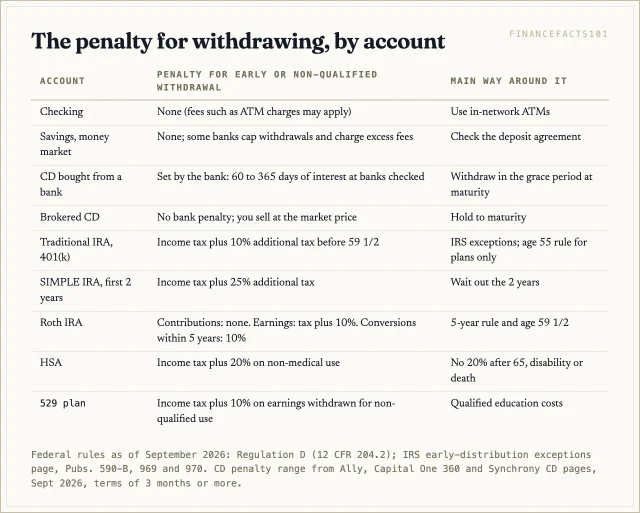
The table sorts accounts by how hard they are to get out of. Bank accounts are built for withdrawals. CDs trade access for a fixed rate, so the bank charges you for breaking the deal. Tax-advantaged accounts (IRAs, 401(k)s, HSAs, 529 plans) trade access for a tax break, so the IRS takes some of the break back if you use the money for something else or too early. Two accounts in the table get less attention below, so here are their rules: an HSA withdrawal not used for qualified medical expenses carries "an additional 20% tax," except after you are disabled, reach 65 or die (IRS Publication 969); and a taxable 529 plan withdrawal generally adds "a 10% additional tax on the amount included in income," which is the earnings part (IRS Publication 970). The sections below go through the rest.
Savings and Checking Accounts: No Early-Withdrawal Penalty
There is no such thing as an early-withdrawal penalty on an ordinary savings or checking account, because there is no term to break. What people search for as a "savings account penalty for early withdrawal" is usually one of three other things.
Withdrawal limits and excess-withdrawal fees. Federal Regulation D used to cap "convenient" transfers and withdrawals from savings and money market accounts at six a month. On April 24, 2020, the Federal Reserve deleted that six-per-month limit. The rule change let banks allow unlimited withdrawals, but it did not require them to. The Fed's savings deposit FAQ says Regulation D "does not require or prohibit" fees for going over six. So some banks still cap savings withdrawals and charge a fee, or convert the account, if you exceed the cap. Your deposit agreement says which.
The seven-day notice right. Under the Regulation D definition of a savings deposit, 12 CFR 204.2(d), a bank can "at any time" require "written notice of an intended withdrawal not less than seven days before withdrawal is made." Banks almost never use it, but it is in most savings agreements.
Fees. Out-of-network ATM charges and minimum-balance fees are fees, not penalties, and they vary by bank.
If you are keeping an emergency fund, this is why it belongs in savings or a money market account rather than a CD. The site's guides on deposit accounts and emergency fund size compare where that cash should sit.
CD Early Withdrawal Penalties: How They're Calculated
A certificate of deposit pays a fixed rate for a fixed term. In exchange, you agree to leave the money in until the maturity date. Break that agreement and the bank charges an early withdrawal penalty.
Federal law sets a floor but no ceiling. Regulation D, 12 CFR 204.2(c), requires at least "seven days' simple interest on amounts withdrawn within the first six days after deposit." Beyond that, the size of the penalty is up to the bank. What the law does require is disclosure. Under Truth in Savings, 12 CFR 1030.4(b)(6)(ii), the bank's account disclosures must include "a statement that a penalty will or may be imposed for early withdrawal, how it is calculated, and the conditions for its assessment."
That same rule explains a line you have probably seen in bank ads: "Note: a penalty for early withdrawal may apply." When a bank advertises an APY on a CD, 12 CFR 1030.8(c)(6)(ii) requires "a statement that a penalty will or may be imposed for early withdrawal." The footnote is a legal requirement, not a warning that something unusual applies to that offer.
Here is how three large online banks set their penalties, as posted on their CD pages in September 2026:
- Ally Bank: 60 days of interest for terms of 3 to 24 months, rising to 150 days for 49 months or longer (Ally High Yield CD).
- Capital One 360: "For 12 month CD accounts (or less), the penalty for withdrawing early is 3 months of interest. For CD accounts longer than 12 months, the penalty for withdrawing early is 6 months of interest" (Capital One 360 CDs).
- Synchrony Bank: 90 days of simple interest for terms of 12 months or less, 180 days for more than 12 but less than 48 months, and 365 days for 48 months or more (Synchrony CDs).
The spread is wide: on a five-year CD, the same early exit costs 150 days of interest at Ally and a full year at Synchrony. Other banks set their own schedules, so read the disclosure before you open the account, not when you need the money.
The penalty can come out of principal. Ally says its penalty is "first deducted from the accrued interest and then - if necessary - the principal." Bank of America's CD page says the same: "If your account has not earned enough interest to cover an early withdrawal penalty, we deduct any interest first and take the remainder of the penalty from your principal" (Bank of America CDs).
The penalty is tax-deductible. Your bank reports it in box 2 of Form 1099-INT, and you can deduct it on Schedule 1 (Form 1040), line 18, even if you don't itemize, per IRS Publication 550.
Exceptions exist but are bank-by-bank. Regulation D lets banks waive its minimum penalty when an owner dies or is declared legally incompetent, among other cases. Ally, for one, states: "If the account owner passes away or is judged legally incompetent, we'll waive the early withdrawal penalty." Don't assume your bank does the same unless your agreement says so.
Worked Example: When a CD Withdrawal Actually Loses Money
Say you put $10,000 into a five-year CD at a hypothetical 4.00%, and four months later you need the money. You have earned about $133 of interest (10,000 × 4% × 4/12). The penalty under each bank's five-year schedule, figured as simple interest at 4.00%:
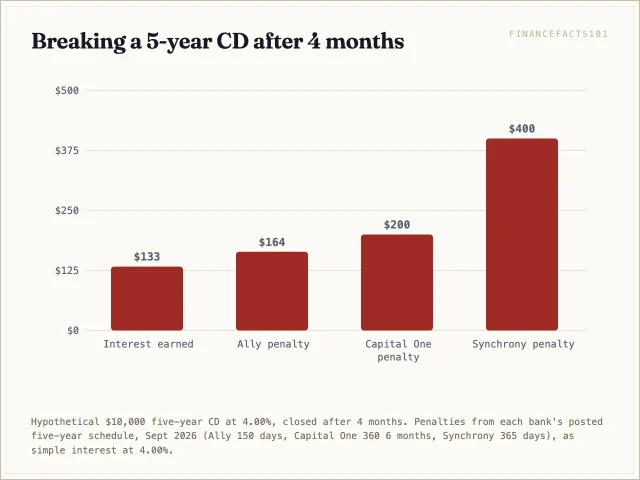
- Ally, 150 days: $10,000 × 4% × 150/365 = $164. You walk away with about $9,969, $31 less than you put in.
- Capital One 360, 6 months: $10,000 × 4% × 6/12 = $200. You get about $9,933.
- Synchrony, 365 days: $10,000 × 4% = $400. You get about $9,733, a $267 loss of principal.
Wait until month 18 and the picture flips. You'd have earned about $600, so every one of those penalties is covered and you keep a positive return. The break-even is simply the penalty period: about five months at Ally, six at Capital One and twelve at Synchrony. Before that point, an early withdrawal takes principal. After it, you give back interest but not your deposit.
That arithmetic is also the honest answer to "is it worth breaking a CD to move to a higher rate?" Compare the penalty with the extra interest the new rate would earn over the old CD's remaining term. If the extra interest doesn't clearly exceed the penalty, stay put. The guide to high-yield savings vs CDs runs that comparison in more detail.
Renewing or Extending a CD: The Rules at Maturity
Most CDs renew automatically. That's where the question "what are the rules for withdrawing if I extend the account?" usually comes from, and the answer has three parts.
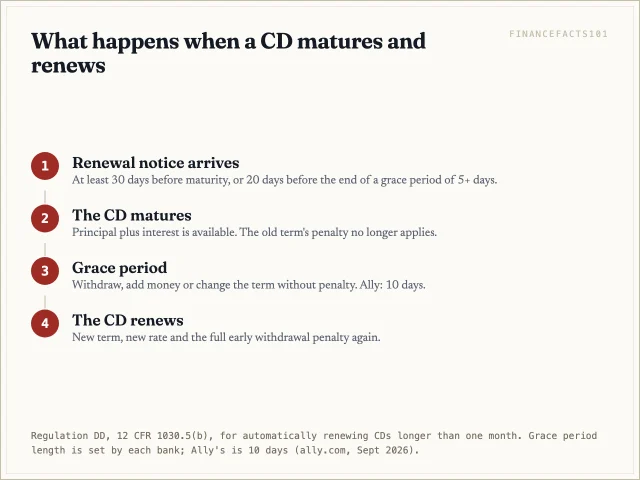
You get notice first. For CDs longer than one month that renew automatically, Truth in Savings, 12 CFR 1030.5(b), requires the bank to send disclosures "at least 30 calendar days before maturity." Alternatively, it can send them "at least 20 calendar days before the end of the grace period," but only if the grace period is at least five calendar days.
The grace period is your penalty-free window. Ally says that when a CD matures, "you can withdraw your money at no charge during a 10-day grace period." Synchrony also describes a 10-day grace period after maturity. Under Truth in Savings, a grace period is by definition "a period following the maturity of an automatically renewing time account during which the consumer may withdraw funds without being assessed a penalty" (12 CFR 1030.2(m)). Grace periods are set by each bank and can be shorter. Some renewals also switch products. Bank of America's page says its 7, 10, 13, 25 and 37 month Featured CDs "will automatically renew into a 3 Month Flexible CD unless you make a change during the 7-day grace period."
Once the grace period ends, the new term's rules apply in full. A renewed CD is a new term with its own maturity date, its own rate and the full early-withdrawal penalty. Missing a 10-day window can lock you in for another five years, with a new penalty to match. Put the maturity date in your calendar.
CD Advantages and Disadvantages
Advantages:
- A fixed rate. Your rate can't fall during the term, which matters if market rates drop. (An adjustable-rate or bump-up CD trades some rate for the right to move up.)
- Deposit insurance. CDs at FDIC-insured banks are covered, and the FDIC says deposits are insured "to at least $250,000 at each FDIC-insured bank" (FDIC deposit insurance).
- Usually more than savings. The FDIC national averages in September 2026 were 1.73% for a 12-month CD against 0.37% for savings, though the best online savings accounts pay far more than the average.
- No temptation. The penalty is a deliberate speed bump for money you have set aside.
Disadvantages:
- The early withdrawal penalty, which can reach principal, as shown above.
- Rate lock cuts both ways. If rates rise, you're stuck at the old rate unless you pay to leave.
- Interest is taxable as it accrues, generally each year, even if you leave it in the CD.
- Partial withdrawals are often not allowed. Ally and Capital One both say you can't make an early partial withdrawal. Needing $2,000 can mean breaking the whole CD.
Brokered CDs work differently. You buy them through a brokerage and usually can't cash them in with the bank. Instead you sell them to another investor. The SEC's investor bulletin on brokered CDs says they "generally do not have early withdrawal penalties like CDs purchased directly from a bank." But if you sell in the secondary market, "you may lose some of your original investment due to a change in the market price." That happens when rates have risen since you bought.
Retirement Account Withdrawals: The 59½ Rule, Exceptions and RMDs
The 10% additional tax. Money taken from an IRA, 401(k) or similar plan before age 59½ is an "early" distribution. The IRS says you "must pay an additional 10% early withdrawal tax unless an exception applies," on top of ordinary income tax on the taxable part (IRS, exceptions to tax on early distributions). For a SIMPLE IRA, a withdrawal within the first two years of participation costs 25% instead of 10%.
The exceptions are specific, and some apply to only one kind of account. Among those on the IRS list:
- Both plans and IRAs: death, total and permanent disability, a series of substantially equal payments, unreimbursed medical expenses above 7.5% of AGI, birth or adoption (up to $5,000 per child), and, since 2024, one emergency personal expense distribution a year of up to $1,000.
- Workplace plans only: leaving your job in or after the year you turn 55 (50 for many public safety workers). This does not apply to IRAs.
- IRAs only: qualified higher education expenses, a first home (up to $10,000), and health insurance premiums while unemployed.
Moving money from a 401(k) into an IRA before taking it can therefore lose you the age-55 exception.
Roth IRAs are different. Withdrawals come out in a set order: your regular contributions first, then conversions, then earnings, per IRS Publication 590-B. Your contributions come back tax- and penalty-free at any age. Earnings are tax-free only in a qualified distribution, which requires the 5-year period to have passed and a trigger such as reaching 59½, disability, death or a first home. The Roth vs traditional IRA guide covers when that flexibility is worth more than the up-front deduction.
Required minimum distributions (RMDs) are the opposite problem: rules that force you to withdraw. You generally must start taking money from traditional IRAs and workplace plans at age 73, per the IRS RMD page. The first RMD is due by April 1 of the following year (for a workplace plan that allows it, you can wait until April 1 after the year you retire). Under the SECURE 2.0 Act, as confirmed by final IRS regulations in 2024, the age rises to 75 for anyone born on or after January 1, 1960 (Internal Revenue Bulletin 2024-33). Miss one and you may owe "a 25% excise tax on the amount not distributed as required," or 10% if you correct it within two years. Roth IRAs, and Roth accounts in a 401(k) or 403(b), have no RMDs while the owner is alive. And an RMD cannot be rolled over into another tax-deferred account: the IRS RMD FAQ answers that question with a flat "No." The site's RMD calculator estimates the amount.
Withholding and the 60-day rule. Per the IRS rollover rules, a 401(k) distribution paid to you "is subject to mandatory withholding of 20%." An IRA distribution is subject to 10% withholding "unless you elect out." You have 60 days to roll money into another IRA or plan, and you can do only one IRA-to-IRA rollover in any 12-month period. A direct trustee-to-trustee transfer avoids both the withholding and the one-per-year limit. Withdrawals while you're still working at the employer are covered in the entry on in-service withdrawals.
Worked Example: What a $20,000 Early 401(k) Withdrawal Leaves You
A 40-year-old takes $20,000 from a 401(k) after leaving a job at 38, so the age-55 exception doesn't apply. Assume a 22% federal bracket and a 5% state income tax (state rules vary; California, for example, adds a 2.5% tax on early distributions, per the Franchise Tax Board).
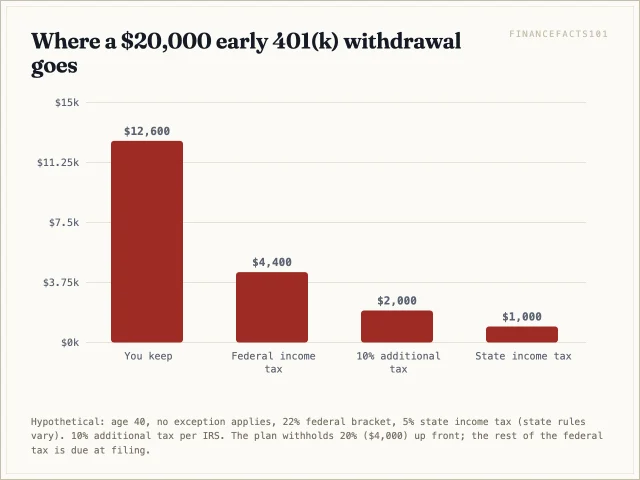
- Federal income tax: 22% × $20,000 = $4,400
- 10% additional tax: $2,000
- State income tax at 5%: $1,000
- You keep $12,600, or 63 cents on the dollar.
The check you receive is $16,000, because the plan must withhold 20% ($4,000) for federal tax. That withholding doesn't cover the $6,400 of federal tax actually owed, so another $2,400 is due when you file, plus the state tax if none was withheld. People who spend the full $16,000 are often surprised in April.
The $7,400 you lose is also only the visible cost. That $20,000 left invested for 25 years at 6% would have grown to about $85,800. An alternative, such as a 401(k) loan where the plan offers one, is worth pricing before you take a distribution.
Cash vs In-Kind Withdrawals
Most withdrawals are in cash: the account sells investments and pays you. An in-kind withdrawal moves the investments themselves, such as shares of a fund, out of the account and into a regular brokerage account.
In-kind does not avoid tax on a traditional IRA or 401(k). IRS instructions for Form 1099-R tell the payer to report "the FMV of the securities or other property on the date of distribution" (Instructions for Forms 1099-R and 5498), and that value is taxable income just like cash. Publication 590-B applies the 10% early tax to "the distribution of any assets (money or other property)." What in-kind does do is let you keep the position without selling and rebuying it, and your cost basis in the shares becomes their value on the day they came out. From a Roth IRA, the basis of distributed property is likewise "its fair market value on the date of distribution."
How to Avoid or Shrink Withdrawal Penalties
Most withdrawal penalties are avoidable with planning rather than luck. Keep anything you might need within a year in savings or a money market account, not a CD or a retirement account. If you want a CD anyway, a no-penalty CD or a ladder keeps some money within reach: Ally's No Penalty CD, for example, lets you withdraw "any time after the first 6 days" from funding, and a ladder of staggered maturities frees some money every few months. Treat every maturity date as a scheduled, penalty-free exit.
For retirement money, check the IRS exceptions before you withdraw, not after; they remove the 10% tax only when they fit precisely. If you must tap retirement savings early, Roth contributions come out first and cost nothing. Move money between plans trustee-to-trustee to avoid the 20% withholding and the 60-day clock. And if you do pay a CD penalty, deduct it on Schedule 1, line 18.
FAQ
Is there a penalty for withdrawing from a savings account?
No early-withdrawal penalty, because savings accounts have no term. Some banks still limit withdrawals to six a month and charge a fee for extras. Regulation D no longer requires the limit, but it doesn't forbid banks from keeping one. Check your account agreement.
Can a CD early withdrawal penalty take my principal?
Yes. If you haven't earned enough interest to cover the penalty, banks such as Ally and Bank of America take the rest from your deposit. On a $10,000 five-year CD at 4.00% closed after four months, a 365-day penalty costs $400 against about $133 of interest earned, a $267 loss.
What does "a penalty for early withdrawal may apply" mean?
It's a required disclosure. Truth in Savings rules (12 CFR 1030.8) say any ad quoting an APY on a CD must state that a penalty will or may be imposed for early withdrawal. The actual penalty and how it's calculated are in the account disclosures you receive before opening the CD.
Can I withdraw from a Roth IRA before 59½ without a penalty?
Your contributions, yes, at any time and tax-free. Earnings are tax- and penalty-free only in a qualified distribution: the 5-year period has passed and you are 59½, disabled, or using up to $10,000 for a first home. Otherwise earnings are taxable, and the 10% additional tax applies unless an IRS exception, such as disability, higher education or large medical bills, covers them. Those exceptions apply whether or not the 5-year period has passed. Converted amounts have their own 5-year clock for the 10% tax.
Sources
- FDIC, National Rates and Rate Caps, September 2026: savings 0.37%, 12-month CD 1.73%, as of September 21, 2026
- Federal Reserve, press release, April 24, 2020: deletion of the six-per-month savings transfer limit; and Savings Deposits FAQ: banks may keep the limit and fees
- eCFR, 12 CFR 204.2 (Regulation D definitions): time deposit seven-day minimum penalty; savings deposit seven-day notice right; permitted waivers
- eCFR, 12 CFR 1030.4, 1030.5 and 1030.8 (Regulation DD, Truth in Savings): penalty disclosure, renewal notices and grace periods, advertising statement
- IRS, Publication 550: penalty on early withdrawal of savings, Form 1099-INT box 2, Schedule 1 line 18
- IRS, Retirement topics: exceptions to tax on early distributions: 10% additional tax, exceptions, SIMPLE IRA 25%
- IRS, Retirement topics: required minimum distributions and RMD FAQs: age 73, April 1 deadline, 25%/10% excise tax, no rollover of RMDs
- IRS, Internal Revenue Bulletin 2024-33: final RMD regulations, applicable age 75 for those born on or after January 1, 1960
- IRS, Publication 590-B: Roth ordering rules, qualified distributions, 10% tax on money or other property, separate 5-year period for conversions
- IRS, Rollovers of retirement plan and IRA distributions: 20% and 10% withholding, 60-day and one-per-year rules
- IRS, Instructions for Forms 1099-R and 5498: in-kind distributions reported at fair market value
- IRS, Publication 969 (HSA 20% additional tax, none after 65) and Publication 970 (10% additional tax on taxable 529 distributions)
- California Franchise Tax Board, Early distributions: additional 2.5% state tax on early distributions (6% for SIMPLE plans in the first 2 years)
- eCFR, 12 CFR 1030.2(m): definition of grace period
- FDIC, Deposit insurance: insured to at least $250,000 at each FDIC-insured bank
- SEC Office of Investor Education, Brokered CDs: Investor Bulletin
- Bank CD terms as posted September 2026: Ally Bank High Yield CD, Capital One 360 CDs, Synchrony Bank CDs, Bank of America CDs
 Next entry · No. 5,765A Comprehensive Guide to Withdrawal Plans: Income Streams for Professional and Institutional Investors
See also
-
 No. 4,598
01 Jul 2025
18 min
Unlocking Wealth: A Comprehensive Guide to Self-Directed IRAs (SDIRAs)
Investments
No. 4,598
01 Jul 2025
18 min
Unlocking Wealth: A Comprehensive Guide to Self-Directed IRAs (SDIRAs)
Investments -
 No. 2,408
03 Jan 2025
19 min
Understanding In-Service Withdrawals from Employer-Sponsored Retirement Plans: Rules, Tax Implications and FAQ
Retirement
No. 2,408
03 Jan 2025
19 min
Understanding In-Service Withdrawals from Employer-Sponsored Retirement Plans: Rules, Tax Implications and FAQ
Retirement -
 No. 4,562
28 Jun 2025
21 min
Maximizing Your Savings: Understanding Savings Accounts
Personal Finance
No. 4,562
28 Jun 2025
21 min
Maximizing Your Savings: Understanding Savings Accounts
Personal Finance -
 No. 3,715
21 Apr 2025
17 min
Understanding Open-End Credit: Types, Advantages, Disadvantages, and Impact on Credit Score
Personal Finance
No. 3,715
21 Apr 2025
17 min
Understanding Open-End Credit: Types, Advantages, Disadvantages, and Impact on Credit Score
Personal Finance -
 No. 2,093
09 Dec 2024
19 min
The Heroes Earned Retirement Opportunities (HERO) Act: Empowering Military Personnel to Save for Retirement with Combat Pay
Personal Finance
No. 2,093
09 Dec 2024
19 min
The Heroes Earned Retirement Opportunities (HERO) Act: Empowering Military Personnel to Save for Retirement with Combat Pay
Personal Finance -
 No. 1,507
25 Sep 2024
18 min
Understanding Financial Health: A Guide for Institutional Investors
Personal Finance
No. 1,507
25 Sep 2024
18 min
Understanding Financial Health: A Guide for Institutional Investors
Personal Finance