SEP IRA vs Solo 401(k): Which Is Better If You Are Self-Employed
On $100,000 of 2026 profit a solo 401(k) shelters $43,087 and a SEP IRA $18,587. The 20% formula, Roth options, deadlines, and when the SEP still wins.
The SEP IRA vs solo 401(k) question turns on one line in the 2026 limits: both accounts let a self-employed person with no employees contribute 20% of net earnings as the "employer," but only the solo 401(k) adds a $24,500 employee deferral on top, so it shelters more at every net profit below about $376,000. On $100,000 of Schedule C profit that is $43,087 in a solo 401(k) against $18,587 in a SEP IRA, under the limits the IRS set in Notice 2025-67, current as of September 2026.
The SEP still wins on simplicity, on late setup, and once employees arrive, and above roughly $376,000 of profit the two hold the same $72,000 for anyone under 50. Below: the formula, three incomes side by side, the tax value of the extra deduction, and the Roth, deadline and paperwork rules that decide close cases. It is general information built on stated assumptions and 2026 federal rules, not personal advice.
SEP IRA vs Solo 401(k): The Short Answer for 2026
A SEP IRA is an employer plan in IRA form. You, as the business, put in up to 25% of compensation, which for a sole proprietor works out to 20% of net earnings, and that is the only contribution type there is. The IRS says so in one line on its SEP contribution limits page: elective salary deferrals and catch-up contributions are not permitted in SEP plans.
A solo 401(k) is an ordinary 401(k) covering only the owner, or the owner and a spouse. The IRS's one-participant 401(k) page describes the owner as wearing two hats: you defer as the employee, up to $24,500 in 2026, and then contribute as the employer under the same 20% formula the SEP uses. Same employer piece, plus a second piece the SEP lacks.
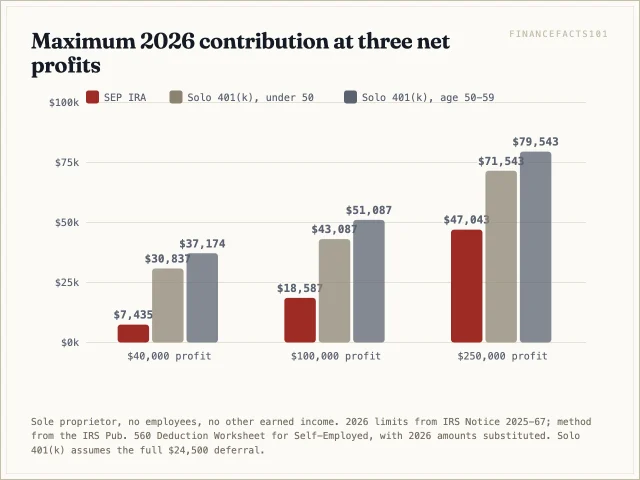
That second piece is the whole gap from roughly $44,000 of profit up to $252,000: exactly $24,500 a year, more for anyone 50 or older. Below that range the gap is a little smaller, above it the solo 401(k) hits the $72,000 ceiling first and the SEP slowly catches up. Everything else, from Roth access to Form 5500-EZ, decides whether those dollars are worth some paperwork.
Who This Is For — and Who It Isn't
This guide is for a sole proprietor or single-member LLC owner filing Schedule C, with no common-law employees and 2026 net profit between about $30,000 and $400,000. A spouse who works in the business does not change the answer; a one-participant plan can cover the owner and spouse.
It is not for partners or S-corporation owners, whose compensation is figured differently (an S-corp owner contributes on W-2 salary, not on net earnings). It is not for anyone with employees, apart from the hiring section below. And if you already defer the full $24,500 at a day job, the IRS warns that deferral limits apply "by person, not by plan", so a solo 401(k) adds no deferral room and the two accounts allow the same amount.
Neither account touches self-employment tax: contributions are figured after it and reduce only income tax. The self-employment tax guide covers that bill and the quarterly set-aside.
The 2026 Limits That Frame the Choice
The contribution limits all come from one notice. IRS Notice 2025-67 raised the defined contribution limit under section 415(c) from $70,000 to $72,000, the elective deferral limit from $23,500 to $24,500, and the age-50 catch-up from $7,500 to $8,000, and it kept the catch-up for people who turn 60, 61, 62 or 63 in 2026 at $11,250. The compensation that can count toward any contribution is capped at $360,000.
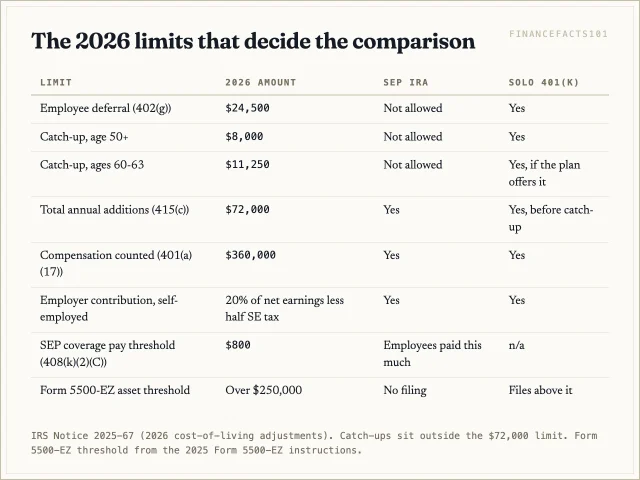
Two items in that table belong to only one account. The deferral and both catch-ups exist only in the solo 401(k). The $800 compensation threshold matters only to a SEP with employees, because anyone you pay that much who meets the age and service tests must be covered. The $72,000 ceiling binds both accounts, but catch-up contributions sit outside it, so a 50-year-old with a solo 401(k) can reach $80,000 and someone aged 60 to 63 can reach $83,250.
The Employer Contribution: Why 25% Becomes 20%
Both plans state the employer contribution as up to 25% of compensation. For an employee that is 25% of salary. For a sole proprietor it is circular: your "compensation" is net earnings after the deduction for the contribution itself, so the contribution shrinks the base it is measured on. IRS Publication 560 breaks the loop with a rate table; for a 25% plan rate the self-employed rate is 0.25 ÷ 1.25, which is 20%.
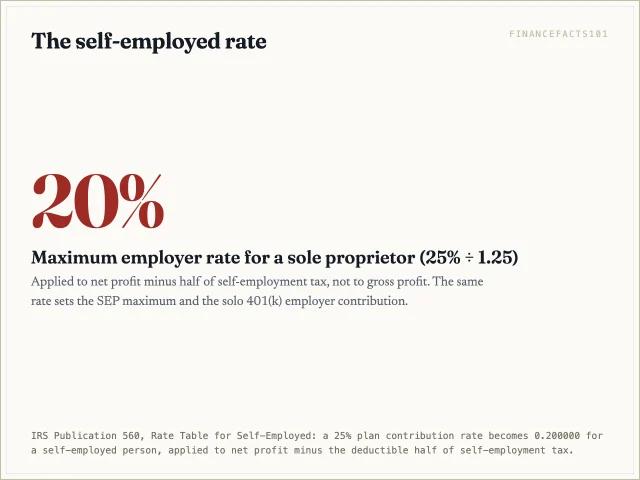
The base that 20% applies to is not your profit. It is profit minus the deductible half of self-employment tax, the figure on Schedule 1, line 15. Here is the chain at $100,000 of net profit, using the 2026 Social Security wage base of $184,500, which no one at this income reaches:
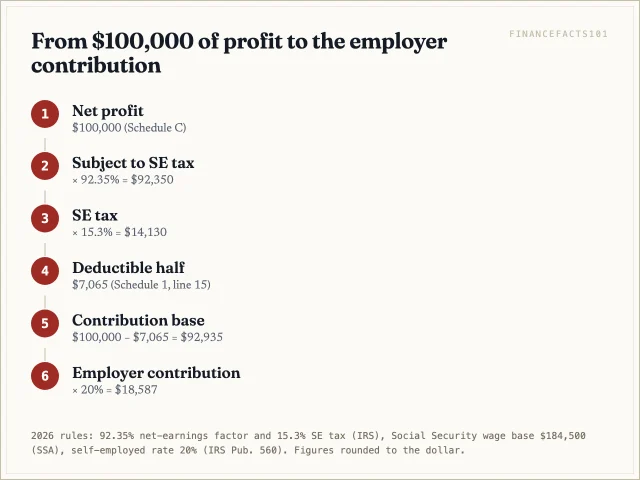
The checkable arithmetic: $100,000 × 0.9235 = $92,350 subject to self-employment tax; × 15.3% = $14,130 of self-employment tax; half is $7,065; $100,000 − $7,065 = $92,935; × 20% = $18,587. The same $18,587 is the SEP maximum and the solo 401(k) employer contribution. The self-employment tax calculator returns the deductible half directly: on its default $80,000 of profit it shows $5,652, so the SEP maximum there is 20% of $74,348, or $14,870.
What the Solo 401(k) Adds: Deferrals and Catch-Up
The employee deferral is not a percentage. Up to $24,500, you can defer 100% of earned income, which is why the solo 401(k) is most powerful at modest profits: a SEP gives a $40,000 earner about $7,400, while a solo 401(k) can take most of the income.
There is one ceiling that catches low earners, and it is easy to miss. Total contributions cannot exceed your compensation, and for a sole proprietor that compensation is net earnings after the employer contribution itself. Publication 560's Deduction Worksheet for Self-Employed enforces it by limiting the employer contribution to half of what is left after the deferral (step 12). With the 2026 amounts substituted for the 2025 ones printed in the worksheet, the limit binds below about $44,000 of profit.
At $40,000 of profit, net earnings after the half-SE deduction are $37,174. The full $24,500 deferral leaves $12,674, so the employer contribution is capped at half of that, $6,337, not the $7,435 the 20% formula alone would allow. Total: $30,837. A 50-year-old can add a catch-up of up to $6,337 more, the room left on the worksheet, which brings the total to $37,174 — every dollar of earned income.
Two more details. The age 60 to 63 catch-up of $11,250 is optional plan design, so check that your provider's document includes it. And the catch-up does not count against the $72,000 limit, so above about $376,000 of profit, where both accounts reach $72,000, it is the only thing the solo 401(k) still adds.
Worked Example: Three Net Incomes, Side by Side
Take one freelancer, age 45, single, a sole proprietor with no employees and no other earned income, at three levels of 2026 Schedule C profit: $40,000, $100,000 and $250,000. Each solo 401(k) row assumes the full $24,500 deferral, which maximises the total at every income here.
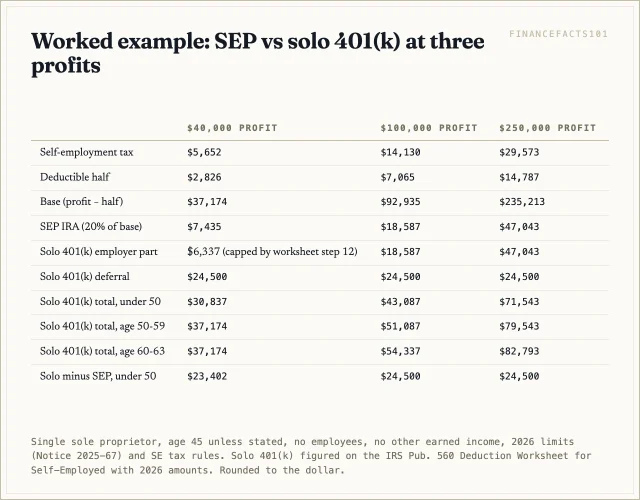
At $250,000 the self-employment tax has two parts: 12.4% on the first $184,500 of the $230,875 subject to the tax ($22,878) and 2.9% on all of it ($6,695), for $29,573. The deductible half is $14,787, which leaves a base of $235,213, and 20% of that is $47,043. Add the $24,500 deferral and the solo 401(k) holds $71,543, just under the $72,000 ceiling. The 0.9% Additional Medicare Tax on self-employment earnings above $200,000 ($278 here) is not part of the deductible half, so it does not move the base.
Read across the bottom row and the pattern is plain. The solo 401(k) adds $23,402 at $40,000 and $24,500 at the other two incomes. At age 50 the gap widens by the $8,000 catch-up (less at $40,000, where the worksheet caps it), and from 60 to 63 by $11,250.
Where the Gap Closes
The $24,500 advantage does not last forever, because both accounts share the $72,000 ceiling. The solo 401(k) reaches it first: its employer piece needs to be only $47,500, which happens at about $252,318 of profit. The SEP needs a $72,000 employer contribution on its own, which takes a $360,000 base, or about $376,480 of profit.
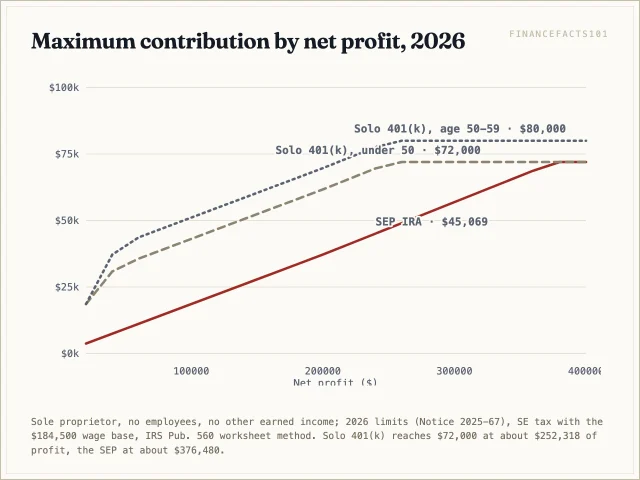
Between those points the gap shrinks: at $300,000 of profit the SEP allows $56,909 and the solo 401(k) $72,000, a $15,091 difference. Above about $376,480, someone under 50 can put $72,000 in either account. Anyone 50 or over keeps the solo 401(k)'s catch-up edge at every income, because a SEP cannot accept one.
What the Extra Deduction Is Worth in Tax
Sheltering more is not the same as saving more tax, and at modest incomes the difference is large. Contributions to your own plan are deducted on Schedule 1, which lowers adjusted gross income. They also lower qualified business income: the IRS rule at 26 CFR 1.199A-3(b)(1)(vi) treats the deduction for your own retirement contributions as attributable to the business. So each deducted dollar also shrinks the 20% QBI deduction, and only about 80 cents comes off taxable income.
Run it at $100,000 of profit, single, with the 2026 standard deduction of $16,100 and brackets, no other income, federal tax only:
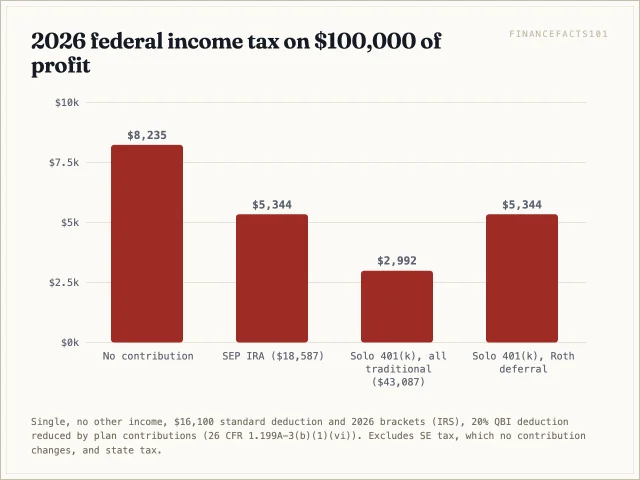
With no contribution, taxable income is $61,468 and the tax is $8,235. The SEP's $18,587 cuts taxable income to $46,599 and the tax to $5,344, a $2,891 saving. Adding the $24,500 traditional deferral takes taxable income to $26,999 and tax to $2,992. The deferral saves only $2,352 more, 9.6 cents per dollar, because every one of those dollars came out of the 12% bracket and then lost 20% of its value to the smaller QBI deduction.
That is the strongest case for making the deferral Roth. At this income the Roth deferral costs $2,352 of tax now and gets $24,500 into an account that is never taxed again; the trade-off between paying 12% today and an unknown rate in retirement is worked through in Roth vs traditional 401(k). The same logic flips at higher incomes: at $250,000, the deferral comes off income taxed at 24%, and the traditional deduction looks better.
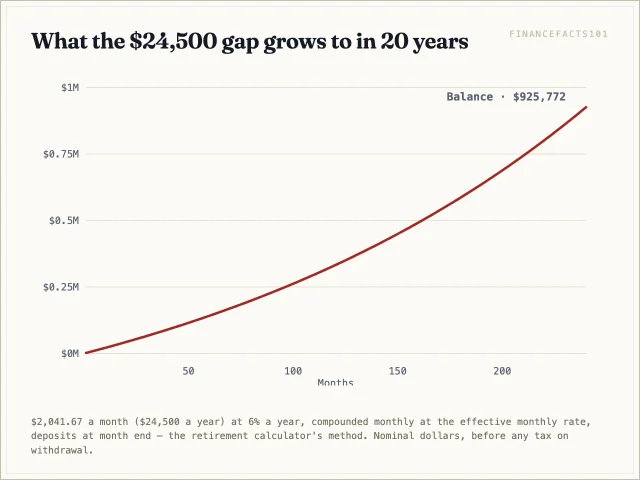
Either way the extra room compounds. Put the $24,500 gap in every year, $2,041.67 a month, and at 6% a year it grows to about $925,800 after 20 years, using the same monthly method as the retirement calculator. That is before tax on a traditional balance; how much you need in total is the subject of how much to retire.
Roth Options After SECURE 2.0
SECURE 2.0 opened Roth doors in both accounts, but not equally.
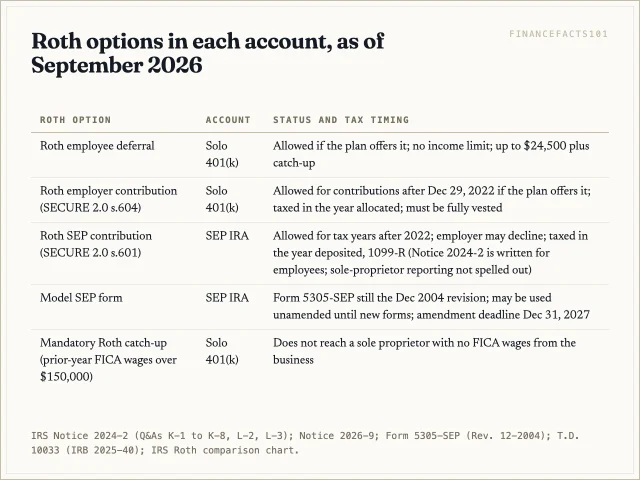
In a solo 401(k), Roth deferrals need only a plan document that offers them, and the IRS Roth comparison chart confirms there is no income limit, unlike a Roth IRA. Section 604 added Roth employer contributions after December 29, 2022; under IRS Notice 2024-2, Q&As L-2 and L-3, they are taxed in the year allocated and allowed only if you are fully vested.
The Roth SEP is newer and rougher. Section 601 permits it for tax years beginning after 2022, and Notice 2024-2 Q&A K-1 says the employer need not offer it. Q&A K-4 says the contribution is taxable in the year it lands in the Roth IRA, even if it counts toward the prior year, and K-5 has it reported on Form 1099-R. Notice 2024-2 is written for employees; it does not spell out how a sole proprietor reports a Roth SEP contribution for himself, so confirm the treatment with your tax preparer.
The plumbing lags behind the law. The IRS model Form 5305-SEP is still the December 2004 revision and says you "may not make SEP contributions to a Roth IRA or a SIMPLE IRA," although Q&A K-7 lets employers keep using it unamended. Notice 2026-9, issued in January 2026, pushed the deadline for amending IRA and SEP documents to December 31, 2027, because model language is still being written. Q&A K-8 left the effect on the Roth IRA contribution limit to future guidance; no later IRS guidance had addressed it as of September 2026. Confirm your custodian accepts Roth SEP money before counting on it.
One SECURE 2.0 rule does not bite here. From 2026, catch-ups for people whose prior-year FICA wages from the plan sponsor exceeded $150,000 must be Roth. Treasury's final regulations (T.D. 10033) explain that someone with no FICA wages from the sponsor, such as a partner with only self-employment income, is not subject, and a sole proprietor's net earnings are not FICA wages either. Pay yourself W-2 wages through an S corporation and that changes. One wrinkle: the same regulations let a plan with no Roth option bar owners whose prior-year self-employment earnings top the threshold from making any catch-up, so if your plan document has no Roth option, check that it does not use that rule.
Setup and Funding Deadlines for 2026
The SEP's deadlines are forgiving: Publication 560 lets you set one up and fund it as late as the due date of your return, including extensions. For 2026 that is April 15, 2027, or October 15, 2027 if you extend. You can decide the SEP after you know the year's profit.
The solo 401(k) has two clocks. For a plan that already exists, Publication 560 says owner deferrals "must be elected by the end of the tax year," December 31, 2026, and can then be deposited by the filing deadline including extensions; employer contributions follow the same funding deadline. For a new plan, Table 1 lets you adopt it as late as the extended due date, but that rescues only the employer contribution. A sole proprietor with no employees can still make first-year deferrals in a plan adopted after year-end only if the plan is adopted, and the deferrals paid in, by the filing deadline without extensions, April 15, 2027.
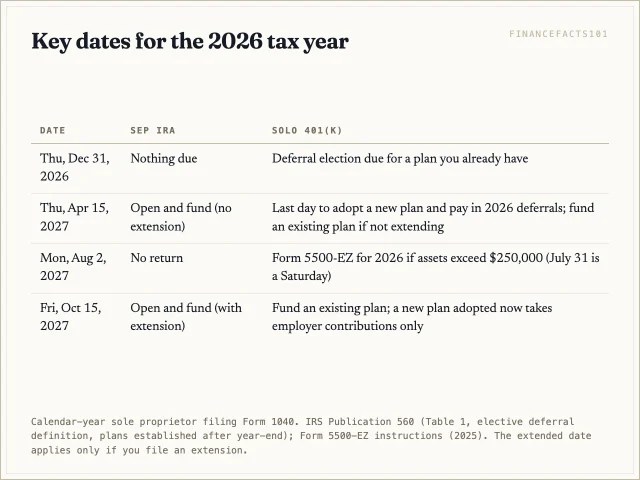
The practical reading: if it is already 2027 and you have no plan, open the solo 401(k) and fund the deferral before April 15 and you lose nothing. Miss that date and the solo 401(k) can only match what a SEP allows, so the SEP's simpler paperwork usually wins the year.
Paperwork: Form 5500-EZ and the $250,000 Line
A SEP has no annual return: the IRS SEP plan page says the employer generally has no filing requirements, including Form 5500. That is the SEP's real selling point.
A solo 401(k) files Form 5500-EZ once its assets grow. Under the Form 5500-EZ instructions, no return is due for a year if the assets of all your one-participant plans combined do not exceed $250,000 at the end of the plan year, unless it is the plan's final year, which always needs a return. Above that, the return is due by the last day of the seventh month after the plan year ends: July 31, 2027 for 2026, which is a Saturday, so Monday, August 2 works. Form 5558 extends it by up to 2½ months.
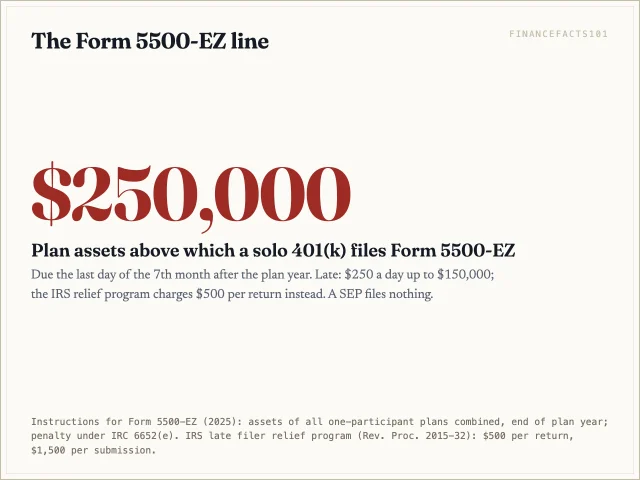
The penalty is out of proportion to the form: $250 a day, up to $150,000 per plan year, under section 6652(e). The IRS's late filer penalty relief program cuts that to $500 per late return, capped at $1,500 per submission for the same plan, if you file on paper before the IRS sends a penalty notice. Calendar it the year your balance nears $250,000: $43,087 a year growing at 6% passes that line in about the fifth or sixth year, depending on when you deposit.
Hiring Changes Everything
"Solo" is a description, not a plan type. Once you have an employee who meets the plan's eligibility rules, the IRS page says you must include them, their deferrals become subject to nondiscrimination testing unless the plan is a safe-harbor design, and the plan is no longer a one-participant plan, so the annual return moves from 5500-EZ to Form 5500 or 5500-SF. A 401(k) can make employees wait no longer than one year of service, or, for plan years after 2024, two consecutive 12-month periods of at least 500 hours for long-term part-timers, per Publication 560.
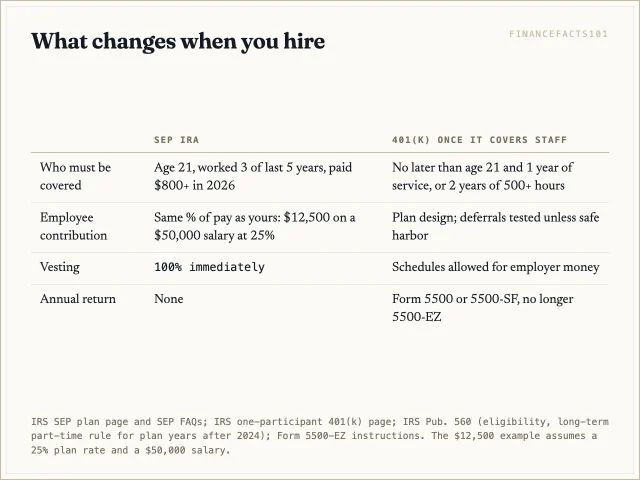
A SEP with employees forces the same contribution percentage for everyone eligible: age 21, worked for you in three of the last five years, and paid at least $800 in 2026. The IRS SEP FAQ says most SEPs, including the model form, require allocations proportional to pay. If you take the full 25% plan rate for yourself, an assistant earning $50,000 gets $12,500, fully vested on day one. The three-in-five-years test can make a SEP cheaper for a few years with new staff, but anyone planning to hire should price a staffed 401(k) with a plan administrator first.
Loans, the Backdoor Roth and Other Tie-Breakers
When the dollar limits tie, above about $376,000 of profit or for a moonlighter whose day-job 401(k) uses the deferral limit, three features decide.
Loans: the IRS loan FAQ says loans are not permitted from SEPs. A 401(k) plan may allow them, up to the lesser of $50,000 or the greater of $10,000 or half your vested balance, repaid within five years. Not every solo 401(k) document offers them.
The backdoor Roth: if your income is too high for direct Roth IRA contributions, a SEP balance gets in the way. The Form 8606 instructions count traditional SEP IRAs as traditional IRAs, so a SEP balance makes most of any backdoor conversion taxable under the pro-rata rule explained in Roth vs traditional IRA. A solo 401(k) balance is not an IRA and stays out of that arithmetic.
IRA deductions: traditional SEP contributions do not reduce what you may put into your own IRA (for Roth SEP contributions that is the open K-8 question above), but the SEP FAQ notes that being in a SEP can reduce or eliminate the deduction for a traditional IRA contribution. Either plan does the same. For the wider menu of deductible accounts, see tax-deductible investments.
The Decision Rule
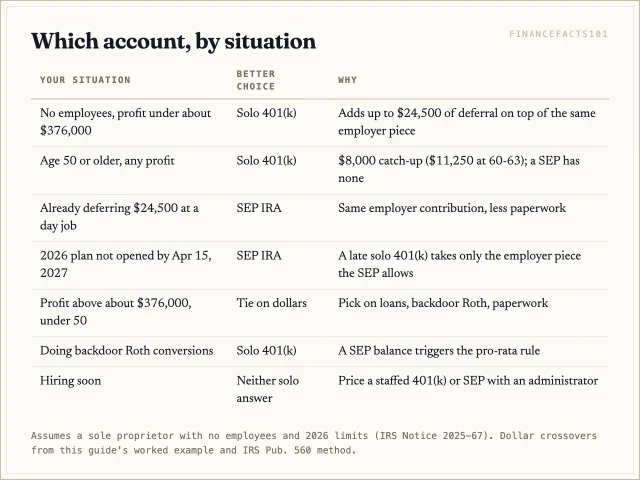
For most readers the answer is the solo 401(k), opened before December 31 so the deferral election is in place, with the deferral split between Roth and traditional by bracket. Choose the SEP instead when the deferral room is already used elsewhere, when you are past the April deadline for a new plan's deferrals, when you want no annual filing ever, or when profit is high enough that both accounts hit $72,000 and you value simplicity over loans and a clean backdoor Roth. And if employees are coming, put the question to a plan administrator before the first hire, because neither solo answer survives payroll.
FAQ
Can I have both a SEP IRA and a solo 401(k)?
You can, but it rarely adds room. Publication 560 adds SEP contributions to those in any other defined contribution plan you maintain for the $72,000 limit, and its self-employed worksheets assume a single plan. Keeping a 401(k) also rules out the IRS model Form 5305-SEP. Most people stop funding the old SEP once the solo 401(k) is open.
Is a solo 401(k) worth it on a small side income?
Often yes, because the deferral is not a percentage of profit. On $40,000 of profit a SEP allows about $7,435, while a solo 401(k) allows $30,837, or $37,174 at age 50 or older. The exception is someone who already defers $24,500 at a day job: then both accounts allow the same employer contribution and the SEP is simpler.
When is the last day to open a SEP or solo 401(k) for 2026?
A SEP can be opened and funded until your 2026 return's due date, including extensions: April 15, 2027, or October 15, 2027 with an extension. A new solo 401(k) adopted after December 31, 2026 can receive 2026 deferrals only if it is adopted and the deferrals are paid in by April 15, 2027; after that it can receive only employer contributions for 2026.
Do SEP or solo 401(k) contributions reduce self-employment tax?
No. Self-employment tax is figured before any retirement contribution, and both plans' contributions are deducted on Schedule 1 against income tax only.
Sources
- IRS, Notice 2025-67 — 2026 limits: $72,000 annual additions, $24,500 deferral, $8,000 and $11,250 catch-ups, $360,000 compensation cap, $800 SEP threshold, $150,000 Roth catch-up wage threshold
- IRS, Publication 560 (2025), Retirement Plans for Small Business — SEP and 401(k) setup and funding deadlines, the self-employed rate table and deduction worksheet, owner deferral timing, plans adopted after year-end, long-term part-time eligibility
- IRS, One-participant 401(k) plans — the two contribution types, per-person deferral limit, hiring and testing, Form 5500-EZ
- IRS, SEP contribution limits — 25% / $72,000; no deferrals or catch-up in a SEP
- IRS, Simplified Employee Pension plan (SEP) — eligibility, vesting, no loans, no Form 5500
- IRS, Retirement plans FAQs regarding SEPs — same-percentage allocations, IRA deduction effect
- IRS, Notice 2024-2 — Q&As K-1 to K-8 (Roth SEP) and L-1 to L-3 (Roth employer contributions)
- IRS, Notice 2026-9 — IRA and SEP amendment deadline extended to December 31, 2027
- IRS, Form 5305-SEP (Rev. December 2004) — the model SEP agreement
- IRS, Internal Revenue Bulletin 2025-40 — T.D. 10033, final Roth catch-up regulations
- IRS, Roth comparison chart — no income limit for designated Roth contributions
- IRS, Instructions for Form 5500-EZ (2025) — $250,000 threshold, due date, extensions, $250-a-day penalty
- IRS, Penalty relief program for Form 5500-EZ late filers — $500 per return, $1,500 per submission
- IRS, Retirement plans FAQs regarding loans — no SEP loans; 401(k) loan limits
- IRS, Instructions for Form 8606 — SEP IRAs count as traditional IRAs
- IRS, Tax inflation adjustments for tax year 2026 — 2026 brackets and $16,100 standard deduction
- eCFR, 26 CFR 1.199A-3 — retirement plan deductions reduce qualified business income
- SSA, Contribution and Benefit Base — $184,500 wage base for 2026
 Next entry · No. 5,980Pay Off Debt or Invest? Compare Two After-Tax Rates
See also
-
 No. 5,979
13 Oct 2026
17 min
Roth 401(k) vs Traditional 401(k): Which Should You Choose?
Retirement
No. 5,979
13 Oct 2026
17 min
Roth 401(k) vs Traditional 401(k): Which Should You Choose?
Retirement -
 No. 5,941
12 Sep 2026
16 min
401(k) Employer Match: How Much of Your Salary to Defer
Retirement
No. 5,941
12 Sep 2026
16 min
401(k) Employer Match: How Much of Your Salary to Defer
Retirement -
 No. 4,965
31 Jul 2025
18 min
Understanding the Thrift Savings Plan (TSP): A Comprehensive Guide for Federal Employees
Retirement
No. 4,965
31 Jul 2025
18 min
Understanding the Thrift Savings Plan (TSP): A Comprehensive Guide for Federal Employees
Retirement -
 No. 5,484
12 Sep 2025
24 min
Understanding Vested Interest in Finance: A Comprehensive Guide for Institutional and Professional Investors
Business Finance
No. 5,484
12 Sep 2025
24 min
Understanding Vested Interest in Finance: A Comprehensive Guide for Institutional and Professional Investors
Business Finance -
 No. 4,606
02 Jul 2025
19 min
Understanding Simplified Employee Pension (SEP) IRAs: A Comprehensive Guide for Small Businesses and Self-Employed Individuals
Business Finance
No. 4,606
02 Jul 2025
19 min
Understanding Simplified Employee Pension (SEP) IRAs: A Comprehensive Guide for Small Businesses and Self-Employed Individuals
Business Finance -
 No. 4,525
25 Jun 2025
18 min
A Comprehensive Guide to Understanding the Benefits and Limitations of a Roth 401(k)
Financial Education
No. 4,525
25 Jun 2025
18 min
A Comprehensive Guide to Understanding the Benefits and Limitations of a Roth 401(k)
Financial Education